


 Francais
 Deutsch
 Italiano
Refine Your Search
+"New Guinea" +1943 stock footage and images
- Showing 7 to 12 of 101 results more
more Hide
Hide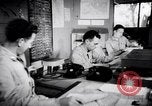
C-47 Skytrains and P-38 Lightning fighters drop supplies with parachutes over Greenview in Papua New Guinea.
March 1943: Australian and American soldiers in Salamaua in Papua New Guinea. Trucks loaded with supplies move to the aerodrome. The Depot officers radio A3 of the 5th Air Force Headquarters, who in turn contact the 54th Troop Carrier Wing for airplanes. Brigadier General Prentiss monitors the mission with Colonel Hampton. Board shows duties of the Troop Carrier Wing. The pilots and crew are briefed for the mission. Soldiers leave in jeeps at dawn for the aerodrome. The pilots are given the time for take off. Supplies are loaded. Planes are ordered off ground. Douglas C-47 Skytrains and P-38 Lightning fighters taxi and take off. Pilot scouts the skies for change in weather and danger. Planes over drop area in Greenview, marked by parachutes from earlier drops on the ground. Soldiers put supplies onto ramps and prepare for the drop. Pilot gives the signal and supplies are dropped. (World War II period).
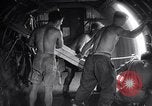
Soldiers drop supplies from C-47 Skytrains over Salamaua in Papua New Guinea.
March 1943: Soldiers in Douglas C-47 Skytrains prepare to drop supplies for American and Australian troops over Salamaua in Papua New Guinea. Aerial view of drop point in Salamaua with parachutes from previous drops visible on the ground. Supplies with and without parachutes descend to the ground. Planes fly low over the drop area. Parachutes with medical, food and ammunition supplies. C-47s fly low over the drop area. Planes fly over the peninsula. (World War II period).
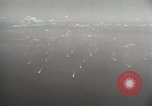
American campaign against Japanese-held islands in the Pacific during World War II
U.S. sea power in the Pacific Theater during World War II. Aerial view of landing craft speeding through the water below. Animated map of Pacific Islands including the Solomons, New Britain, and New Guinea. Shows arrows depicting American amphibious assaults on Russell Islands in February, 1943; on New Guinea, and Rendova in June, on New Georgia in July, on Eastern New Georgia in August, on Choiseul, in October, and Bouganvillle in November, 1943. Aerial view of a Pacific Island airfield. Grumman F4F aircraft with engine running on an aircraft carrier. Bow view of an American Essex class Aircraft Carrier making way in heavy seas. A Douglas Dauntless airplane heading away from a carrier (in background). Map showing locations of American North and South Pacific naval forces and arrows pointing to Tarawa Atoll in the Gilbert Islands, and then to the Marshall Islands (Kwajalein Atoll and Enewetak Atoll). American infantry marching with full field packs, at a port, where they board transport ships. An artillery field piece being loaded on the ship, along with landing vehicles tracked, and army trucks. A convoy of troop ships and supply ships at sea.
USAAF B-24 Liberator bombers drop 1000 lb demolition bombs over Nubia in World War II.
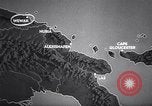
1943: An animated map depicts the strategic Japanese air and shipping base at Nubia in Papua New Guinea, during World War Two. 25 August 1943, Nubia: USAAF 5th Air Force B-24 Liberator bombers drop 1000 lb demolition bombs, from 16,000 feet, over Nubia. They target bivouac and supply areas. That afternoon, U.S. B-25s, flying low to the ground, make strafing attacks against the Japanese airfield at Nubia. United States soldiers unload jeeps, bulldozers, scrapers and other construction equipment in an abandoned Japanese airfield at Nadzab. U.S. 5th AAF constructing their air base. USAAF C-47s bring Australian infantrymen to the new base.
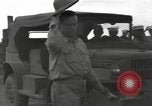
Bob Hope and his USO Troupe visit a U.S. Navy base on Mios Woendi island, Schouten Islands, Papua New Guinea, during World War II.
Bob Hope and members of his USO troupe ride on a PT boat during visit to entertain U.S. Navy personnel during World War 2. In opening scene, Bob Hope doffs his pith helmet as he strolls past the camera to climb aboard a PT boat (PT-331) of U.S. Navy Motor Torpedo Boat Squadron 21, where several naval officers greet him. Members of Hope's USO troupe, Patty Thomas, and Francis Langford, step from jeeps to board the PT boat. Next, the two are seen in the cockpit of the boat next to its captain, Lieutenant Kermit W. Montz, USNR, as the boat speeds along in the water. Among sailors occasionally glimpsed behind them is Radioman 1st Class bill Thielen. In change of scene, Bob Hope climbs out a hatch, holding onto his pith helmet to keep it from blowing off. The boat's number, 331 is clearly displayed on superstructure behind him. Various Navy sailors on deck. (Note: Squadron 21 received a Presidential Unit Citation for outstanding performance during the Huon Peninsula Campaign against Japanese forces from October 1943 to March 1944.)
Japanese forces capture Corregidor, Philippines; Bataan Death March; Pacific supply lines to allies in Australia in World War II
Japanese forces fire artillery at Corregidor Island, during Japanese occupation of Philippines during World War II. Smoke rising from Corregidor under bombardment. Japanese troops land on Corregidor, the Philippines, on May 5 1942. A soldier watches enemies' action through binoculars. Soldiers fire artillery in the field. General Wainwright surrenders. He sits with other officers and Japanese officers and discusses. Japanese soldiers lower the American flag. Japanese troops Banzai cheer and celebrate their victory. They raise the Japanese flag. Captured Americans and Filipino prisoners of war departing Mariveles during the Bataan Death March, under Japanese guard. Map shows Japanese targets for invasion in other areas like Malay, Borneo, and New Guinea. Close up view of Japanese soldier's face. Briefing documents labeled Secret are opened and reviewed. Airplanes on the ground. U.S. And Australian troops march in Australia. Animated globe shows different countries. View of armament and artillery production factory operation in the United States supplying war materiel. Close up views of faces of war production workers. Animation and models show a supply line through which supplies are transferred to Australia. Lockheed P-38 Lightning wrapped in camouflage is lowered onto a transport ship deck. U.S. Army tank loaded onto ship and American troops go ashore in Australia. United States planes bomb and sink Japanese ships in the Bismarck Sea on March 2, 1943. View of American machine gunner firing machine gun from aircraft in flight toward enemy Japanese ships. Cockpit point of view shot out of American aircraft as it bombs and strafes Japanese ship. Bombs away view as U.S. aircraft release bombs. Smoke rises from the burning Japanese ships. General Douglas MacArthur and Admiral Chester W. Nimitz meet and discuss strategy and review maps. Animation shows different potential routes for American forces to return to the Philippines.