


 Francais
 Deutsch
 Italiano
Refine Your Search
+"Normandy France" +1944 stock footage and images
- Showing 283 to 288 of 579 results more
more Hide
Hide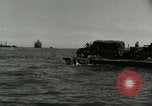
A Rhino barge and other vessels during invasion of France in World War II
A large military barge, marked "US RHF-25" (Rhino Ferry) passes camera viewing from a boat in the water (unseen). Large transport ships seen in background. The barge is filled with military equipment including trucks, construction equipment, and soldiers. As it proceeds, the camera reveals a large transport ship behind it. Closeup of soldiers standing among the cargo on the barge. Landing ship Tank, (LST 499) flanked by a tug boat. Barrage balloons aloft. Closeup of LST 499 port bow. A transport ship in the background. (Note: on June 8th, 1944, LST 499 struck a mine while backing away from Utah Beach, loaded with wounded and medical personnel. Fourteen Crew members were lost, and an unknown number of casualties among the wounded passengers and medical personnel.)
Soldiers of the 1st Infantry Division in England and during the invasion of Normandy and subsequent campaigns toward Germany (WW2)
Soldiers of the 1st Infantry Division training in England under General Clarence R Huebner, in preparation for the D-Day Normandy invasion in World War II. U.S. Navy ships underway at sea. Heavy naval guns bombard the coast of France on D-Day. U.S. Army soldiers seen during assault on Omaha beach with heavy losses on D-Day. U.S. soldiers and tanks encounter heavy German resistance in the "hedge rows." American soldiers digging trenches with shovels and picks and treating wounded comrade. Dead German soldier lying in street as Americans enter the town of Caumont (Caumont l'Eventé). Frenchman civilian pours wine for American soldier after they liberated Caumont l'Eventé from the entrenched German forces. An American helps a French civilian woman to reach a safe place crossing rubble. Damaged French houses along the sides of street. During rest, a soldier gives another a haircut, and another writes a letter. U.S. Air Force B-17s fly overhead and bomb near St. Lo, France on July 25, 1944. Other U.S. Army artillery units, the 4th and 9th Divisions, and General Patton's tanks provided support so the 1st Infantry (First Infantry or Big Red One) could occupy the area. Army combat engineers dig up mines and use construction equipment to clear debris. Wrecked houses and rubble. U.S. soldiers keep advancing through towns and eat and rest as they can. Road sign reads: "Coutances." First Infantry goes through Mortain, Etampes, Meaux, Soissons and across the Belgian border. German prisoners of war walk with their hands raised. German soldier digging out of fox hole. Siegfried Line and dragons teeth. Strong German resistance encountered at Aachen. Tanks fire in the field. House to house fighting in Aachen. Surrender of Aachen. A German flag laying in the street is run over by a U.S. military vehicle. German resistance is heavy during battle scenes in Battle of Hürtgen Forest. German and American artillery are seen in Hurtgen Forest. U.S. wounded treated. The 1st Division is pulled out for rest at the rear, in Belgium.
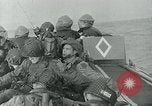
U.S. Army troops wade ashore from landing craft during D-Day invasion of Normandy in World War II
U.S. soldiers in a landing craft approaching Omaha Beach, Normandy, on D-Day, June 6, 1944, in World War II. Support ship firing rockets in background. Barrage Balloon overhead in distance. smoke rising from hillside and many troops already on the shore. View from beach as U.S. troops wade from landing craft and make their way around numerous steel obstacles placed on the beach. Two soldiers felled by German gunfire. U.S. troops of the 16th Infantry Regiment sheltering by an overhanging ledge of chalk cliff at the edge of the beach. Warships and landing craft offshore. View from base of protecting chalk cliff as more troops wade ashore. Troops huddled at base of cliff, some still wearing personal flotation gear. They begin to dig in. Soldiers preparing explosives. View from cliff base of fallen soldiers at waters edge and damaged landing craft in the water. Distant view of bodies of some U.S. soldiers floating in surf at edge of beach.
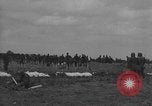
Graves being prepared for fallen U.S. troops at the temporary American St. Laurent Cemetery, in France, during World War II.
German prisoners of war at work digging graves for fallen American soldiers, at the temporary American St. Laurent Cemetery, established by the U.S. First Army on June 8, 1944, shortly after the D-Day invasion of Normandy (Operation Overlord). This is the first American cemetery on European soil in World War II, and located on a cliff overlooking Omaha Beach and the English Channel, east of St. Laurent-sur-Mer and northwest of Bayeux in Colleville-sur-Mer. (It is now the Normandy American Cemetery and Memorial.) Vertical posts with dog tags attached, mark the gravesites of the fallen troops. American soldiers sit near covered dead bodies of the fallen and perform tasks of identification and grave assignment. Covered remains of one soldier are carried across the field on a stretcher. Barrage balloons are seen in the sky overhead.
The Allied invasion of Normandy on D-day, during World War II
U.S. Army Air Forces C-47 aircraft painted in D-Day stripes, seen taking off at nightfall on June 5, 1944, carrying Airborne troopers from a base in England, during World War 2. Large formations of U.S. B-17 bombers en route to targets in Europe. Clusters of indendiary bombs falling from a U.S. bomber. View from a bomber of explosions on the ground from bombing at a coastline. Allied paratroopers fill the sky with their parachutes as they jump from formations of C-47 transport aircraft. Thirty minutes before the amphibious assaults at Normandy, Allied warships bombard the shore with heavy naval guns. Troops leave their transport ships and board small landing craft (Higgins boats). Soldiers try to stabilize the rope nets for others climbing down, as their small craft pitch in choppy seas. The boats speed away from their transport ships, and head toward the shore. Smoke rising from the shore where naval shelling has caused explosions and fire. Troops from landing craft of the USS, Samuel Chase (APA-26), wade ashore under enemy machine gun fire, at "Fox Green" section of Omaha Beach. They are far away from the beach itself, because of steel and concrete obstacles placed by the Germans, and relatively low tide.
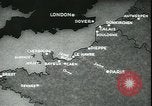
German forces fire at Allied vessels. Battle of Villers-Bocage in World War II
German soldiers in France during the Battle of Villers-Bocage of World War 2. A pictorial map showing cities along French coastline. A German soldier looking through binoculars. Allied ships at sea. German soldiers prepare artillery and fire. Smoke rising from explosions. German soldiers beside artillery. Smoke rising from Allied vessels at sea. Explosions on land and smoke rising. Two German soldiers talking. A wrecked landing craft at a beach. Debris of wreckage spread on the beach. A bomb wrecked U.S. LST (Landing Ship, Tank) on the beach and armored vehicles aboard the ship. Vehicles moving along a road. recked British Cromwell tanks and M3 Halftracks along the side of a road. A German soldier beside a damaged tank. Wide shot of a Stuart light tank. A damaged signboard which reads 'Villers Bocage'. Damaged buildings on the street of Villers-Bocage and a wrecked Tiger tank beside the buildings. Debris strewn on the ground and a damaged tank among the debris. A damaged tank with its front part into a building. A British helmet in the debris on a Cromwell tank. (Note: During this battle, On June 13th, 1944, German tank commander, Michael Wittmann, in a single Panzerkampfwagen VI Tiger tank reportedly destroyed up to 14 tanks and 15 personnel carriers along with 2 anti-tank guns. Many were of the British 22nd Armored Brigade of the 7th Armored Division, AKA the 'Desert Rats'.)