


 Francais
 Deutsch
 Italiano
Refine Your Search
+"Normandy France" +1944 stock footage and images
- Showing 289 to 294 of 579 results more
more Hide
Hide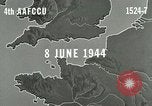
U.S. 9th Air Force B-26 aircraft drop bombs on a communication center and marshaling yards in France during World War II.
U.S. 9th Air Force air attacks against France during World War II. Aerial views of the 9th Air Force L-5 Sentinel aircraft in flight on June 8, 1944. An aircraft flies over Allied camouflaged positions in France. Aerial views of an abandoned tank, abandoned parachutes and 155 mm gun emplacements. U.S. Army Air Forces B-26 Marauders in flight over a convoy of Allied ship in the English Channel. Smoke rises from a ship on fire. Smoke rises from the city of Caen. Marauders bombard a communication center and smoke rises. Bombs being dropped on communication lines and marshaling yards.
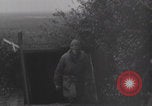
General Omar Bradley with other generals, United States soldiers before the start of Operation Cobra (WW2)
United States General Omar Bradley emerges from a bunker with other generals in Normandy during World War 2. United States generals walking as a group, with General Bradley speaking with General Eisenhower. Television host Alexander Scourby says with regard to Operation Cobra, “No plan in war is fool-proof. But this one is bold, and if it worked it would enable the Allies to break the stalemate in which they have become bogged down”. “Brittany was still the eventual goal” says Alexander Scourby as he points to the region of Brittany in France on the map. United States troops resting and doing chores during their free time. A soldier gets a haircut. A young soldier reads a letter. A soldier doing laundry using a washboard and metal tub. A soldier polishes his leather boots. Soldier cleaning a spot from his uniform. A United States soldier wearing a bowler hat reads a newspaper. Daily News headline reads “OWN OFFICERS BOMB HITLER; PURGE STARTS” after the 20 July plot to assassinate Hitler in 1944. German Chancellor Adolf Hitler speaks to a crowd at rally. A group of German military troops, with an officer wearing the Iron Cross, convene for a meeting in a forest. A German soldier with machine gun rounds slung over his shoulders smoking a cigarette. German soldiers smoke cigarettes while resting. Shirtless German soldiers digging a trench. German soldier spreads butter on bread. A German soldier drinks water from a bucket. A group of German troops, with close ups showing tired faces. United States General Omar Bradley shakes hands with another officer before boarding a Jeep. Soldiers sitting beside a hedgerow. United States soldiers sitting in a ditch next to a hedgerow and smoking. A soldier holds a pocket watch. A soldier lights up another’s cigarette. A formation of B-17 flying fortress bombers in flight. Close view of bombs dropping towards ground. Aerial view of explosions on ground. A German soldier uses binoculars. A tank on the field. Soldiers creep up beside hedgerow. Soldiers hiding while wearing camouflage. German commander commands troops to fire. German soldiers firing artillery. German soldier puts shell into artillery. Artillery fires behind shrubs. General Omar Bradley observes battle from afar. General Omar Bradley listens to Major General J. Lawton Collins, who is describing how the city of Cherbourg was taken. German armored vehicles covered in camouflage driving. German half-tracks moving.
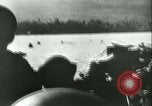
Signal Corps weekly film reports sent to Photographic Center and used in training films for U.S. troops during World War II.
The role and contribution of the U.S. Army Signal Corps in combat and war. Amphibious landings of the first wave of Allied troops including Signal Corps Units in Normandy, France on D Day during World War 2. The Joint Assault Signal Companies (a Signal Corps Unit that accompanies the soldiers on every beach landing) go ashore in Normandy. Soldiers in landing crafts approach the beach. Landing crafts anchored along the shore line. A U.S. flag on the beach. Crafts approach the beach. U.S. Army Signal Corps combat photographers using motion picture cameras to film the battle that ensues on the beach and in the fields. Gun fire and explosions in the battlefield, filmed by combat cameraman. Allied aircraft in flight. Airmen load weekly film reports of the war in all Theaters made by Signal Corps officers from a van into an aircraft. The films are sent to the Photographic Center in New York. A soldier assembles the films. Technicians organize and arrange the films. They place the film reels onto racks. The film content is used to make training and orientation films for the U.S. troops. Troops watch the films in order to cut down the training period, and stay informed about the order of event in other Theaters of Operation. The films include 'Why We Fight' and 'The Fighting Men' series. Clips and recordings from these films.
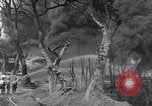
British soldiers fight fire at a bombed oil supply depot near their base in England, during World War II.
United States soldiers at a base camp in England, prior to D-Day invasion in Normandy, France during World War II. Immense smoke rises off a bombed oil supply depot. British soldiers use chemical foam apparatus to fight fire at the oil depot. Flames come out of a building on fire.
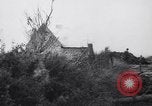
British troops advance from beachhead during D-Day invasion of France in World War II.
A wrecked German seawall concrete fortification as smoke rises from it along the Atlantic Wall near Normandy France. A German soldier buried to his chest in a hole with rubble and dirt surrounding. He is digging at the dirt with little progress trying to free himself. British soldiers advance from beach past burning houses and wrecked buildings. Allied soldiers, artillery and tanks are seen on the beach coming ashore.
Robot bomb damage in England; launching sites and wide gauge tracks for transporting bombs in Cherbourg, France (WWII)
U.S. Army 9th Air Force North American P-51 Mustang fighters in flight and tracking a V-1 Flying bomb to shoot it down over Southern England, United Kingdom, during World War II. Crowds inspect damage caused by V1 flying bombs and V2 rockets, also known as “robot bombs.” A crater formed by a German robot bomb. A U.S. Army soldier collects fragments while inspecting the bottom of the bomb crater. British and American soldiers and British civilians inspect the damage. Aerial and ground views of an unfinished German V-1 and V-2 launch site on the Cherbourg Peninsula in Normandy, France after its capture by Allied forces. The main rocket ramp is seen on the launch site. A crane at the unfinished launch site. A concrete strip under construction. An unfinished section at the Cherbourg rocket launch site. The rich concrete mixture used in the construction of the massive installation is reinforced by lattice-type steel rods (half inch thick woven in squares). Unfinished and destroyed platforms from 29 rocket launch installations made by German forces at Cherbourg before the Normandy landings. Large solid underground structures intended as showrooms for shells and equipment. Unfinished or damaged narrow-gauge railroad used for supplies and construction. Carts are seen on the railroad. Netting laced with metal leaves to prevent fading is used for camouflage. A soldier arranges green coverings outside a bunker. A man stands on a crater. Wide gauge tracks to bring bombs to the platform. Some parts of the installation are bombed by Allied bombers.