


 Francais
 Deutsch
 Italiano
Refine Your Search
+"Normandy France" +1944 stock footage and images
- Showing 31 to 36 of 579 results more
more Hide
Hide
D-Day invasion of Normandy during World War II.
Allied Invasion of Normandy, France during World War 2. British Armstrong Whitworth Whitley bomber in flight. Allied paratroopers of 6th British,and American 101st and 82nd Airborne Divisions jumping from aircraft. Allied troops in gliders being towed across the English Channel. A British pilot in cockpit of aircraft towing a glider. Several gliders descending over French farm fields.Formations of Martin B-26 bombers overhead. Allied Navy warships underway. Scenes on decks of the warships. Navy heavy guns being loaded and fired from Battleships and cruisers. American B-26s and British Armstrong Whitworth Whitley bombers in flight overhead. British spitfire fighter aircraft overhead. U.S. B-26 in D-day stripes. Bombs exploding on German enemy targets. Navy ships bombarding shore. Allied infantry descending rope nets from troop ships. B-17 bombers aloft.Gunner in a B-17. British warship in camouflage bombarding French coast. British spitfire zooming low over landing craft. Allied American and British soldiers in landing craft going ashore at several different Normandy beaches. London, with streets quiet, in early morning, June 6, 1944. Journalists assemble at British Ministry, and a U.S. Army Colonel tells them the invasion at Normandy is underway. The reporters run from the room to file their stories. People reading about it in their newspapers in various cities of the world.
U.S. Signal Corps employ the Eureka/Rebecca transponder system during the American airborne landings in Normandy, France.
The role and contribution of the U.S. Army Signal Corps in combat and war. Parachute drop-markers with radio signals guide an airborne operation in the European Theater. U.S. airborne troops board a U.S. Army Air Forces Douglas C-47 Skytrain or Dakota transport aircraft. A woman soldier greets the paratroopers as they prepare to board the aircraft. The paratroopers jump out and descend towards the ground. The paratroopers are furnished with markers for every dropping point. A paratrooper with a radio beacon hooked onto his belt. The beacon is the ground section of the Eureka/Rebecca transponder system. The paratrooper fixes the Eureka extension including the cable and the receiver transmitter. Animation depicts the working of the Eureka-Rebeca system. An aircraft unloads paratroopers over Normandy in France during World War II. Allied troops, landing crafts, landing ships arrive at Normandy on D-Day (6 June 1944). Soldiers wade through the water towards the shore and advance inland across the beach during Allied invasion of France.
U.S. troops in Scotland rehearse for amphibious invasion of Normandy, France during World War II
Higgins Boats (landing craft) from the USS Bayfield (APA-33) are seen heading toward the shore on the River Clyde in Scotland, where they carried out amphibious landing exercises from 14 March, through 21 March,1944, in preparation for the Allied invasion of Normandy during World War 2.. Snow-covered mountains dominate the background. View of a U.S. Coast Guardsman standing in one of the boats. Several landing craft are seen near the shore in the background. Snow extends almost as low as the beach. Several landing craft moving in loose formation across the water, with rising moon low on horizon in background. View of one Higgins Boat plowing through the water, towards the camera. The moon is now higher in the sky. American troops wading ashore through surf, in the moonlight. Some stars are visible high in the background sky. Troops coming ashore along a wide stretch of beach. Clouds obscure the sky.
Seabees construct an artificial harbor during the Allied invasion of Normandy, France in World War II.
A film about the role of U.S. Navy Seabees in construction of artificial harbors in the English Channel during the Allied invasion of Normandy in World War II. U.S. Navy Captain Clark, in charge of artificial harbors and Commander Calair, in charge of installing Phoenixes and pier heads in the English Channel. Ships underway in the English channel. Tugs at a harbor. Beetles being pulled. A tug prepares to tow a Phoenix. Men work on lines. Whales spread across the channel. Pier head at sea. A dumb barge underway at sea. A captain looks at the towing operation from the bridge of a vessel. Aircraft in flight. Crew aboard a phoenix. Gliders in flight above the convoy. A signalman sends a blinker signal. Animated diagram depicts the creation of an artificial harbor. First tow arrives at Normandy on June 6, 1944. Landing crafts at the Normandy beach. Artificial harbor being constructed. A bridge being completed and pier head being attached to it. Seabees at work.
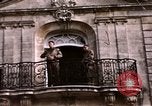
U.S. Army officers and war correspondents at the bombed, abandoned French Chateau de Pont-Rilly during World War II after D-Day
Uniformed U.S. war correspondents and U.S. Army officers explore the house and grounds of the French Chateau de Pont-Rilly, in Négreville near Normandy France, soon after the Invasion of Europe. (The chateau was designed in 1765 by architect Pierre-Raphaël de Lozon for the Marquis d'Ourville). U.S. Army officers in the balcony of the mansion overlooking the entrance. Exteriors of the palatial chateau. A large bomb hole is visible in the roof, right of the main entrance. A French boy points out something distant on the grounds of the Chateau. A swan in a pond. Exteriors of the mansion. At the end of July 1944, near the time this footage was shot, the chateau became the headquarters of Advance Section of Com Z, also known as "ADSEC" (Advance Section, Communications Zone).
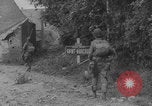
United States soldiers talk to villagers in Saint-Marcouf, Normandy (WW2)
United States soldiers enter the village of Saint-Marcouf, in the Manche department in Normandy, France during World War 2. Soldiers pass by sign “Saint-Marcouf”. United States troops carry rifles. French villagers walking. Soldiers talk to an old French man and woman. Soldiers sitting on the street side of what is now known as the “Route du 5 Juin 1944”. Soldier smoking a cigarette during a break. Groups of soldiers crowd outside a damaged house. Soldiers talking to a French man. A soldier talks to children. A little girl points upwards. A statue of the Virgin Mary stands among the rubble. A statue of Jesus Christ on the Cross leaning sideways inside a church wrecked. Words by George C. Marshall, Chief of Staff of the United States Army says “No compromise is possible and the victory of the democracies can only be complete with the utter defeat of the war machines of Germany and Japan”. A “V” is superimposed over marching soldiers and a ringing Liberty Bell.