


 Francais
 Deutsch
 Italiano

Refine Your Search
+"Normandy France" +1944 stock footage and images
- Showing 25 to 30 of 585 results more
 Hide

Infantry, artillery, and warplanes during the D-Day invasion by Allies in Normandy, France during World War 2.
The D-Day assault on Normandy by the Allies, against Germany's conquest in World War 2. Troops of infantry, artillery and tanks, warplanes ready assembled in south of England for attack at Normandy in France on June 06, 1944. Supreme Commander General Dwight D. Eisenhower and British General Montgomery in discussion with each other. B-17 bombers on mission to Nazi bases. Soldiers move from warships to landing crafts, and land on the coast of Normandy under enemy fire. Parachute troops jump from aircraft landing behind enemy lines. Surrendered German soldiers march, guarded by Allied soldiers. From a June 13, 1963 newsreel recounting events years earlier.
Beach and wreckage three days after the D-Day Allied invasion of Normandy, France during World War II.
Opening scene behind introductory writing, shows U.S. troops climbing down from a landing craft and walking towards a beach during Normandy invasion of World war 2. Date is D-Day +3 (June 9, 1944) and allies are setting up logistic resupply operations. Views across beach at extreme low tide. A cluster of DUKW amphibious vehicles sitting on the sand, below some cliffs. Some buildings of the French village of Arromanches-les-Bainsin background. Closeup of a demolished French dwelling at base of cliff. Two U.S. soldiers walk along a road at the waterfront, where steel barriers that have been removed from the beach, are piled up. Closeup of the steel barriers. An M4 Sherman tank, equipped with deep wading gear is seen mired in the sand. A closeup of U.S. Landing Craft Tank (LCT-25) on the beach with an M3A1 Half-Track destroyed on its offramp. It had been hit by shell fire on D-day, setting other half-tracks and the landing craft afire. Closeup of the destroyed halftrack.
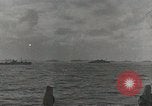
United States 1st Infantry Division soldiers land at Normandy, France during D-Day invasion of France in World War II.
The role of United States 1st Infantry Division (Big Red One) in various campaigns during World War II. Allied ships underway in the Atlantic Ocean. Soldier of United States 1st Infantry division practice an amphibious landing during training in England. Naval guns being fired on D-Day, June 6th , 1944. Troops of 1st Infantry Division climb down landing nets onto a landing craft. Soldiers land at Normandy Omaha beach in France on D-Day. Some soldiers drop to ground, shot crossing the beach. Troops move inland. Tanks being fired among hedge rows. Troops fire guns from dugouts and provide medical aid to a wounded soldier.
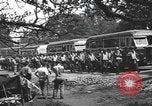
Allied forces assemble in England and depart for the invasion of Normandy in World War II
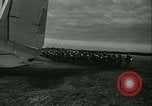
American paratroopers of the 82nd Airborne Division, boarding hired British commercial buses that take them to a marshaling point, in preparation for the invasion of Normandy, France, in World War 2. Views from below of U.S. Army Air Forces C-47 transport aircraft in formation, carrying paratroopers toward Normandy, France, on June 5, 1944. Aerial view of British and American invasion ships en route to rendezvous off the Isle of Wight. U.S. Army Air Forces B-26 and B-17 bombers in flight. B-17 dropping bombs on lines of communications in Normandy, to hinder German movements of reinforcements. Allied warships and transports beginning their move toward the coast of Normandy. British landing craft underway under cover of barrage balloons.
U.S. Signal Corps employ the Eureka/Rebecca transponder system during the American airborne landings in Normandy, France.
The role and contribution of the U.S. Army Signal Corps in combat and war. Parachute drop-markers with radio signals guide an airborne operation in the European Theater. U.S. airborne troops board a U.S. Army Air Forces Douglas C-47 Skytrain or Dakota transport aircraft. A woman soldier greets the paratroopers as they prepare to board the aircraft. The paratroopers jump out and descend towards the ground. The paratroopers are furnished with markers for every dropping point. A paratrooper with a radio beacon hooked onto his belt. The beacon is the ground section of the Eureka/Rebecca transponder system. The paratrooper fixes the Eureka extension including the cable and the receiver transmitter. Animation depicts the working of the Eureka-Rebeca system. An aircraft unloads paratroopers over Normandy in France during World War II. Allied troops, landing crafts, landing ships arrive at Normandy on D-Day (6 June 1944). Soldiers wade through the water towards the shore and advance inland across the beach during Allied invasion of France.
Seabees construct an artificial harbor during the Allied invasion of Normandy, France in World War II.
A film about the role of U.S. Navy Seabees in construction of artificial harbors in the English Channel during the Allied invasion of Normandy in World War II. U.S. Navy Captain Clark, in charge of artificial harbors and Commander Calair, in charge of installing Phoenixes and pier heads in the English Channel. Ships underway in the English channel. Tugs at a harbor. Beetles being pulled. A tug prepares to tow a Phoenix. Men work on lines. Whales spread across the channel. Pier head at sea. A dumb barge underway at sea. A captain looks at the towing operation from the bridge of a vessel. Aircraft in flight. Crew aboard a phoenix. Gliders in flight above the convoy. A signalman sends a blinker signal. Animated diagram depicts the creation of an artificial harbor. First tow arrives at Normandy on June 6, 1944. Landing crafts at the Normandy beach. Artificial harbor being constructed. A bridge being completed and pier head being attached to it. Seabees at work.