


 Francais
 Deutsch
 Italiano
Refine Your Search
+"North Africa" +1942 stock footage and images
- Showing 73 to 78 of 149 results more
more Hide
Hide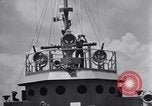
Allied Invasion of North Africa during World War II
Allied warships move towards North Africa during World War 2. A U.S. Navy sailor on a destroyer monitors sonar indicating presence of a submarine. A sailor looks through a pair of binoculars and another U.S. Navy sailor nearby has a pair of headphones. Loudspeaker signals call to general quarters. Sailors rush up the stairs. Numerous depth charges are launched and explode in the water. Next, a wide oil slick on the surface indicates the submarine has been struck by the depth charges. An officer looks through a pair of binoculars. A man speaks into a radio. Soldiers amuse themselves on a troop ship. One plays the piano and others playing play cards, read novel while eating an apple. Flags of Major General Patton and Rear Admiral H. Kent Hewitt aboard the USS Augusta (CA-31) off the coast of North Africa. Semaphore flags and signal lights communicate between ships. Soldier with 'map of West Africa' in his back pocket. Two soldiers read a language guide. An animated map detailing Plan Acrobat to invade North Africa. Map includes Casablanca, Algiers, Tripoli, and Libya. Soldiers exercise, peel potatoes and relax on a troop ship. Clothes hung on a line. British soldiers write letters home. A soldier pastes news on a bulletin board. The bulletin announces that the 'German Afrika Corps' are in full retreat. Night time aerial views of bombing of cities in Italy. Narrator states the bombing included Naples, Genoa, and Turin. Explosions and smoke on the ground below from the bombing. Aerial view of daylight bombing at lower altitude of a Renault tank factory. Submarine on surface at twilight. Eighth Army plane. General Eisenhower, General Mark Clark and French General Giraud. Night scene. Soldiers on the deck. German WWII headquarters at night with guards in Rome and at the The Reich Chancellery in Berlin. Hitler at Berghof . German switchboard, terminal, and radio communications. Messages passed between Allied ships via signal light and ship-to-ship cargo transfer. ( Note The Operation Acrobat discussed in this film is misleading. That plan was scrapped, and the Allied North African campaign was conducted as part of Operation Torch.)
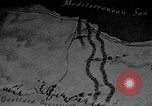
Allied and Axis positions for the second battle of El Alamein in Egypt.
Beginning of the second battle of El Alamein in Egypt between British Eighth Army and German Forces in October, 1942, during World War 2. Map of Africa shows German forces advancing from coast. Positions of German and Italian forces. Allied positions include Australian, Indian, South African and Highland Divisions joined in as reinforcement for British Eighth Army. German officers attend a conference in Berlin. Joseph Goebbels and Fuhrer Adolf Hitler greet German Field Marshal Erwin Rommel in Berlin after Rommel became Commander of German Forces deployed in North Africa. Rommel, beside Goebbels, speaking to German political and military leaders in Berlin. View from a July 15, 1942 ceremony in which Hitler congratulates Rommel on his promotion to Field Marshal (a promotion which was effective June 21, 1942.)
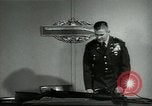
History of 1st Infantry Division, or Big Red One, focusing on deployment and action during Operation Torch in North Africa
Colonel William Wilson Quinn introduces an episode of "The Big Picture" that tells about the history of the 1st Infantry Division of the United States, called the "Big Red One." We see the boots and the shoes that 1st Infantry soldiers wore beginning with the Revolutionary War, through the Civil War, the First World War and the Second World War. Recruits are shown in training during World War 2 before deploying overseas in Operation Torch and the invasion of North Africa. Commanding General of the 1st Infantry Division, General Terry Allen, is seen during the Division's deployment to North Africa in World War II. Soldiers relaxing aboard troop ship. Naval barrage at night followed by amphibious assault on coast of Algeria. Animation shows the target areas of the division as they capture Oran. German counter attack is seen with bombers, tanks (including brief view of a German Tiger I tank), and artillery. American soldier standing with rifles shooting at low-flying German aircraft that are bombing their position. Scenes of German and American gun crews firing. Nazi German General Rommel seen in his staff car. Animation shows route of the Division with others towards the North. Heavy nighttime gunfire is seen. American soldiers meet and greet British troops of General Montgomery's 8th Army.

American and British troops in landing crafts reach the beachheads in Oran, Algeria in Operation Torch invasion of North Africa
Allied offensive in North Africa, part of Operation Torch in World War 2. Allied convoy underway near the coast of Oran in North Africa. Antiaircraft guns provide cover fire for the naval fleet to land on the shores. British and American warships lay a smoke screen. Troops descend from a ship via a climbing net and board a transport boat. Troops in landing crafts head toward the beachheads. British and American troops reach the North African shores. Supplies and equipment are unloaded.
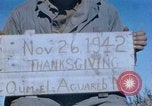
Thanksgiving Day celebrations at Oum El Aguareb in Algeria, North Africa in World War 2.
Thanksgiving Day celebrations at Oum El Aguareb in Algeria, North Africa, during World War 2. American soldiers chase a flock of turkeys. Natives gift turkey to U.S. soldiers. U.S. soldiers roll up copies of detailed war maps meant for tank commanders. Allied tanks deployed near Tebourba in Tunisia. Convoy of Allied tanks, half tracks and jeeps move.
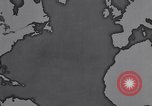
American naval forces join with British in Operation Torch to attack at Casablanca in Morocco, North Africa during World War 2.
Animated map shows the advancement of American forces toward North Africa, being joined by British Naval forces near Gibraltar for Operation Torch. American and British allied naval fleets position at key locations near Oran, Algiers and at Casablanca for simultaneous attack. United States Navy fleet starts its attack after being fired upon by shore batteries of Vichy French forces at Casablanca, commencing the Naval Battle at Casablanca. Carrier aircraft swarm the skies above the harbor at Casablanca. Antiaircraft guns fired by Vichy French. Huge explosions in water and on ships. Guns aboard a battleships fired. The unfinished French battleship Jean Bart is hit by a U.S. battleship's 12 inch shell. The ship Jean Bart erupts in flame and emits heavy smoke. Several destroyed French ships in harbor at Casablanca.