


 Francais
 Deutsch
 Italiano

Refine Your Search
+"North Africa" +1942 stock footage and images
- Showing 79 to 84 of 149 results more
 Hide

Production of petroleum at oil refineries and its transportation in United States, before and during World War II
Documentary titled, ' Oil Is Blood ' on production and transportation of petroleum and its by products in United States. Crude oil in a pit. Man takes samples from the pit. View of derricks at an oil drilling site. Derricks at sea. Exteriors of a building near the derricks. Service station attendants, pumping gas and cleaning the windshield, on a 1942 Lincoln Continental convertible, at a "Tydol Flying A" gas station. Scenes of busy highways and plenty of fuel give way to empty roads, closed gas stations, and restricted hours for obtaining fuel, as it is rationed during World War 2. Views of persons obtaining ration stamps and books. Various gasoline ration books including the "A" books (allowing the smallest amounts) and "B", "C", and other books allowing larger rations to more essential users. Oil rig "roughnecks" inserting new sections of pipe and proceeding to drill. Closeup of a "gusher" before it is capped. Men filling railroad tank cars with petroleum products. A long train of tank cars pulled by a steam locomotive. Animated map illustrates the ocean shipping lanes that formally served as means to transport fuel and oil, before the German U-Boat threat made them too dangerous for general use. Drums of fuel and oil being loaded aboard a ship to supply the Allies during the war. A convoy of ships heading to the war zone of North Africa.
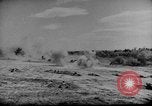
U.S. Army Quartermaster Corps prepare mortars, fire anti aircraft guns, and provide supplies during World War II.
Clip opens with brief World War I scene, circa 1917, of new American army recruits receiving army uniforms being issued by a U.S. Army Quartermaster. Clip then covers U.S. Army Quartermaster Corps' combat operations in various Theaters of Operations during World War II. Quartermaster Corps soldiers with rifles under the cover of a military truck during battle. Troops in trucks. An aircraft in low flight over a field. A U.S. Army truck. A Quartermaster fires an anti aircraft gun. Explosions occur and smoke rises. A British tank in a field. Soldiers beside a truck. Cans and barrels stacked on the ground. An enemy German tank in a field. Soldiers take cover. Quartermasters with guns in a trench. They come up the trench in prone positions. Dramatized battle scene with several Quartermaster corps casualties beside a wire fence. Soldiers prepare a mortar gun. An anti aircraft gun on an army truck. A soldier takes aim and fires a rifle during training. The Quartermaster flag hoisted on a pole. Actual footage shows aerial view of Bataan, and then ground views of groups of remaining U.S. Army soldiers around time of surrender of Bataan in April 1942. American soldier seen with their hands up and under guard of Japanese soldiers during Bataan surrender. Landing crafts arrive at a beach in North Africa. Supplies being offloaded at various battle fronts of World War 2. Soldiers and supplies off-loaded on the beach. Quartermasters seated on supplies boxes. Landing crafts arrive at a beach in the South West Pacific. Troops move across the beach. Troops disembark from landing crafts and move across a beach in Sicily, Italy. The Quartermasters unload boxes of supplies during various beach landings. They unload supplies and fire artillery on a beach head in Italy. Troops in trucks. A convoy of trucks loaded with supplies. Ammunition, ration and personnel in trucks move from Algeria to the front in Tunisia. Explosions occur and smoke rises. Trucks advance through smoke at night and in difficult conditions. Quartermaster General Major General E. B. Gregory speaks about the Quartermaster Corps. He says that the Quartermasters distribute goods to the army during training and combat. The movement of the Corps should be so regulated so as to deliver the goods at the right time in the right quantity.
Montage of World War 2 scenes from all theaters of Allied operations and scenes of the U.S.A.
Peaceful scenes of pre-war England, showing a church with sheep grazing on its lawn, and a college building with ivy growing on the walls. In contrast, explosion and results of German bombing is shown, with buildings collapsing and ruined from the German blitz over England. A long line of Chinese soldiers marching along the Great Wall of china. Shadows of three Japanese bombers flying over Chinese landscape. On May 4, 1942, Madame Chiang Kai-Shek decorates American fliers who made the first attack on Tokyo in World War 2. Wearing a Chinese decoration around his neck, Lieutenant Colonel Jimmy Doolittle, who led that raid by U.S. B-25 bombers from the Aircraft Carrier USS Hornet, poses with Madame Chiang and others of his group. Scenes of Moscow, Soviet Russia, including a T-70 light tank moving rapidly along a city street. A Soviet Petlyakov Pe-2 dive bomber taking off in a snow storm. U.S. troops on a halftrack in North Africa. British artillerymen firing a 25 pounder in the desert. Glimpses of smoke rising from enemy strikes at cities in England, Russia, and China. Scenes of destruction from bombing. Brief street scenes of unharmed and intact towns and cities in the United States, including brief New York City scene of pedestrians and traffic in Times Square. Defense workers in America going to work at Ranger Aircraft Engines factory (later part of Fairchild Aircraft and Engine Corporation), and a star flag showing war service by worker families. Farmers in Western U.S. harvesting grain. Railroad trains and river barges carrying harvest from U.S. farms. Herds of cattle and sheep being raised for the war effort in Western U.S. Aerial view of orchards and farms in America. A mining bucket filled with iron ore. Barge carrying the ore. A steel mill in operation. Scrap iron being recycled. View from production floor of U.S. bomber aircraft being built in a defense plant. Countless freight cars in a railroad marshaling yard at a port, where a tug boat and a freighter are seen in the water. War materiel piled up at the port. A convoy of supply ships underway.
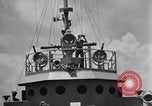
Allied Invasion of North Africa during World War II
Allied warships move towards North Africa during World War 2. A U.S. Navy sailor on a destroyer monitors sonar indicating presence of a submarine. A sailor looks through a pair of binoculars and another U.S. Navy sailor nearby has a pair of headphones. Loudspeaker signals call to general quarters. Sailors rush up the stairs. Numerous depth charges are launched and explode in the water. Next, a wide oil slick on the surface indicates the submarine has been struck by the depth charges. An officer looks through a pair of binoculars. A man speaks into a radio. Soldiers amuse themselves on a troop ship. One plays the piano and others playing play cards, read novel while eating an apple. Flags of Major General Patton and Rear Admiral H. Kent Hewitt aboard the USS Augusta (CA-31) off the coast of North Africa. Semaphore flags and signal lights communicate between ships. Soldier with 'map of West Africa' in his back pocket. Two soldiers read a language guide. An animated map detailing Plan Acrobat to invade North Africa. Map includes Casablanca, Algiers, Tripoli, and Libya. Soldiers exercise, peel potatoes and relax on a troop ship. Clothes hung on a line. British soldiers write letters home. A soldier pastes news on a bulletin board. The bulletin announces that the 'German Afrika Corps' are in full retreat. Night time aerial views of bombing of cities in Italy. Narrator states the bombing included Naples, Genoa, and Turin. Explosions and smoke on the ground below from the bombing. Aerial view of daylight bombing at lower altitude of a Renault tank factory. Submarine on surface at twilight. Eighth Army plane. General Eisenhower, General Mark Clark and French General Giraud. Night scene. Soldiers on the deck. German WWII headquarters at night with guards in Rome and at the The Reich Chancellery in Berlin. Hitler at Berghof . German switchboard, terminal, and radio communications. Messages passed between Allied ships via signal light and ship-to-ship cargo transfer. ( Note The Operation Acrobat discussed in this film is misleading. That plan was scrapped, and the Allied North African campaign was conducted as part of Operation Torch.)
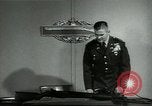
History of 1st Infantry Division, or Big Red One, focusing on deployment and action during Operation Torch in North Africa
Colonel William Wilson Quinn introduces an episode of "The Big Picture" that tells about the history of the 1st Infantry Division of the United States, called the "Big Red One." We see the boots and the shoes that 1st Infantry soldiers wore beginning with the Revolutionary War, through the Civil War, the First World War and the Second World War. Recruits are shown in training during World War 2 before deploying overseas in Operation Torch and the invasion of North Africa. Commanding General of the 1st Infantry Division, General Terry Allen, is seen during the Division's deployment to North Africa in World War II. Soldiers relaxing aboard troop ship. Naval barrage at night followed by amphibious assault on coast of Algeria. Animation shows the target areas of the division as they capture Oran. German counter attack is seen with bombers, tanks (including brief view of a German Tiger I tank), and artillery. American soldier standing with rifles shooting at low-flying German aircraft that are bombing their position. Scenes of German and American gun crews firing. Nazi German General Rommel seen in his staff car. Animation shows route of the Division with others towards the North. Heavy nighttime gunfire is seen. American soldiers meet and greet British troops of General Montgomery's 8th Army.

American and British troops in landing crafts reach the beachheads in Oran, Algeria in Operation Torch invasion of North Africa
Allied offensive in North Africa, part of Operation Torch in World War 2. Allied convoy underway near the coast of Oran in North Africa. Antiaircraft guns provide cover fire for the naval fleet to land on the shores. British and American warships lay a smoke screen. Troops descend from a ship via a climbing net and board a transport boat. Troops in landing crafts head toward the beachheads. British and American troops reach the North African shores. Supplies and equipment are unloaded.