


 Francais
 Deutsch
 Italiano
Refine Your Search
+"North Pole" +1926 stock footage and images
- Showing 1 to 6 of 17 results more
more Hide
Hide
The Byrd arctic expedition Fokker airplane departs Spitsbergen, Norway, on its flight to the North Pole in 1926
The 1926 Byrd expedition to fly over the North Pole. The expedition's ski-equipped Curtiss Oriole (Curtiss Model 17) airplane is seen parked in front of their Fokker F-VII Tri-motor airplane, the "Josephine Ford," on the snow at Spitsbergen, Norway. Engines start on both aircraft. The Oriole takes off with its photographer waving to the camera as they depart. They gather speed on a downhill slope and break ground to proceed over open water in Kings bay. Next, the Fokker (piloted by Floyd Bennett and navigated by LCDR Richard Byrd) is seen high above on its flight towards the North Pole. Views of dramatic Ice formations as seen from a boat in waters nearby. Aerial views of arctic terrain.
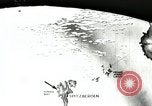
Film shot by Lieutenant Commander Richard Byrd, while circling over the North Pole, with pilot Floyd Bennett, in their Fokker tri-motor airplane.
Byrd arctic expedition to fly an airplane over the North Pole, in 1926. Animated map illustrates the planned Northward course of Lieutenant Commander Richard Byrd and pilot Floyd Bennett, headed to the North Pole, in their Fokker tri-motor airplane. The starting point is Kings Bay, Spitsbergen, Norway, where they took off on May 9, 1926. A slate states that, "Byrd circles the Pole, checking observations and photographing." Scene shifts to images being recorded by Byrd from inside their Fokker F-VII Tri-motor airplane, the "Josephine Ford." One shows the big "F" in the name "Fokker" on underside of the right wing. From there, the camera pans back over the frozen wasteland below, with parts of the aircraft also seen. Another shot shows the aircraft tail (empennage) with mountains in background amidst snow-filled valleys while the airplane is in a gentle right-hand turn. Underside of engine is seen with arctic scenery, passing below.
Fokker aircraft strikes a snowbank and breaks a ski in attempted takeoff during Byrd's 1926 arctic expedition to fly over the North Pole
Lieutenant Commander Richard Byrd's 1926 arctic expedition to fly an airplane over the North Pole. The expedition's F-VII Tri-motor airplane, the "Josephine Ford," is seen parked on the snow at Spitsbergen, Norway. Men work to level a surface in the snow to permit takeoff. Snow and ice covered mountains in the background. The aircraft with engines running. It begins a takeoff roll, but strikes a snowbank and breaks one of its skis. Men gather near the airplane. They shovel snow from the airplane.
Richard Byrd and Floyd Bennett pose in their arctic parkas during preparation for their polar expedition to fly over the North Pole.
The first Polar expedition, led by United States Navy Lieutenant Commander, Richard Evelyn Byrd (an attempt to fly an airplane over the North Pole). The first image seen is a Still photograph of U.S. Navy commodore Robert E. Peary, credited with reaching the North Pole, in 1909. He is seen in fur arctic gear. Next, Lieutenant Commander Richard E. Byrd, USN, is seen standing beside his expedition's Fokker F-VII Tri-motor monoplane, the "Josephine Ford." Byrd is dressed in a fur arctic parka similar to the one Peary was wearing. Next, the expedition's Pilot, Floyd Bennett, also poses beside the airplane, wearing his parka. They are preparing to attempt a flight over the North Pole, in 1926.
Mixture of arctic scenes, from the ground and the air, including some from the Byrd expedition Fokker aircraft during its flight to the North Pole
Views of arctic terrain, with waves crashing against shore and leaving frozen hills of ice and snow. Closeup of waves. Sea ice glistening in sunshine. Brief views from the cockpit of the Fokker F-VII Tri-motor airplane, the "Josephine Ford," while Richard Byrd and Floyd Bennett occupied it during their flight to the North Pole in 1926. (Neither occupant is seen.) The views include glimpse of underside of wing; engine parts in the open; and engine crankcase covered with frozen oily sludge. Views appear limited by restricted visibility from the cockpit. Clip concludes with several views downward to the frozen arctic wasteland below.
U.S. Navy LCDR Richard Byrd is congratulated upon completion of historic airplane flight over the North Pole.
Crew members aboard the SS Chantier, look over the ship's side and seize an American flag from the hand of U.S. Navy Lieutenant Commander, Richard Byrd, as he climbs aboard, dressed in his arctic parka. Next, Byrd and pilot Floyd Bennett, are seen surrounded by cheerful, congratulatory expedition members, as they stand on the deck. An illustrated scroll is seen listing America's polar heroes: Robert E. Peary and Richard E. Byrd, both of the U.S. Navy. Closeup of Richard Byrd. A message of congratulations to Commander Byrd, sent from the Presidential Yacht, USS Mayflower, dated May 9, 1926, and signed by President Calvin Coolidge.