


 Francais
 Deutsch
 Italiano
Refine Your Search
+"Nuremberg Germany" +1945 stock footage and images
- Showing 1 to 6 of 66 results more
more Hide
Hide
Opening statement of the prosecution at the Nuremberg Trials; flashback scenes of Nazi crimes and starving civilians in 1945
Events related the Nuremberg Trials held at the Palace of Justice in Nuremberg, Germany. Flashbacks of a variety of Nazi crimes against humanity during World War II. Europe during 1945. War devastation: buildings and cities laid in waste, people in hunger and despair emerge from shelters searching for the causes of the war and of the immediate human suffering. Deprived children and adults weep, starve and beg on the streets. November 21, 1945, Nuremberg, Palace of Justice, seat of the International Military Tribunal. List shows the names of the convicted Nazi criminals. Chief prosecutor from the United States, Robert Houghwout Jackson, makes the opening statement of the prosecution. He presents Count 1 of the indictment a conspiracy to commit war crimes and crimes against peace and humanity. He makes the statement that criminals who have done injustice to the laws of humanity must be brought to justice. Stenographers wearing headphones take down notes. Defendants stand in their dock including Herman Goring, Rudolf Hess, Joachim von Ribbentrop, Wilhelm Keitel, Karl Donitz, Erich Raeder, Baldur von Schirach and Fritz Sauckel. Faces of the convicted criminals. Scenes from mass burial of victims from German bombing of Coventry, England. Scenes from the end of World War 2, with women weeping and civilian victims of war in Europe, including Germany, seen scavenging on streets for food. Women and hungry children scrape out trash cans and metal lids for bites of food. Desperate civilians cut down remaining tree stumps from formerly tree-lined streets to use for fuel. A group of men and women struggle in a food relief line in Italy.
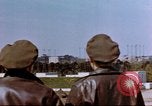
United States Airmen visit the Zeppelinfeld and Zeppelintribüne in Nuremberg, Germany
Activities of United States Airmen in Germany very soon after end of World War II in Europe. United States Army Air Forces Lieutenants visiting the war-damaged Zeppelintribüne, at the zeppelinfeld, in Nuremberg, Germany, 1945. They climb the stairs of the Zeppelintribüne grandstand. Later, the American soldiers look at the remains of the Swastika and Eagle that formerly adorned the Zeppelintribüne, and was blown up by the U.S. Army. One tries to pick up a piece of it. Airmen stand and chat. One Lieutenant helps another to lit up a cigarette. They smoke cigarettes, and pose for a photograph on the field.
Chief prosecutor Robert H. Jackson opens the Nuremberg War Crime Trials at the Palace of Justice in Nuremberg, Germany.
The Nuremberg War Crime Trials at the Palace of Justice (Fürther Str. 110, 90429 Nürnberg, Germany) in Nuremberg, Germany after World War II. The Palace of Justice where the proceedings of the war crime trials take place. Guards at an entrance doorway check the identity cards of the visitors. Adolf Hitler's Deputy in the Nazi Party Rudolf Walter Richard Hess, the President of the Reichstag Hermann Wilhelm Goring and Foreign Minister of Germany Joachim von Ribbentrop seated in a courtroom. Judges take their seats. Chief United States prosecutor Robert H. Jackson opens the trials. He states about crime against peace of the world. A judge states his comments. The defendants pleading to the judge. Goering attempts to make a statement and is admonished by the court. All defendants plead not guilty. From a newsreel released November 29, 1945.

Portion of Trial of Nazi war leaders during Nuremberg Trials in Nuremberg Germany. Audio only.
Audio only. Nazi war leaders on trial in Nuremberg Germany. Coverage on how the charges will be grouped. The speaker focuses on three major issues: international situations and aspirations for expansion of Germany between 1943-1945; conquering of Austria and Czechoslovakia, and improvement of military and political positions.
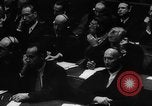
Nazi criminals are questioned during the Nuremberg Trials in Nuremberg, Germany.
Events related to the Nuremberg Trials held at the Palace of Justice (Fürther Str. 110, 90429 Nürnberg, Germany) in Nuremberg, Germany. German attorneys defend the accused. One by one the accused are cross examined. Rosenberg is examined on the count of high mortality rate among Russian prisoners of war. Joachim von Ribbentrop is questioned about the military pressure on Russian from Germany. Goering is questioned about his knowledge of the policy to exterminate Jews. Speer testifies about negative things Hitler said about Goering in response to Goering's telegram suggesting that Goering took power in April 1945.
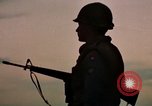
Visual saga of the American Soldier from 1945 to 1970: WWII; Korea; Berlin Crisis;Cuban Missile Crisis; Red China
Review of conflicts involving U.S. from World War 2 to 1970. A U.S. soldier with rifle and binoculars, on guard. German Chancellor Adolf Hitler speaks in Germany to mass audience. German mobilization and blitzkrieg. U.S. troops firing small arms on island in Pacific, battling Japanese. U.S. soldiers on half-track firing artillery. Explosive destruction of Nazi swastika and Eagle symbol on top of building in Zeppelin Field, Nuremberg, Germany. General Douglas MacArthur stands as Japanese General signs surrender documents aboard USS Missouri, ending World War II. Times Square in New York City on Victory over Japan Day (VJ Day) marking end of World War 2. American troops firing artillery and small arms in Korean War. Soviet leader Nikita Khrushchev speaking at the United Nations. Newspaper headlines about postwar Berlin Crisis. Soviet missiles on display in military parade in Red Square in Moscow, Russia, Soviet Union. Soviet General Georgy Zhukov and Nikita Khrushchev, at Kremlin, reviewing the parade. Cuban President Fidel Castro giving a speech. A newspaper headline reading: "Khrushchev orders removal of missiles" ending the Cuban Missile Crisis. Soviet cargo ship with covered missiles on its deck. Red flag with image of Lenin and message: 'Partido Communista Dominicano' and a crowd chanting support for the Communist party in the Dominican Republic. Communist Chinese people marching with massed flags in the People’s Republic of China. Chairman Mao Zedong waving to a crowd of young supporters and Red Guards in China as they chant. A United States soldier in South Vietnam during Vietnam War looks through binoculars and then walks carrying his M-16 rifle. A map of Vietnam.