


 Francais
 Deutsch
 Italiano
Refine Your Search
+"Nuremberg Germany" +1945 stock footage and images
- Showing 61 to 66 of 66 results more
more Hide
Hide
Robert G Storey addresses the Nuremberg Trials about art seized by Nazis and presents the catalogue to the judges.
Robert G Storey addresses the Nuremberg Trials in Germany. He talks about the vast quantity of art objects, paintings, scuplutres, and stolen artwork confiscated by the German Nazis and presents the 39 volumes list of the seized art. Judges examine catalogues. Justice Robert Falco. Storey says that if all stolen art objects seized by the Nazis were catalogued they would fill 350 to 400 volumes.
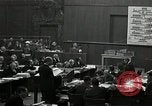
Robert G Storey addresses the court during the Nuremberg Trials in Germany.
Robert G Storey addresses the Nuremberg Trials in Germany. Lights put out in courtroom for slide to be shown. Storey explains chart on a wall showing advancement from'Hitler Youth' to 'SS'. Chart on the wall.
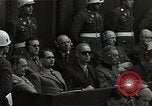
Major Walsh, U.S. prosecutor, reads original Nazi letters during the Nurembergn Trials, Germany.
Hermann Goering reads exhibit document during the Nuremberg Trials, Germany. Major Walsh, U.S. Prosecutor, reads the documentation on the removal of gold teeth and filling from the mouths of German Nad Russian Jews before their annihilation. He states that 516 Jews were killed. He starts to read the covering letter part of the document, consisting actions against Jews as subjects.
U.S. 3rd Infantry Division troops raise U.S. flag and exhibit parade at Zeppelinfeld in Nurnberg,Germany.
American soldiers raise a large U.S. flag to cover a German Swastika emblem on top of the Tribune at Zeppelinfeld in Nuremberg (Nurnberg),Germany. U.S. 3rd Infantry Division soldiers gather around the stadium in large numbers and exhibit a parade. Commander of the U.S. 7th Army Lieutenant General Alexander M Patch, Major General John W O'Daniel and other officers review the troops from the speaker's platform. (World War II period).
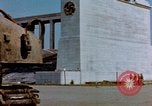
United States Airmen at Zeppelinfeld, Nuremberg, throw stones at Swastika on Zeppelinfeld,
Activities of United States Airmen in Germany after World War II. United States Airmen walking at Zeppelinfeld, Nuemberg, pause at colonnaded Zeppelintribüne grandstand. One throws stones at Swastika sign adorning the Zeppelintribüne. A truck passes by. on the memorial. The airmen climb stairs of the Zeppelintribüne grandstand. Heaps of bricks seen on the stairs. An American airman picks up a paper from stairs and reads it. The airmen look at the street from the grandstand. A truck parked on the street. The Zeppelinfeld seen in front of the Zeppelintribüne. Two airmen hold another airman and they pretend to throw him on the ground. The airmen sit and chat. A formation of American P-51 fighter aircraft flies overhead and planes start peeling off from the formation.
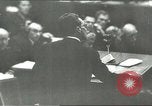
Concentration camp atrocity scenes and testimony by Rudolf Hess during Nuremberg trials regaring extermination of Jews
During Nuremberg trial Nazi leader Rudolf Franz Ferdinand Höss (sometimes spelled Höß or Hoess or Hess), the first commandant of Auschwitz concentration camp, describes the final extermination of Jews at concentration camps in Germany. Scenes of inmates and slave laborers filing past prison wire in a prison yard, wearing prison uniforms. Young children prisoners filing past and some showing tattoos on their arms. Scenes of gas chambers, piles of dead bodies, piles of gold teeth extracted from bodies, scenes of emaciated atrocity victims barely alive, and dead bodies removed from concentration camps and buried in mass burial trenches by German citizens and POW soldiers after liberation of the camp in World War 2.