


 Francais
 Deutsch
 Italiano
Refine Your Search
+"Pacific Theater" +1944 stock footage and images
- Showing 91 to 96 of 210 results more
more Hide
Hide
Brief wartime scenes from Pacific Theater during World War II
First scene shows a raging fire on an island in the Pacific during World War 2. Next, the dense smoke cloud is seen from a boat offshore as it covers all of the sky. A landing ship Tank nearby is silhouetted against the light sky. U.S. medics are seen bending a wounded soldier lying on the ground, as they administer first aid to him. Change if scene shows natives preparing to dig a dead soldier out of mud. U.S. Marines push wounded away from a shore on an inflated raft. Natives help a blinded Australian soldier wade through water and mud in jungles of Papua New Guinea. Australian soldiers, in rain gear, stand in a battlefield graveyard containing several rustic crosses. One of them reads from a document, as the others stand with heads bowed. Closeups from camera panning around the group of soldiers. Next, one is seen reading from a small prayer book. More closeups from various views of the mourning soldiers.

People cheer as the members of the WAC arrive at a harbor in the Pacific Theater.
The American Army women, Women Army Corps (WACs) serving on all fronts. Army aircraft parked at an air base in Arizona. The WAC mechanics working and servicing the airplanes. Several aircraft parked on the air base. WACs seated at the air base. WACs aboard a ship arrive at a harbor. People and officers gather at the harbor to greet them. Women waving towards them. They disembark from the ship. People cheering. An officer holds a board which reads: Welcome WACs'.
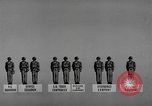
Functions and workings of Air Force Service Group in the Pacific Theater during World War 2.
A film on the workings of the Air Force Service Group. Their role in keeping remote air force landing strips supplied and in repairing and salvaging damaged airplanes and equipment during World War II is demonstrated. A diagram depicts the workings of an Air Service Center. The center is a nine men team. Each man is an expert in some field. The functions of the center are explained. The center handles the supplies, repairing of vehicles and equipment and communication to and from the center. Men seated outside a tent in the center. Airplanes flying in formation overhead. Men looking at the airplanes. Men working for the center are motor experts, electrical experts and parachute experts. Medical services are also provided at the center. A man stands holding a rifle. A special light mobile unit is also shown as it works to repair or salvage parts of an aircraft at its crash site. U.S. Army soldiers at the Air Service Center line up to receive pay on pay day. A canteen area is shown where soldiers can buy coca-cola and other refreshments. P-40 Warhawk aircraft parked on a field. A chaplain conducts a religious service for soldiers, with a Mitchell B-25 bomber aircraft parked behind him. A wounded soldier being unloaded from an airplane and treated by the medics who arrive on site. A mobile surgical team prepares a soldier for surgery in the field.
Battle between U.S. Marines and Japanese soldiers at Bougainville Island, Pacific Theatre, World War 2
U.S. Marines climb up a hill between trees and throw grenades at a enemy Japanese position on Bougainville during World War 2. Wounded or dead American soldier lying on ground. Soldiers looking at fire on the hill. Helmet covered with camouflage netting lying on ground. U.S. Marine operating a flamethrower directing flame at Japanese position. Japanese equipment scattered around dead Japanese soldier. A U.S. soldier talks over telex phone. Remains of Japanese men and artillery captured in dug out. Japanese on hilltop, soldier view pill box, another soldier discovers a mine and removes it. Shells lying on ground. Soldiers walk down the road.
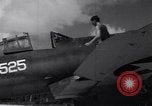
Pilot and plane captain of F4U aircraft perform engine start during World War II in the Pacific theater
Location looks like Espiritu Santo in the New Hebrides Islands, during World War 2. Palm trees in background. The weather is clear and sunny. Plane captain, in shorts, climbs into cockpit of an F4U corsair airplane of Marine Aircraft Group 11 (Number 525 on fuselage). Marine pilot hands him his seat pack parachute, which the plane captain places into the seat. The pilot climbs into cockpit, as plane captain stands on right wing and gives thumbs up for engine start. The engine does not start, so he walks along wing to check the engine. The scene is repeated, with plane captain scrambling over the fuselage again to a position on the wing for engine start. This time the engine starts. He clambers back to cockpit and helps pilot with his shoulder harness. Another view of this shown in closeup from left wing of the aircraft. View from in front of the aircraft, as engine starts, and plane captain steps up to help pilot with shoulder harness.
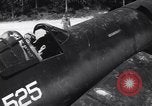
U.S. Marine Corps F4U aircraft returning from missions in Pacific theater in World War II
Location is probably Espiritu Santo in the New Hebrides Islands, during World War 2.The day is clear and sunny and palm trees are seen in background. Pilot sits in cockpit of Marine Aircraft Group 11 F4U Corsair airplane number 525 after returning from a mission. Plane captain, in shorts, climbs up to cockpit and gives the pilot a booklet in which he makes notes regarding any aircraft problems.He hands the booklet back to the plane captain and climbs out of the cockpit. He unfastens the chute leg straps and carries the chute in his arms. Scene shifts to another F4U that has just parked and is shutting down it's engine. Plane captain climbs up to the cockpit. A crew truck pulls up and a ground crewman picks up a parachute and places it on the truck fender.