


 Francais
 Deutsch
 Italiano
Refine Your Search
+"Pacific Theater" +1945 stock footage and images
- Showing 115 to 120 of 211 results more
more Hide
Hide
A U.S. Coast Guard photographer on Coast Guard operated APA and troops ready to board an LCT during World War II
Activities aboard U.S. Coast Guard operated Landing Ship Transport (LCT) and Attack Transport Ship (APA) in the Pacific Theater during World War 2. A Coast Guard Chief Petty Officer Photographer, carrying a tripod and case, comes up to a gangway, he stops and then walks up the gangplank of the ship. He salutes the colors and then Officer Of the Deck (OOD). The deck of Attack Transport Ship (APA). Sailors lean against the rail. Another view of the photograper arriving, this time from the deck of the APA. U.S. troops in full battle gear, prepare to board Landing Landing Craft Tank (LCT- 1031) on a beach in the background. A gun tub on the bow of the LCT. Several men in the gun tub. Marines without packs go up a gangway to board the transport. OOD and marines pass in the foreground. A man walks up the gangway carrying a mail sack. The gangway removed from the pier. Personnel aboard look over side of the APA from the rails. The photographer sits with sailors and photographs the departure. Several sailors on the pier mug for the camera.
Japanese troops surrender in Singapore, Hong Kong, and Nanking China at end of World War 2
Victory over Japan at end of World War 2. Japanese troops surrender Singapore and Hong Kong to British troops in Pacific Theater. Aerial view of city in Singapore. Allied ships in nearby harbor. Allied soldiers of Britain landing and marching on streets in Singapore. Next scene shows ships of British fleet seen in waters at Hong Kong. Low-flying aerial views of port areas and buildings of Hong Kong. British Navy combat teams move from building to building in small groups, flushing snipers from alleys, streets, and buildings. A British soldier rests a Bren light machine gun on an elevated porch and fires at an enemy sniper position. Several Japanese soldiers surrender to British forces. Next scene is in Nanking, China. View of officials gathering in Nanking for Japanese surrender ceremony at the Central Military Academy, which had been the enemy Japanese headquarters during the war.
Wounded soldiers treated aboard hospital ship USS Bountiful (AH-9) during Pacific campaign of World War 2
Portrays the suffering of wounded U.S. soldiers in action during a Pacific campaign in World War II. Shows naval air transport plane in action for transporting severe cases to hospital in the Pacific Theater. Wounded soldier being carried on a stretcher. Wounded soldiers loaded aboard army transport aircraft parked on an airfield. Wounded soldier lying on stretchers and beds aboard hospital ship USS Bountiful (AH-9) at anchor off the coast. Nurse and doctor examine wounded men. A wounded soldier gets a head massage. Operation theater aboard hospital ship and soldiers with severe wounds on arms and legs being operated by surgeons. Patient on wheel chair being pushed on deck of USS Bountiful. Wounded soldiers on deck of ship relax and smoke. Blood stained faces of soldiers.
Aguiguan Island south of Tinian. P-38 in flight. Fleet at Ulithi anchorage in Caroline Islands. World War Two.
Scenes from Pacific theater during Second World War. Aerial view of Aguiguan Island south of Tinian Island in the Mariana Island chain. Aerial views of the Caroline Islands in vicinity of Ulithi atoll. A U.S. P-38 lightning fighter plane aloft near clouds. Aerial views of the U.S. fleet at anchor near Ulithi atoll.
Seabees unload supplies from LST as fire burns fiercely on deck of LST as it underway in the Pacific Ocean.
U.S. Navy Seabees (Construction Battalion) work on beachhead in the Pacific Theater during World War II. Seabees unload supplies from LST (Landing Ship Tank) at a beach head. Seabees on ramp of LST. They pull supplies for a constructing bridge. Fire burns fiercely on the deck of LST as it underway. Two LSTs underway.
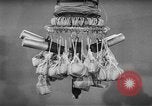
United States Navy technicians set up attachments in the fire balloon used to attack on North America during World War II.
Demonstration of the Japanese Paper Balloon or fire balloon bomb used to attack North America in the Pacific Theater during World War II. A United States Navy technician demonstrates the set up of the attachments in the Japanese paper balloon or fire balloon. He sets up the demolition block and connects the plugs. He demonstrates the wire connections of the aneroid. Animation depicts the rise up and descend of the balloon in air as the fuse burns and plug blows. United States Navy technician explains the diagram showing mechanism of battery, starter fuse, blowout switch, fuse leads, blow out plugs and the aneroid box.