


 Francais
 Deutsch
 Italiano

Refine Your Search
+"Pacific ocean" +1942 stock footage and images
- Showing 85 to 90 of 103 results more
 Hide

U.S. B-25 Mitchell bombers take off from USS Hornet (CV-8) for Doolittle Raid on Tokyo in World War II.
Start of Jimmy Doolittle Raid on Tokyo, Japan, during World War 2. Ship's lookout silhouetted against sun. B-25 taking off from the USS Hornet (CV-8) in overcast weather. Choppy seas. Admiral William F. Halsey in foul-weather gear on bridge. B-25 takes off from the Hornet. Admiral Halsey's face framed by foul-weather gear. Many B-25"s taking off from the Hornet. Army sergeant sending a salute to the planes aloft as Army private (wearing earphones) stands by. Sailor (in peacoat and watch cap) waving goodbye to Doolittle fliers.Two mess attendants waving goodbye and good luck. Two sailors waving goodbye; one carries signal flag.
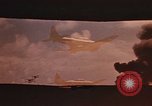
Aftermath of the Battle of Midway in World War II
Views of U.S. Navy pilots, their aircraft, and aftermath of Japanese bombing of Midway Island, in World War 2. Opening scene shows a formation of U.S. Navy Douglas Dauntless aircraft in flight. A U.S. Navy pilot climbs from the cockpit of an F4f Hellcat airplane on the deck of an aircraft carrier. His aircraft displays symbols for two Japanese aircraft downed. Another pilot in cockpit of his airplane that displays symbols for 7 downed Japanese aircraft. He climbs from his cockpit. Other pilots climbing out of their aircraft. One displays symbols for 6 kills. Three of them pose in front of an airplane. Scene shifts to Midway Island where a hangar is still burning from Japanese bombing. Glimpse of Gooney birds. Sentries stand on the airfield, with black smoke rising in the background. Closeup of wing from a downed Japanese airplane. Marines look through tangled pieces of crashed airplanes. One leans on a bent propeller blade. Heavy black smoke from petroleum fire is seen in background. Scene shifts to a PBY Catalina flying boat in flight, searching for survivors of the Battle of Midway. A U.S. Navy aircraft is seen floating in the sea, as a Navy warship heads toward it. A survivor is seen being helped from a PBY aircraft. Earlier picture of him smoking a cigarette inside the PBY aircraft. Sailors help him to a waiting ambulance. Other rescued survivors are seen standing about. Sailors place a litter aboard a PBY and use it to transport another survivor to sick bay. (Narrator states this is the 13th survivor rescued by the pilot of this PBY Catalina.) Ambulatory survivors being covered with blankets as they sit in the back of an ambulance, that then drives away with back door still open. Views of destroyed hospital on Midway Island. Red cross markings on are shown in the debris.
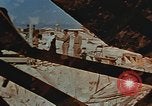
U.S. Navy and Marine personnel recover after the battle of Midway in World War II
Recovery actions by U.S. Navy and Marine personnel in the wake of the Battle of Midway in World War 2. Opening scene shows religiious services being held by a bomb crater that had once been a chapel on Midway Island. That evening, marines are assembled near flag-covered coffins of fallen comrades, in a burial ceremony. A marine chaplain conducts a funeral service, as Marines stand, with their rifles, at parade rest Several views from different perspectives of the event. An honor guard fires a volley with rifles. The American flag is at half staff, in the background. Among the officers seen is Marine Major James Roosevelt, son of the U.S. President, Franklin Roosevelt. Next, Navy boats are seen offshore, carrying the fallen for burial at sea. U.S. Navy aircraft fly in formation overhead. A marine scans the sky with binoculars as dense black smoke continues to billow from the petroleum facility bombed by the Japanese several days ago, and hangs like a pall over Midway Island. The American flag on a tall pole, is highlighted against the black smoke. Film ends with series of Slates summarizing Japanese losses in the Battle of Midway. The first shows 4 Japanese Carriers sunk. It is painted over by a brush containing red paint. Another slate announces 28 Japanese Battleships, Cruisers, Destroyers sunk or damaged. A paint brush places a large black cross over that slate. A final slate states 300 Japanese aircraft destroyed. The red paint brush appears again, but this time it marks a big “V” for Victory across the slate.

Sailors at work inside 8-inch gun turret of the USS Chicago (CA-29) during World War II
Sailors stripped to the waist, working in a triple 8 inch 55 caliber gun turret of the American Cruiser USS Chicago (CA-29) in the Southwest Pacific, during World War 2. They bring up and load 8-inch shell followed by gunpowder charges, for one of the three guns in the turret. After firing, they repeat the process. Closeup as they open the gun breech, insert a metal chute to guide the shell and follow it with two propellant charges. Interesting view looking upward from below the gun as the sailors repeat the process. They step back briefly, as the gun fires. Next, sailors are seen below deck, partially rolling shells into a lift and sending up to the gunners.

United States sailors operate machinery inside the engine room aboard USS Chicago in Southwest Pacific.
Activity aboard USS Chicago in Southwest Pacific. United States sailors operate machinery in the engine room of the ship. A sailor looks into periscope eye and turns a wheel. Another crew man wearing headphones checks equipment and speaks over a mouthpiece. A group of sailors lifts a lid and takes out shells from it.

United States sailors load shells on the shell board of a 20mm gun aboard USS Chicago in Southwest Pacific.
Activity aboard USS Chicago in Southwest Pacific. United States sailors aboard USS Chicago look through binoculars. A sailor rotates turret of a 20mm gun and fires. Crew members load shells on the shell board of the gun. (World War II period).