


 Francais
 Deutsch
 Italiano
Refine Your Search
+"Papua New Guinea" +1944 stock footage and images
- Showing 19 to 24 of 71 results more
more Hide
Hide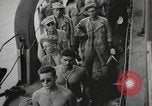
Allied soldiers eat food and clean mess gear aboard a ship underway in the Pacific Ocean heading
Allied troops aboard a ship heading towards Manus Island in Papua New Guinea during World War II. Allied soldiers in a mess line aboard the ship underway in the Pacific Ocean. Mess gear in the hands of the soldiers. The soldiers eat chow. Tablets on a table. One being given to each soldier. The soldiers eat food. They clean the mess gear aboard the ship.
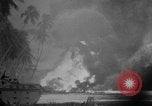
Brief wartime scenes from Pacific Theater during World War II
First scene shows a raging fire on an island in the Pacific during World War 2. Next, the dense smoke cloud is seen from a boat offshore as it covers all of the sky. A landing ship Tank nearby is silhouetted against the light sky. U.S. medics are seen bending a wounded soldier lying on the ground, as they administer first aid to him. Change if scene shows natives preparing to dig a dead soldier out of mud. U.S. Marines push wounded away from a shore on an inflated raft. Natives help a blinded Australian soldier wade through water and mud in jungles of Papua New Guinea. Australian soldiers, in rain gear, stand in a battlefield graveyard containing several rustic crosses. One of them reads from a document, as the others stand with heads bowed. Closeups from camera panning around the group of soldiers. Next, one is seen reading from a small prayer book. More closeups from various views of the mourning soldiers.
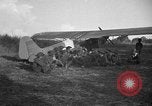
Indian Punjab soldiers freed from Japanese prison camp are interviewed by Australian soldiers in Senai, New Guinea, during World War II
Indian Punjabi soldiers freed from Japanese prison camp, are seated in shade under wing of a U.S. Army Air Corps L-4 Grasshopper airplane, at an air field in Senai, Papua New Guinea, during World War 2. They are being interviewed by an Australian Sergeant and an officer. The Punjab former prisoners have been provided uniforms including ranger hats. (They have short hair and no beards, so they may include Sikhs, Dogras, Pathans, and Punjabi Muslims, but haven't yet obtained material for their traditional turbans.) The Sergeant makes notes and sketches on a pad as the escaped POWs provide information about their experiences and information of possible value regarding Japanese forces. Scene shifts to the Punjab soldiers sitting in a grass-roofed hut, with the native Chief of Senai. Several of them sit in in front of the hut, smoking long-stemmed native pipes. The Senai Chief poses with a Punjab Sergeant. Two Stinson L-5 airplanes take off from the Senai field. A group of liberated prisoners prepares and eats a meal.
U.S. Army Air Forces light Grasshopper aircraft on a reconnaissance mission on Bougainville during World War II.
U.S. and Japanese forces battle during the Bougainville Campaign of World War II. A U.S. Army Air Forces Grasshopper light aircraft takes off to conduct a reconnaissance mission against Japanase forces who hold part of Bougainville, New Guinea. The aircraft in flight over difficult terrain, flying slowly at tree-top height. The pilot spots Japanese positions and radios the ground forces. U.S. artillery is positioned and fired. They blast revealed Japanese positions. Infantry units land near the Jaba River and progress to clean up isolated Japanese troops. A Grasshopper in flight overhead.
Battle between U.S. Marines and Japanese soldiers at Bougainville Island, Pacific Theatre, World War 2
U.S. Marines climb up a hill between trees and throw grenades at a enemy Japanese position on Bougainville during World War 2. Wounded or dead American soldier lying on ground. Soldiers looking at fire on the hill. Helmet covered with camouflage netting lying on ground. U.S. Marine operating a flamethrower directing flame at Japanese position. Japanese equipment scattered around dead Japanese soldier. A U.S. soldier talks over telex phone. Remains of Japanese men and artillery captured in dug out. Japanese on hilltop, soldier view pill box, another soldier discovers a mine and removes it. Shells lying on ground. Soldiers walk down the road.
Wounded soldiers at Bougainville carried on litters to C-47 aircraft via an ambulance during WWII.
U.S. soldiers crawling through underbrush during Bougainville campaign in World War 2 against the Japanese. American soldiers carry injured soldiers. Wounded US soldier or Marine lying on litter, using helmet for pillow. Soldiers squatting in forest. Loading wounded on litters into ambulance backed up to a plane. Soldier walks towards jeep with "Operations Officer - Acorn l3". Ambulance on field. Ambulance backed up to open door of C-47 loading wounded on plane. Two soldiers rest in the shade of a C-47 wing. Wounded soldiers lie inside medical evacuation aircraft.