


 Francais
 Deutsch
 Italiano
Refine Your Search
+"Paris France" +1945 stock footage and images
- Showing 1 to 6 of 133 results more
more Hide
Hide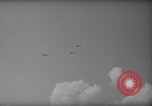
French POWs and repatriated civilians arriving at Le Bourget Airport in Paris, France, near end of World War II in Europe
Repatriation of French war prisoners and civilians in Paris, France toward the end of World War Two. Three U.S. C-47aircraft in flight approaching the Le Bourget airport. A fleet of U.S.Army Air Forces C-47 aircraft parked on the ramp and some taxiing. Ambulances and vehicles are positioned on the ramp as repatriated French soldiers deplane. Soldiers with their belongings moving in loose formation along the ramp. A C-47 taxiing. Its tail number is 42-24174, belonging to the 34th Troop Carrier Squadron, 315th Troop Carrier Group, of the U.S. 9th Air Force. An Air France JU-52 passenger aircraft is parked on the ramp, and civilians deplane, including Marcel Bloch, a French aircraft builder,who had been imprisoned in the Buchenwald Concentration Camp, until April 11, 1945. (He later changes his name to Dassault, which will also become the name of his aircraft company, after the war). Also among the passengers is Marcel Rene, director of the French paper 'Resistance.' Several views of the aircraft's pilot and the civilian passengers.
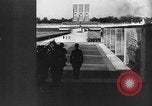
Nazi Party ceremonial grandeur is contrasted to the horrors perpetrated under the 3rd Reich
6th Nazi Party Congress at Nuremberg, in 1934, featuring a "Totenehrung" ceremony, honouring dead. Nazi SA ( Sturmabteilung) and SS (Schutzstaffel) troops in precise formations fill the Zeppelin Field Luitpold Arena, leaving only a wide pathway to the Ehrenhalle war memorial. View from behind honor guard standing at the Ahrenhalle, as Adolf Hitler, flanked by SS leader, Heinrich Himmler (in Black) and Viktor Lutze, head of the Sturmabteilung (SA), approach. Three huge banners with swastikas are seen in the far background. Scene shifts to 1945. American troops are now assembled at the main grandstand (Ehrentribüne) of Zeppelin Field. The American flag covers the wreathed swastika sculpture at the top of the Grandstand. View of German soldiers, who have been mustered out, mingling with civilians in a town. Some speak with an American soldier, who is part of the U.S. occupying force. Scene shifts to the Yalta conference in February, 1945. Winston Churchill, Franklin D. Roosevelt, and Joseph Stalin are seen seated while their most senior military staff members stand in the background. Allied leaders sit around a large conference table. U.S. Secretary of State James F. Byrnes, sits near Prime Minister Winston Churchill. Scene shifts back to Nazi era. Joseph Goebbels, Reichminister of Propaganda is speaking and haranguing a crowd. In contrast, German soldiers are seen conversing with occupying American soldiers. This is contrasted with more scenes of Nazi leaders giving impassioned speeches to a hall filled with Nazi faithful. German soldiers, prisoners of war are seen directed by U.S. military police, behind a barbed wire enclosure. Large numbers of German prisoners of war in an open holding area. Closeups of some. Bucolic scenes of farmers working in fields and herds of sheep and cattle. Hitler speaking in a forceful, animated way and haranguing an audience of rapt listeners. German civilians standing quietly in a group. (Narrator refers them being the people of Beethoven, Goethe, and Martin Luther, as statues of those iconic Germans are shown.) In dramatic contrast, numerous dead bodies of victims are being shown to German citizens by American troops, at Nordhausen, Buchenwald, and Bergen-Belsen concentration camps. This is contrasted against views of German people folk dancing in traditional costumes, German contributions to science (view of Albert Einstein speaking) and industry (view of professional glass blowers at work). Glaring contrast shows German civilians moving the body of a concentration camp victim; several civilians being shot dead by a firing squad (unseen); Rudolf Himmler; and an image Germany being destroyed, as result of the Nazis. American soldiers are loosely assembled in an open field. by the Elbe River at Torgau, Germany on 26 April 1945. American and Russian officers greet each other at the site, where their armies have met in World War 2. American and Russian soldiers mingle and greet one another. Views of Allied forces entering Germany. Another scene of victims' bodies stacked at a concentration camp. French soldiers examine stake where prisoners were tied and executed in the Gestapo headquarters on Paris France. Other views of the Gestapo prison, where victims were buried. Examples of torture devices used to coerce information from prisoners. More views of stacked bodies of victims. Germans carrying bodies from a concentration camp. General Dwight Eisenhower and General George Patton visiting the Ohrdruf Concentration Camp. Burned remains of victims. Closeup of General Patton. German officials and citizens confronting horror as they are compelled to walk through the camp. A huge wagon loaded with bodies of the dead. German women appalled and repelled by the sights. Countless numbers of dead victims covering a large courtyard. German citizens compelled to carry body of a victim from the yard. Others carrying bodies of victims. Large numbers of German citizens, seemingly shamed and remorseful at the revelations. A group of German men carrying shovels and others carrying crosses to commence burying the victims appropriately. Men carrying victims bodies in open wooden caskets along a road lined with spectators. Coffins of victims laid out in a cemetery. (Narrator alludes to them never forgetting.) German men gently place covered coffins in a long mass grave.
Events of World War 2, and creation of United Nations Organization following the surrender of Germany and Japan
Summary of World War II events and formation of the United Nations Organization. Soviet troops on Eastern Front of Europe fire artillery on German positions in 1944. Russian troops advance. German soldiers come out of buildings and surrender. Allied Forces land in France on D-Day. Allied troops and tanks fight Germans on streets in towns and villages of France. U.S. Army tanks fire at German positions. Various groups of German prisoners of war march along roads and are herded into prison camps operated by American and British forces. In 1945, the Allied leaders meet at Yalta on the Crimean Peninsula to discuss Allied military strategy in the final months of WWII. Leaders included British PM Winston Churchill, U.S. President Franklin D Roosevelt and Soviet Premier Joseph Stalin. The meeting of U.S. and Soviet Russian troops at the Elbe River. German Nazi Swastika symbol blown up in explosion atop Zeppelinfeld Nazi party rally grounds in Nuremberg. Aerial view of Berlin in ruins, as seen from low-flying aircraft flying directly over the Unter den Linden boulevard and the Brandenburg Gate. Wrecked and bombed German buildings seen everywhere. German officials signing surrender instrument at Rheims. U.S. President Harry S Truman, Winston Churchill and Joseph Stalin at Potsdam Conference. U.S. Marines battling on beaches of Pacific Islands. Iconic shot of U.S. Marines raising the American flag on Mount Suribachi at Iwo Jima. Aerial view of bombed and ruined city of Tokyo, Japan. The Japanese surrender to MacArthur aboard the battleship USS Missouri. General MacArthur speaks aboard Missouri. Victory celebrations all across the world, with some scenes from earlier V-E Day (Victory in Europe) day in May 1945, including crowds celebrating in Paris, France, and some scenes on V-J Day (Victory over Japan day) in August 1945. Crowds on streets celebrate. Happy crowds jam streets. Delegates of Nations, among them Andrei Gromyko and Vyascheslav Molotov meet in San Francisco and create a United Nations organization. Truman arrives at signing of UN charter. Various delegates sign charter. U.S. troops disembark troop carrier ships at U.S. ports and are discharged after completing military service in World War 2. Group of U.S. Army soldiers exits a church (the Chapel at Fort Dix, New Jersey), waving their discharge papers in hand.
Harry S Truman, Joseph Stalin and Winston Churchill discuss the problems related to Germany in Potsdam Conference, Berlin (WW2)
Question marks on screen. Reconstruction of the buildings and denazification in Berlin, Germany after World War II. A factory in Germany. A farmer leads a horse to plow a field. Men at a farm cultivate crops. The wreckage of the IG Farben plant. Men speaking to Hermann Göring. The trial of Norwegian leader and Nazi collaborator Vidkun Quisling. The rail goes on for the criminal. People burn Nazi books and pamphlets in a bonfire. A man burns a pamphlet with a photo of Adolf Hitler. The people stand around the burning books. German civilians read a poster on a wall. General Dwight D. Eisenhower of the United States, Marshal Georgy Zhukov of the Soviet Union, and Field Marshal Bernard Montgomery of the United Kingdom sign a joint agreement. The three of them stand together. The United States Capitol building. Chongqing National Government building in No. 232 Renmin Road, Chongqing (Chungking), China. The Big Ben in London, United Kingdom. Aerial view of the Arc de Triomphe in Paris, France. General Francisco Franco saluting to marching soldiers in Spain. The delegates including United States President Harry S. Truman, General Secretary of the Communist Party of the Soviet Union Joseph Stalin, and UK Prime Minister Winston Churchill seated around a table during the Potsdam Conference in 1945. They discuss the problems. A close up view of Truman looking into some documents. Stalin smokes a cigarette. The delegates discuss problems. The funeral ceremony of President Franklin D. Roosevelt. The soldiers fire guns. President Harry S. Truman attends the ceremony. Churchill salutes from a moving vehicle. Women voting in the United States. Truman gets off an aircraft. Delegates in the Potsdam conference. Newspaper headlines read Russian declares war on the Empire of Japan in 1945. The first atomic bomb explosion over Hiroshima, Japan. The newspaper headlines about the war. Truman, Stalin and delegates at the Potsdam Conference. Soldiers advancing in the battlefield. A flag of the United States and people celebrate the victory. Newspaper headlines feature the surrender of Japan.
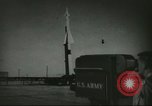
Atomic bomb scenes WWII; atomic testing at U.S. Army atomic experiment station 'Camp Desert Rock' in Nevada, United States
Episode of "The Big Picture", a U.S. Army series of news release programs. U.S. Army cameraman recording Nike missile launch. Atomic cannon fires shell creating atomic explosion and classic mushroom cloud.. Army troops spill out of Sikorsky YH-19 helicopters. U.S. Army infantry soldiers ascend hill firing their rifles. Atomic experiments at Camp Desert Rock in Nevada, United States. U.S. Army Master Sergeant Stuart Queen seated at a desk in his office. He speaks about a series of atomic experiments ("Desert Rock 6") held in barren lands of Nevada at Camp Desert Rock. Celebrating victory in Europe, during World War 2, American troops parade down the Champs Elysees in Paris, France, with the Arc de Triomphe behind them. Happy Parisians watch the parade. War scenes in Japan: footage of explosion and mushroom cloud rising after atomic bomb blast over Nagasaki on August 9, 1945. Barren land on the ground in Hiroshima after the August 6, 1945 atomic blast there . B-29 bombers in flight. Atomic bomb test detonation. Atomic artillery gun M65, also called the Atomic Cannon or Atomic Annie, fires and creates nuclear explosion on distant target.Viking missile launch. U.S. soldiers on parade. Headquarters sign at U.S. Army atomic experiment station at Camp Desert Rock, Nevada, displaying 6-pointed star with "A" in center.. Several atomic test explosions. Soldiers on hillside witness a non-nuclear explosion. Buses carry troops along a road past a sign warning of radiation hazard. Army captain, instructor, briefing troops before the start of atomic maneuvers.. Maps of planned maneuvers. Engineer surveyors lay out ground zero target. View of the ground zero area which is the target area for testing. Signal men lay communication lines to receive and transmit teletype messages. Men operate machinery and dig trenches in which troops will take cover. Other men cover them with sand. [Note: According to the U.S. Department of State, Office of the Historian, from February 18 to May 15, 1955, the United States conducted Operation Teapot, a nuclear test series at Yucca Flat and Frenchman Flat on the Nevada Test Site in the continental United States. During the test period 14 nuclear shots and 1 non-nuclear shot were detonated. Several thousand scientific, military (army, air force, navy, marines), and civilian contract personnel participated in the organization, planning, and execution of the test series. Military exercises undertaken during and following the shots took place under the name Desert Rock 6.]
1st Allied Airborne Army troops take off from a field in the European Theater during Operation Varsity of World War II.
A film titled 'First Allied Airborne Army in Operation Varsity, 24 March 1945' about the successful airborne crossing of the Rhine river by the 1st Allied Airborne troops during World War II. Aerial views of aircraft and gliders on ground in areas the narrator describes as East Anglia (England, United Kingdom) and in the Paris, France area. U.S. Army Air Forces C-46, C-47 aircraft and CG-4 gliders on a field. British Halifax and Sterling bomber aircraft. A glider with nose art name, "Texarkana Belle." U.S. Army soldiers of the U.S. 17th Airborne Division near the glider aircraft. Soldiers load equipment into gliders and aircraft. Jeeps, vehicles and other equipment loaded onto gliders. Airborne troops waiting near the aircraft, smoking cigarettes and talking as they await takeoff time. Aircraft lined up on a field. Troops put on gear and board the gliders and towing C-47 Skytrain aircraft. Propellers turn as towing aircraft prepare to take off. Men ensure slack lines are taken up properly and engage the gliders being towed. Aircraft tow gliders as they take off. Gliders and aircraft in flight and ground crews waving to the aircraft in the sky.