


 Francais
 Deutsch
 Italiano
Refine Your Search
+"Philippines" +1942 stock footage and images
- Showing 91 to 96 of 116 results more
more Hide
Hide
Japanese soldiers clean their weapons and prepare for an assault at Limay, Bataan, Philippines (WW2)
Japanese occupation of the Philippines following invasion during World War II. A map shows the various mountains of Bataan Peninsula in Japanese. Japanese infantrymen prepare for an assault on Bataan. Japanese soldiers clean their weapons. The infantry aboard a landing craft at Limay in Bataan. Groups of Japanese landing craft sailing to Corregidor Island.
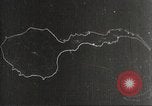
Destroyed trees, a sunken ship in a bay and wrecked U.S. forts due to battle in Corregidor, Philippines (WW2)
The Japanese invasion and occupation of the Philippines during World War II. A map of Corregidor Island. The map shows United States Army positions and the mission of each Japanese unit. Panorama of destroyed trees and installations. A sunken ship in Manila Bay. Damaged U.S. forts in Corregidor.
Japanese pilots lined up on airfield as troops advance through Bataan, Philippines during the Battle for Corregidor.
Japanese troops in Bataan, Philippines during the Battle of Corregidor of World War II. Japanese troops rotate propellers of an aircraft. Japanese pilots lined up on an airfield as they sing. Japanese machine guns fire. Tanks and infantry advance in the jungle of Bataan. A long line of infantry with pack mules moves up. Japanese aircraft in flight. Troops on truck in front of a damaged building. Explosions occur on ground.
Japanese fire knee mortars and rifles and launch Banzai attack in Corregidor island, Philippines during World War 2
Japanese troops in Corregidor island, Philippines during the Battle of Corregidor in World War II. Japanese fire knee mortars. Japanese snipers fire rifles in the jungle. Artillery being fired as Japanese infantry advance. Group of Japanese soldiers yelling a Banzai battle cry together from atop a mountain. U.S. prisoners standing next to a Japanese soldiers and a jeep beside a bridge.
Invasion of Corregidor by U.S. 503rd Air Regiment and 24th Division during World War II.
Battle of Corregidor fought between U.S. troops and Japanese troops in Corregidor, Luzon Island, Philipinnes during World War II. Japanese troops lower the U.S. flag and raise the Japanese flag after the fall of Corregidor in 1942. U.S. troops in Japanese prison camps. Invasion of Corregidor on February 16, 1945 by U.S. 503rd Air Regiment and 24th Division. A U.S. convoy underway at sea. U.S. naval battleships attack shore targets. Planes take off from an airfield. U.S. 503rd Air Regiment dropped by parachutes. Paratroopers land in Corregidor. U.S. 24th Division comes ashore in amphibious vehicles, troops land and fight their way inland.
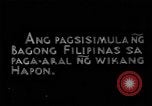
Filipino students study the Japanese language under Japanese Occupation (WW2)
Filipinos study the Japanese language during the Japanese Occupation of the Philippines in World War 2. Title card reads “Ang pagsisimula ng bagong Filipinas sa paga-aral ng wikang Hapon” (“The start of a new Philippines through learning the Japanese language” in English). A Japanese flag is displayed on a tall flagpole. Elementary schoolchildren performing physical exercises in front of a teacher playing a small piano. Schoolchildren form a circle around the teacher while dancing and singing. Schoolchildren enter school. Schoolchildren playing in the yard. Three Filipino boys sitting. A group of Filipino children sitting. Students crowd a school corridor. Children listen attentively to a teacher. A teacher writes in Japanese on a blackboard. Sign reads “Japan Cultural Hall Entrance- 219”. Young Filipino men and women attend a class in Nihongo (Japanese language). A Nihongo teacher teaches Japanese to Filipino adult students in a Japanese cultural center in Manila.