


 Francais
 Deutsch
 Italiano
Refine Your Search
+"Philippines" +1942 stock footage and images
- Showing 13 to 18 of 116 results more
more Hide
Hide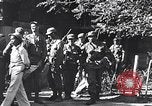
U.S. Rangers and Filipino guerrillas rescue Allied prisoners from Japanese prison camp in Philippines during World War II.
On January 30, 1945, 121 members of the 6th Ranger Battalion and 286 Filipino guerrillas are seen setting out on a 30 mile trek behind Japanese lines, to free Allied prisoners of war (POWs) and civilians from a Japanese camp near Cabanatuan City, in the Philippines, during World War 2. They stretch out in a long, informal column as they traverse low flat lands and ford a wide shallow river. The men carry weapons and supplies (some on their heads) as they move along, almost like a Safari. Scene shifts to rescued prisoner, Major Emil P. Reed, U.s. Army Medical Corps,26th Cavalry. He was the senior officer among prisoners at the Cabanatuan prison camp number 1. He recounts being told by the Japanese Commandant that commencing January 7th, they were free at their own risk, but also assured them they would not be molested by the Japanese if they stayed within their regular camp area. Sergeant Samuel E. Goldy, Signal Corps, also speaks a few words about that period when Japanese were departing. Next the camera records the Rangers and Filipino guerillas returning with the approximately 500 freed POWs. Some Filipino women and children watch them return. At one point, the cadre climb aboard army trucks and continue their journey in a convoy. The POWs climb down from their trucks at the 92nd Evacuation Hospital, in Guimba, Luzon. Some take pleasure is simply lying down on the grass at the site. Many gather around hospital staff handing out packages of treats, including cigarettes, candy and the like. A couple of them express pleasure as they smoke cigarettes. Two frail and injured are seen hobbling with canes. Some appear seriously malnourished. A group are seen trying on new clothes. A British prisoner, Sergeant Robert Bell, Manchester Regiment, British Army, speaks of his experience. He was taken prisoner in Singapore and sent to Thailand where he worked to build a railway for the Japanese. Many prisoners died there from disease and malnutrition. He was one of a small number who survived after being on a Japanese ship with other prisoners when it was sunk by American dive bombers. Sergeant Walter Ring, of San Roque, Luzon, is seated, relaxed on a chair, as he recounts his experiences. Two young Filipino boys sit on the grass at his feet. He reaches to one, whom he says is his son Louis and to the other, his son Sam. His captivity began on Bataan in 1942. Finally, after rest and rehabilitation, the former POWs are seen heading away from the battle fronts to be transported back to the U.S.A.
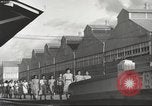
Filipino people going about their routine activities in the Philippines; Filipinos trained by American soldiers.
Part of a 1944 film showing scenes of Filipino people circa 1940, before World War 2. At opening, Filipino women are seen walking alongside a row of factory buildings. A factory room filled with Filipino women dressed in white caps and white uniforms engaged in production at individual individual work stations in a factory. A machine shop filled with Filipino men engaged in metal work. Several people at the window of an office, conducting business with a woman inside. A stock or commodities market office with quotes on tote boards. Women working alongside a moving production line. A woman operating a fabric processing machine. Filipino miners pushing hopper cars of mined ore across a bridge. Miners riding on an engine pulling a train of hopper cars filled with ore from a mine. Filipino longshoremen handling cargoes on a wharf. Scene shifts to an open field where a number of Filipino men are being trained to use firearms during World War 2. One is being coached by an American soldier as he works with a Browning M 1917 water cooled machine gun. Lines of Filipino men firing rifles under supervision of U.S Army trainers. A contingent of uniformed Filipino soldiers, led by an American soldier, marches past a sign, in an camp of tents, reading "A-T Company, 1st Filipino Infantry." Filipino soldiers at a tent camp, being instructed by an American soldier, using a large set of maps. Camera pans over a camp of many tents laid out in order. A formation of Filipino soldiers marches between tents. An American soldier opening his foot locker at his quarters. An illustrated portrait of General Douglas MacArthur. A formation in a field with a Filipino band playing and a Color Guard carrying the American and Filipino flags. A large group of Filipino children walking along a path. A Filipino boy lying on the floor in his home, reading a large book. Filipino school girls seated at benches next to tables. Women doing laundry at an outdoor pond. Next, an actor in khaki clothing sits in a tent and speaks as if addressing American soldiers regarding the Philippines. Among other things, he says,"These people aren't natives. They aren't beggars. They have cities and farms and industries.They have schools and courts and a Constitution. They also have pride and patriotism and self-respect. They love freedom They'll die for it." He cautions American soldiers about their behavior vis-a-vis Filipinos. He states that "Filipinos are American." He alludes to messages received from American and Filipino defenders in Fort Mills, at the fall of Corregidor on May 5, 1942. View of radio towers and worker in radio studio. Morse code messages heard as an American army radio operator with a headset transcribes the messages. Scene shifts to an amphibious invasion fleet attacking a Japanese held island in the Pacific.
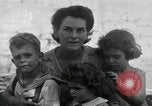
Margaret Moule, wife of William Moule, describes their life in Manila,Philippines during World War 2
Margaret Moule, the wife of William Moule, is seen along with her three children, Billy, Eileen, and Linda, late in World War 2. She describes how they hid from the Japanese in 1942, but were captured by the Japanese in 1943 and lived in a concentration camp in Manila, Philippines.
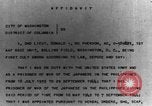
The Fall of Corregidor in World War II
Opening shows affidavits attesting to the authenticity of source films. Views of the island fortress of Corregidor, as Japanese troops occupy it while Americans and Filipinos stand with hands up, in surrender. Japanese and American Army officers having discussions. Scene shifts to Lieutenant General Jonathan Wainwright with members of his staff: Brigadier General Lewis C. Beebe; Lieutenant Colonel John R. Pugh; Major William Lawrence; and Major Tom Dooley, as they arrive at the Japanese headquarters building on Bataan to discuss surrender. They line up outside the wooden building and are saluted by the Commander of the 14th Japanese Imperial Army, General Masaharu Homma, as he climbs the steps of the building. Next, the Americans are seen seated at a table on the porch, opposite General Homma, who has General Wachi at his left and Colonel Nakayama, to his right. Reporters, an interpreter, newsreel camera men and others are also on the porch. General Homma and Wainwright discuss surrender. (These discussions proved fruitless, as Homma demanded surrender of the entire Philippine Garrison, and Wainwright tried to avoid that, citing lack of authority. Accordingly, Homma curtailed the meeting, and Wainright and staff returned to Corregidor, where, on May 6, 1942, he finally surrendered all forces in the Philippines to Japanese Colonel Sato, commander of the 61st Infantry.) Camera outdoor pans over Corregidor Island. Scenes of prisoners standing in the so-called Garage area of Corregidor, where American and Filipino POWs were interred, following their surrender on May 6th. The remainder of the film shows various scenes of POWs on Bataan, moving under Japanese guard. A makeshift sign points the way to Mariveles, where the infamous Bataan Death March commenced.
2nd Sino-Japanese war, precursor to World War II in the Pacific. Pearl Harbor attack. Early phase of Pacific conflict between Japan and the U.S.
The film 'Sea power in the Pacific' showing Japanese dominance in China and at start of World War 2. Then it chronicles U.S. efforts to build Navy and fight back on sea and in the air. Opening scene shows Japanese Mitsubishi G3M (Type 96) bombers high overhead, and then closeup in formation. View from bomber of bomb bays open with bombs falling and view from ground of explosions and destruction. Overlay on film says: "China---1931." (This is not correct. The G3M bomber was not yet in service.) This film depicts Japanese attacks during second Sino-Japanese War, commencing 1937, Chinese civilians running to escape Japanese bombing of Singapore. Buildings destroyed and on fire. Next, Japanese troops, carrying the Rising Sun flag, are seen establishing a beachhead in an Amphibious assault. More scenes of Japanese infantry advancing through Singapore, ad it is being destroyed and burned. Soldiers charging along an alleyway, with pagoda in background. Next, Japanese soldiers are seen attacking Nanking, and committing atrocities and killing Chinese during the so-called "Rape of Nanking," in December, 1937. Chinese civilians being summarily shot and dumped into a large open grave after execution. Two Chinese prisoners with hands bound, being executed by rifle fire. Jubilant Japanese troops celebrating their victory. Map shows areas of China occupied during second Sino-Japanese war and the East Indies to the South. View of oil tanks; an open pit tin mine; a native cutting rubber tree bark to collect latex. Flags on map show regions of English, French, and Dutch colonial interest. It also shows Islands to the East, fortified by the Japanese. Cartoon shows Japanese soldier opposed by and American sailor (representing U.S. Sea Power). Next, famous images of the Japanese attack on Pearl Harbor, Hawaii, December 7, 1941, are shown, including the USS Arizona burning and sinking. Hawaii, Midway, Wake, and the Philippines Islands, are highlighted on a map and Japanese control of the Pacific is illustrated. Japanese soldiers are seen displaying a captured American flag. U.S. Lieutenant General Jonathan M. Wainwright is seen surrendering the garrison at Corregidor, on May 6, 1942. View of Japanese General Masahara Homma discussing surrender terms with Wainright. Map shows interlocking web of Japanese fortified bases in Pacific and need for seapower to oppose it. View of American shipyard with hundreds of workers, employed to build ships for the war effort, in World War 2. Views welding, metal fabrication, and other shipbuilding activity. A new ship going down the ways and a woman christening a new ship with splash from bottle of champagne. A new "Liberty Ship," the Richard Bassett, going down the ways at Bethlehem-Fairfield Shipyard Inc. Baltimore, Maryland. Closeup view as the stern of another ship enters the water upon launching. View of it from a distance. Shipyard workers knock supports from under what may be a landing craft, as it is launched. Japanese warships underway in the Pacific and firing their naval guns. Explosions on a shoreline from naval bombardment. Japanese infantry wading ashore during an amphibious assault. Map shows where Japanese forces attempt an amphibious assault on Southern New Guinea, thwarted by the U.S. Navy in the battle of the Coral Sea of May, 1942. In June, 1942, a Japanese attempt against Midway Island, was again checked by the U.S. Navy in the Battle of Midway. View of USS Wasp (CV-7) carrier deck filled with airplanes, including Grumman F4F Wildcats. A Douglas SBD Dauntless dive bomber being cleared for takeoff from the Wasp. Gun camera film showing Japanese airplanes being shot down by pursuing U.S. aircraft.
The United States mobilizes and joins Allies in World War II. A montage of numerous World War 2 period images.
Film opens with views of goosestepping German, Italian, and Japanese soldiers during parade reviews in their respective countries. Emperor Hirohito, on a white horse. American battleships burning in the Japanese attack on Pearl Harbor. U.S. General Douglas MacArthur decorating a soldier in Manila, Philippines. Air raid sirens sounding in Manila and residents hurrying to take cover. Heavy black smoke rising from a bombed site and emergency vehicles responding and rushing to several bombed and burning locations. A burning rickshaw amidst other bombing rubble and bodies of victims. U.S. Army General MacArthur greeted by Australian officials at his headquarters in Brisbane, Australia. Sign reads: Headquarters UNITED STATES ARMY FORCES in Australia. American flag flying on tall flagpole. View from ship underway in supply convoy. A battleship seen on horizon and a destroyer passing the camera ship. U.S. President, Franklin D. Roosevelt signing the "Lend Lease Act" of 1941. A U.S. industrial plant with four tall stacks emitting smoke. A steam locomotive belching steam. A locomotive pulling an open car and some tank cars. New 1941 Plymouth automobiles coming off a production line. A new M3 Medium Tank in a U.S. factory. View of Liberty Ships, including the "Zebulon Pike" and the "Henry Knox" under construction at the California Shipbuilding Corporation yard, Terminal Island, California. U.S. Navy Destroyers constructed at Federal Shipbuilding & Dry Dock Company, Kearny, New Jersey. One is being launched, next to DD-446 (the USS Radford). A formation of U.S. Navy aircraft including Curtiss SBC Helldiver scout bombers and Douglas TBD Devastator torpedo bombers. A tight formation of U.S. Army Douglas B-18 Bolo medium bombers in flight. A formation of U.S. Army Curtiss P-36 Hawk aircraft in flight. Closeup of a U.S. Army Lockheed P-38 Lightning aircraft in flight. Several huge gun barrels for guns under construction at a U.S. war plant. Large artillery shells lined up in a manufacturing plant. U.S. Army M3 Medium tanks under construction at a factory. Steam and smoke rising from a U.S. industrial plant. Aerial view of open pit iron mine. Sparks shooting up inside a steel plant. A virtual "forest" of oil well derricks in the Western U.S. drilling for oil. Coal being transported by railway. View from stern of a warship in a convoy. An Atlanta-class light cruiser leading three destroyers at sea. Transport ships in convoys to places like Australia, Britain, and the Middle East. Troops on a pier near a large transport ship. A stack of wartime supplies on a pier next to a ship destined for Russia. Glimpse of wake from a U.S. warship having triple guns astern. Silhouette of a U.S. Navy Enterprise-class Aircraft carrier, with an aircraft taking off from her deck. The aircraft carrier, USS Saratoga. U.S. Army soldiers marching on parade, followed by numerous jeeps with machine guns mounted in their rears. Young men being drafted into the U.S. military. A draft lottery being conducted. New recruits doing calisthenics. Trucks pulling artillery pieces. B-18 Bolo bombers flying over U.S. tanks. Closeup of M3 tank. Cavalry fording a stream. Soldiers on motorcycles. Troops crossing a pontoon bridge. A loaded troop ship. A troop transport at Newfoundland. Sentry in Trinidad. Troops encamped in Bermuda. Troop transport ship docked in Greenland. Troops disembarking in Iceland. Formations of Curtis P-36 Hawk aircraft. Douglas DC-2 aircraft factory. P-36s with engines running. M3 tank suspended on factory crane. Exterior of Palácio Tiradentes in Rio de Janeiro, Brazil on January 15, 1942. U.S. Under Secretary of State Sumner Welles ascending the steps during Rio Conference of 1942. Officials of Pan American nations meeting there to declare their support for the Allies against the Axis nations. Sumner Welles speaking and declaring, "At this time the issue is clearly drawn. There can be no peace until hitlerism and its monstrous parasites are utterly obliterated." Scenes changes to montage of views of Allied troops including Dutch, Belgian, Yugoslav, Greek, Czech, Filipino, Polish, Norwegian, Free French, Australian, New Zealand, South African and Canadian soldiers. British warships. British Hawker Tempest aircraft. British commandos. Russian troops on parade. Chinese troops on the Great Wall of China.