


 Francais
 Deutsch
 Italiano
Refine Your Search
+"Philippines" +1942 stock footage and images
- Showing 19 to 24 of 116 results more
more Hide
Hide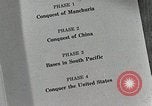
Japanese aggression in China and various events leading to Japanese attack on U.S. at Pearl Harbor (WW2)
A hand writes check marks beside “Bases in the South Pacific” and “Conquer the United States” on the summary report purporting to reflect phases of Japanese so-called "Tanaka Plan". Animated map shows pressure by German forces in offensive against Soviet Union and illustrates German air war against Britain. Scenes of bombing destruction in Britain, including overturned double-decker bus in ruins of buildings. A Nelson Class British battleship viewed from dead ahead. She is followed by the aircraft carrier HMS Illustrious. The U.S. Capitol building in Washington, DC. American newspaper headline reads: "Navy Bill Passes House." and "Huge Sum Voted for Two Ocean Navy." A line of U.S. Navy battleships underway, led by the USS Mississippi (BB-41). A field full of U.S. M3 Lee tanks moving in formation, as they are overflown by several Douglas B-18 bombers. Assembled Japanese leaders in a forum. Japanese Naval officers in a planning conference. Closeup shows Admirals Shigeyoshi Inoue and Raizō Tanaka pointing at a chart and conversing as other officers look on. Next, bomb bursts and black smoke rises as the attack on Pearl Harbor is underway. The USS West Virginia, USS Tennessee, and the USS Arizona, burning on Battleship row, during the attack. Generalissimo Chiang Kai-Shek with staff officers walks to a waiting car. Forces allied with China, including American troops marching; British troops marching; and Dutch Colonial troops marching (in Batavia, the Capital of the Dutch East Indies). Japanese troops continuing their conquest of China, firing a field piece, and infantry charging. Newspapers announce Japanese advances into Malay Peninsula and Hong Kong. Others cite the Fall of Singapore and the Fall of Corregidor in the Philippines (6 May, 1942). Animated map shows Japanese occupation encompassing Indochina, Thailand, and Burma (with loss of the Burma Road) all of which compounded China's war efforts.
The Pacific War Council and British and American General staffs meet at the White House in Second Washington Conference in World War II
Allies of the Pacific War Council met at the White House on June 25, 1942 Pictured with President Franklin D. Roosevelt and British Prime Minister Winston Churchill (both seated) and Canadian Prime Minister, Mackenzie King, standing immediately behind and between them. Others, standing behind are: Dutch Minister of Foreign Affairs, Eelco N. van Kleffens, Australian representative, Stanley Melbourne Bruce. The tall man behind Prime Minster King, is British Vicount Halifax (Edward Wood). To his left is Chinese Foreign Minister T.V. Soong, and Manuel L. Quezon, President of the Commonwealth of the Philippines. The last person standing at the right, is Walter Nash, New Zealand's minister to the United States. Scene shifts to military leaders of the combined British and American General Staffs, meeting in the so-called Second Washington Conference (Code named Argonaut). Closeup of U.S. Army Chief of Staff, General George S. Marshall, conversing with lieutenant General Henry H (Hap) Arnold, Commanding General of the U.S. Army Air Forces. Another closeup shows U.S. Navy Chief of Naval Operations, Admiral Ernest King, conversing with Admiral William D. Leahy, personal Chief of Staff to President Roosevelt. Glimpse of British Military General Staff members.
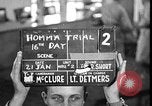
Major Tisdell talks about American surrender to the Japanese in 1942 during the trial of General Homma in Manila, Phillipines.
U.S. Army Major Achille C. Tisdell testifies before a military tribunal in Manila, Phillipines during the trial of Japanese Army General Masaharu Homma for World War II crimes. Major Tisdell, aide-de-camp to Commanding General of the American forces in Luzon Major General Edward King, speaks about the American unconditional surrender in Bataan before the Japanese forces. He recalls that an interpreter told American Commanding General Edward King to get U.S. Army General Jonathan Wainwright. General King expressed that there were no means to contact General Wainwright. He says that General King presented four conditions of surrender to the Japanese that included his return to the headquarters to notify the surrender and a 12 hour armistice. But Japanese declared that the surrender must be unconditional. General King asked if U.S. troops would be well treated. The Japanese replied that they were not barbarians.
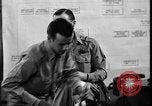
Major Tisdell says that U.S. officers were disarmed after American surrender in 1942 in Manila, Phillipines.
U.S. Army Major Achille C. Tisdell testifies before a military tribunal in Manila, Phillipines during the trial of Japanese Army General Masaharu Homma for World War II crimes. Major Tisdell, aide-de-camp to Commanding General of the American forces in Luzon Major General Edward King, speaks about the American unconditional surrender in Bataan before the Japanese forces. He recalls that an Japanese officer asked General King how many guns and tanks they had. The Japanese asked General King whether they would surrender and the General nodded his head. After this all American officers were disarmed.
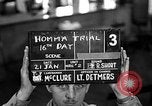
Major Tisdell speaks about events after American surrender in 1942 during the trial of General Homma in Manila, Phillipines.
U.S. Army Major Achille C. Tisdell testifies before a military tribunal in Manila, Phillipines during the trial of Japanese Army General Masaharu Homma for World War II crimes. Major Tisdell, aide-de-camp to Commanding General of the American forces in Luzon Major General Edward King, speaks about the Americans being taken to various prison camps. He says that Major General Edward King and General Jones were taken to Camp O'Donnell. He says that other officers including him were taken to a warehouse near San Fernando and from their they were taken to U.S. head quarters. Major Tisdell recalls that leaflets were dropped for the prisoners. He hands over a leaflet to a member of the tribunal. Tisdell reads out the part of the leaflet related to treatment of prisoners of war.
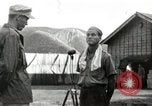
An American prisoner talks about the harsh treatment at a Japanese prison camp in Honshu, Japan during World War II.
American prisoners of war being interviewed at a Japanese prison camp in Honshu, Japan after World War II. A U.S. officer interviews a prisoner who has been liberated from a Japanese prison camp. The prisoner says that his name is James Robertson. He says that he is from St. Louis and was born in Chicago, United States. He speaks that he came to fight against the Japanese on April 22, 1941. He states that he was captured by the Japanese on May 6, 1942 in Corregidor, Philippines. He narrates an incident to prove that they were tortured at the prison camps. He also states how hot tea was poured on the legs of a prisoner.