


 Francais
 Deutsch
 Italiano
Refine Your Search
+"Philippines" +1945 stock footage and images
- Showing 211 to 216 of 453 results more
more Hide
Hide
The living conditions of American prisoners of war at the Bilibid Prison, Philippines (WW2)
American prisoners of war at the Bilibid Prison near Manila, Philippines during World War II. Exterior of Bilibid Prison. Photographs of the wounded. War damage in the prison. A wrecked statue of Jesus Christ lying. The prisoners eat food. A prisoner talks over a phone. A prisoner with a wooden support on the damaged leg reads a paper. Mutilated dead bodies.
Remains of Japanese prison camp near Cabanatuan City, in the Philippines, during World War II.
Film opens panning across damaged remains of former Japanese Prison Camp near Cabanatuan City, in the Philippines, during World War 2, Several men are walking through the site, during the filming. The buildings show battle damage and have been gutted. View of Interior of one building that contains benches.
Men remove dead bodies of American prisoners massacred by the Japanese in Palawan, Philippines (WW2)
Bodies of dead American prisoners in Palawan, Philippines, victims of the Palawan Massacre of American POW by Japanese forces in December 1944 (World War II). A sign board reads: 'This area off limits to all personnel'. 'Remains of American prisoners of war'. Men exhume corpses in the area. They dig the graves. Exterior of a building. Recovered dead bodies of soldiers lying on the ground. Men sit nearby. A man searches the dead bodies.
Men dig out a trench and take out the remains of American prisoners who were burned alive by Japanese in Palawan, Philippines.
Dead American prisoners recovered in Palawan, Philippines after the Palawan Massacre of American POW by their Japanese captors in December 1944. The remains of the prisoners who were burned alive. Remains of the prisoners in a trench. Men dig the trench and take out the remains. They hold a skull in hands and inspect it. (World War II period).
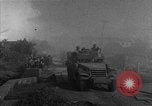
U.S. troops and Filipino guerrillas enter the town of Carigara in the Philippines Islands.
U.S. troops enter the town of Carigara on the Philippine Islands. A line of half tracks enters the town. Dust fills the area. A group of Filipino guerrillas enters the town. A line of GIs enter the town. A battery of three U.S. field artillery pieces fires at Japanese positions. The soldiers stand near artillery pieces. (World War II period).

General Douglas MacArthur visits Santo Tomas University after liberation by the U.S. 1st Cavalry Brigade in Manila, Philippine
Allied prisoners hold American flags at a Japanese prison camp in Santo Tomas University in Manila, Philippines. General Douglas Macarthur arrives at Santo Tomas on February 6. Japanese forces fire artillery at the camp on February 7 and injured prisoners are carried away for medical aid. Malnourished men and women work at the camp. People outside their thatched roof huts. Women and children eat and drink. A woman shows gratitude in finally being able to smoke a cigarette. Red Cross field workers hand over mail to the internees. Prisoners read their mail. (World War II period).