


 Francais
 Deutsch
 Italiano
Refine Your Search
+"Philippines" +1945 stock footage and images
- Showing 19 to 24 of 453 results more
more Hide
Hide
Japanese 1931 aggression in Manchuria condemned by the League of Nations. Continued Japanese aggression in the Pacific, through World War II
Japanese international activities during 1931-1945. Opening scene shows Japanese troops embarking on ships bound for an invasion of Manchuria, in 1931. Officers walking on the dock, amongst the departing troops. Scenes of explosions and destruction. Views of Shanghai during Japanese attacks in 1937. Destroyed buildings. Civilian dead lying in the streets. Japanese soldiers racing along a street in a three wheeled motorcycle vehicle. Change of scene shows Japanese diplomat Yosuke Matsuoka addressing a League of Nations meeting in 1933, after that body adopted a report blaming Japan for events in Manchuria. He objects to that action and then leads his delegation in walking out of the meeting. View of Japanese delegates in top hats and bowler hats exiting the building. Scene shifts to Japanese forces firing artillery and machine guns in Manchuria.They wave large Japanese flag victoriously after a battle. The next scene shows Italian forces occupying Ethiopia and raising the flag of the Kingdom of Italy, as Italian troops salute, presenting arms of rifles with fixed bayonets. Axis leaders celebrate the 1940 Tripartite Pact between German, Italy and Japan. The festivities take place in a hall displaying the three nation's flags on the walls. A large number of persons attend including Japan's Prime Minister, General Hideki Tojo, seen with two celebrants. Scene reverts to China with Chinese civilian people trying to escape from invading Japanese forces. The refugees carry their belongings as they flee. Occasional shell burst is seen among advancing Japanese troops as Chinese soldiers put up resistance. Chinese soldiers firing artillery. In the U.S., Japanese envoys Kichisaburō Nomura and Saburō Kurusu are seen walking together into a building and entering a room inside. Next, are views of the Japanese attack on Pearl Harbor, with huge plumes of smoke obscuring the bombed U.S. battleships in the harbor. U.S. battleships in line formation in the Pacific during World War 2. Aerial view of U.S. warships moving in parallel. British ships augmenting the U.S. warships. Naval guns firing. U.S. amphibious assaults on Japanese held islands in the Pacific. Prisoners of the Japanese who suffered in the Philippines. General Douglas MacArthur mingling with former prisoners and internees upon his return to Manila in 1944. Aerial views of Iwo Jima. Naval bombardment and amphibious assault of Iwo Jima. Numerous fallen Japanese soldiers. The iconic American flag raising by U.S. Marines on Iwo Jima. View of Lieutenant General Simon Bolivar Buckner Jr. during the campaign on Okinawa, where he was killed in action. A Soldier being carried on a stretcher. Another throwing a hand grenade. U.S. soldier firing at a Japanese defender who falls out of his bunker. Large numbers of Japanese prisoners of war assembled in a field. Japanese Kamikaze attacking U.S. warships off Okinawa. The sky filled with antiaircraft flak clouds. View of 40mm Bofors antiaircraft cannon firing and a Japanese plane falling and exploding on impact in the ocean.
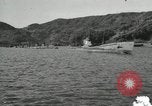
Operation "Road's End" and preparations for destruction of the Japanese submarine fleet moored in Sasebo Bay, Japan
Views from U.S. boat moving among Japanese submarines in Sasebo Bay, Japan, during Operation Road's End, involving the scuttling of the Japanese submarine fleet. Seen are submarines: I-47; I-162; I-156l;n-203;I-158;I-103;107;I-58. An American launch pulls up to I-58 (the sub that sank the USs Indianapolis on July 31, 1945, in the Philippine Sea).Vice-Admiral Robert M. Griffin, Commander of U.S. Naval Forces, Japan, climbs aboard the sub, followed by other members of his party. Admiral Griffin walks the deck of the submarine, followed by a Rear Admiral, who points out some features of the boat to Admiral Griffith. View of the group standing on the deck of the I-58.
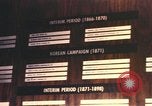
Hall of Heroes at the Pentagon showing hero names from Korean Campaign to the Vietnam War
View of the Hall of Heroes at the Pentagon, in the United States, during the Vietnam War. Names of the war heroes in the hall. Nameplates of the war heroes of each historical conflict on the wall. Names of the soldiers and officers who served the best in the wars. Names under the nameplates reading: 'Interim Period (1866-1870)', 'Korean Campaign (1871)', 'Interim Period (1871-1898)'. Other nameplates read: 'War with Spain (1898)', 'Philippine insurrection (1899-1913)', 'China Relief Expedition-Boxer Rebellion (1900)'. Several other conflicts mentioned in the hall. Other nameplates read: 'World War I (1917-1918)', 'Haitian Campaign (1919-1920), 'Second Nicaraguan Campaign (1925)', 'Word War II (1941-1945) and 'Vietnam (1964-Present).
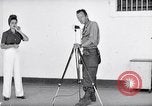
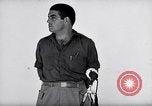
Interview with liberated female internee Georgette Kramer from the Los Banos camp in Manila, World War 2
Interview in Manila with freed female internee Georgette Kramer from the Japanese operated Los Baños internment camp (liberated 13 days before the interview). A microphone is set on a tripod stand for the interview. Ms. Kramer relates how she was wounded by a stray Japanese bullet during the February 23, 1945 liberation operation. During the firefight with Allied forces a bullet went through her mother's arm, through Ms. Kramer's abdominal wall, and into her friend's hand. Wounded, they were rushed to a tank. She says one other internee was also shot through the hip. When asked what she wants to do now that she is free she says she is not sure. A young girl, Ms. Kramer's sister, Aoife Kramer, runs up to the camera and says she wants to say something too. The interviewer lifts up the child in his arms. The girl says she wants to go to the United States. (World War II period).
Three sisters, liberated prisoners of the Japanese Los Banos intermenent camp, sing during a post-liberation interview
Three women prisoners released from Japanese-operated Los Baños internment camp being interviewed two weeks after the February 23, 1945 liberation by U.S. and Filipino forces in World War 2. The three Fernando sisters sing while a microphone is kept on a tripod in front of them. Their song about the "Three Little Sisters" tells the story of their internment and their expectant waiting for liberation by the U.S. armed forces which was finally realized.
Men of 121st Infantry Regiment of Philippine Army stand on crutches, receive medals at Luna in North Luzon Philippines.
Men of 121st Infantry (Guerrilla) Regiment of the Philippine Army awarded medals at Luna in North Luzon Philippines, a month after World War 2. Filipino women seated in spectator stands fanning themselves as they watch a military award ceremony for their relatives and friends, who served with the Philippine 121st Infantry (Guerrilla) Regiment during World War II. A Filipino soldier, on crutches (missing his left leg) with Purple Heart medal pinned to his uniform blouse. Colonel Russell W. Volckmann, commander of United States Armed Forced in the Philippines, North Luzon (USAFIP-NL), is seen shaking hands with and presenting Purple Heart medals to other Filipino soldiers as they stand in a line, most of them on crutches. Filipino soldiers parade in honor of the medal recipients.