


 Francais
 Deutsch
 Italiano

Refine Your Search
+"Philippines" +1945 stock footage and images
- Showing 403 to 408 of 453 results more
 Hide

U.S. 25th Infantry soldiers inspect wrecked Japanese planes on airstrip during S-Day invasion of Lingayen in World War II.
U.S. 25th Infantry soldiers in Lingayen, Philippines during its invasion in World War II. Smoke rises from explosion. Army truck along road. Civilians and soldiers examine wrecked Japanese aircraft on Lingayen airstrip. Soldiers talk to Filipino civilians in front of native huts.

Japanese delegation meets with members of General MacArthur's staff to plan formal Japanese Surrender ending World War II
Japanese officials arrive to coordinate arrangements for a formal Japanese surrender, at a Conference in Manila, Philippine Islands. Headed by Lt. Gen. Torashiro Kawabe, Vice-Chief of the Army General Staff, the sixteen-member Japanese delegation descends steps from U.S. Army Air Forces C-54 transport Aircraft, tail number 44-9045, at Nichols Field, near Manila. General Kawabe salutes American Colonel Mashbir, coordinator of the Allied translator and interrogator Section. Major General Charles Willoughby, Director of Intelligence, leads them to waiting cars. Meeting in the City Hall in Manila, the Japanese officers surrender their personal swords and present documents delegating them powers Plenipotentiary by the Japanese Government. They file into a conference room, where they and American counterparts take their places across a long, black table. U.S. Army Lieutenant General Richard Kerens Sutherland, General MacArthur's Chief of Staff, presides over the discussions, accompanied by Major General S. J. Chamberlin, General MacArthur's Operations Officer. They are supported by Allied translators and interpreters. The conference is concluded successfully and sets the stage for the final formal surrender of Japan. (Note: Plans for this critical conference were developed by Colonel David Larr, Chief of Planning on General Chamberlin's staff.) The clip concludes with views of many U.S. warships and of cargoes being loaded in readiness for the occupation of Japan.
U.S. 8th and 5th Cavalry Regiment troops entering outskirts of Manila. Officers refer to map on the street
United States 8th Cavalry and 5th Cavalry Regiment troops enter Manila, Philippine Islands during World War II. 8th Cavalry Regiment troops file past dead Japanese lying in a street. Major General Verne D. Mudge, commander, U.S. 1st Cavalry Division, and Regimental officers study a map at a street intersection.
P-51 of 41st Fighter Squadron, 35th Fighter Group, spills fuel while taxiing, near end of World War II
A view of an P-51K Mustang of the 41st Fighter Squadron, 35th Fighter Group on an airstrip at Clark Field in Manila, Philippines, near end of World War 2 . A pilot climbs into the cockpit of the aircraft. An airplane lands and a fuel truck drives past in the background. Mountains in the far background. The pilot starts the engine and prepares to taxi. Fuel begins to slosh and spill from his left auxiliary drop tank. It continues as he begins to taxi. A new sequence shows nose of P-51 and propeller, then switches to pilot climbing into cockpit.

Members of the 302nd Naval Construction Battalion construct shipping containers during World War II.
Carpenters of the 302nd Naval Construction Battalion (Seabees) at work constructing shipping containers in the Philippines, during World War 2. One uses a power circular saw. View of a fan placed in a new wooden container. A native being instructed by a Seabee. Stacks of finished containers.
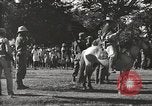
U.S. Rangers, Alamo Scouts, and Filipino guerrillas, on mission to rescue POWs from Japanese prison camp in World War II
Soldiers of U.S. Army 6th Ranger Battalion, Alamo Scouts, and Filipino guerrillas setting out on a mission to rescue American prisoners of war from a prison camp behind Japanese lines, at Kabanatuan (Cabanatuan) in the Philippines, during World War 2. They move out on foot and ford a stream on their way.