


 Francais
 Deutsch
 Italiano
Refine Your Search
+"Philippines" +1945 stock footage and images
- Showing 421 to 426 of 453 results more
more Hide
Hide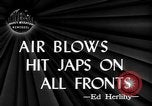
U.S. Army Air Force bombers strafe Japanese barracks and supply bases in Indo-China during World War II.
U.S. Army Air Force bombers strafe Japanese targets in Indo-China during World War II. U.S. bombers in formation drop 30 lb bombs Malaybalay on Mindanao in Burma. Explosions on ground create huge smoke cloud as the Japanese barracks get destroyed. U.S. 10th Air Force drops 500lb RDX bombs on Toungoo destroying the Mandalay-Rangoon railroad line. U.S. Bombers drop bombs on Japanese positions in Philippines. Japanese supply base in China Yungcheng destroyed completely by U.S. bombers strafing.
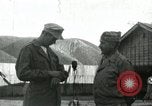
An American prisoner talks about his experiences at a Japanese prison camp in Honshu, Japan during World War II.
American prisoners of war being interviewed at a Japanese prison camp in Honshu, Japan after World War II. A U.S. officer interviews a prisoner who was liberated from a Japanese prison camp. The prisoner says they he was brought to the prison camp from Taiwan and he basically belongs to Seattle, Washington. He says that he came to fight against the Japanese in the Philippines where he was taken a prisoner. He gives an account of the treatment meted out to the prisoners at the camps. He talks how brutally the prisoners were treated. He recounts an incident of execution of few prisoners.
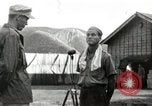
An American prisoner talks about the harsh treatment at a Japanese prison camp in Honshu, Japan during World War II.
American prisoners of war being interviewed at a Japanese prison camp in Honshu, Japan after World War II. A U.S. officer interviews a prisoner who has been liberated from a Japanese prison camp. The prisoner says that his name is James Robertson. He says that he is from St. Louis and was born in Chicago, United States. He speaks that he came to fight against the Japanese on April 22, 1941. He states that he was captured by the Japanese on May 6, 1942 in Corregidor, Philippines. He narrates an incident to prove that they were tortured at the prison camps. He also states how hot tea was poured on the legs of a prisoner.
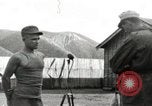
A freed American prisoner talks about the experiences at a Japanese prison camp in Honshu, Japan during World War II.
American prisoners of war being interviewed at Japanese prison camp number 3, in Honshu, Japan after World War II. A U.S. officer interviews a prisoner who has been liberated from a Japanese prison camp. The prisoner says that his name is Benini. He says that he is from Pennsylvania, United States. The officer asks him whether he was in the Philippines and when was he captured. He states he was captured before the Bataan Death March. He narrates his experiences of his prison camp, noting that a building in the prison camp was called the white house because it was large and painted white.
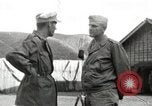
An American medical officer talks about the experiences at a Japanese prison camp in Honshu, Japan during World War II.
American prisoners of war being interviewed at a Japanese prison camp in Honshu, Japan after World War II. A U.S. officer interviews a medical officer who has been liberated from a Japanese prison camp. The medic says that he is from San Antonio, Texas. He talks about his early days. He says that he came to the Philippines on November 3, 1940. He discusses the difficulties faced by the medical officers at the prison camp. He narrates an incident where a soldier developed an infection in his foot and he lost nearly 20-30 kilos of weight. The medical officer also talks about the scarcity of medical supplies at the prison camp. He states that many men died due to malnutrition at the camp.
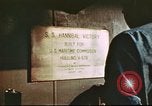
Men loading railroad locomotive, wheels and other equipment aboard victory ship Hannibal Victory at harbor in San Francisco.
The sea voyage of the victory ship Hannibal Victory from San Francisco to the Philippine Islands during World War II. A ship being launched for the purpose of transportation of equipment. A plaque on the ship. 'SS Hannibal Victory built for U.S. Maritime Commission' engraved on the plaque. Railroad wheels and axles, coal tender and, other equipment stacked on the dock to be loaded. Men working for the loading of the equipment. Rations and hospital supplies are also loaded onto the ship. Men preparing to load railroad locomotives onto the ship. A man and woman walking on the streets of San Francisco, with San Francisco harbor views and skyline views beyond them. Buildings and houses in the area. Cars parked outside a building. A woman bids good bye to the man. The man boards the ship.