


 Francais
 Deutsch
 Italiano
Refine Your Search
+"Poland" +1939 stock footage and images
- Showing 19 to 24 of 129 results more
more Hide
Hide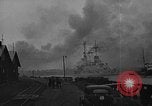
German Battleship SMS Schleswig Holstein bombarding Gdansk,Poland in World War II and Polish tank demonstration
View from the waterfront pier, of the German Battleship, SMS Schleswig Holstein, firing its 150mm and 290mm guns point blank at the Polish Westerplatte defenses, on September 1, 1939, as Germany precipitated World War 2 and invasion of Poland. Views from the Schleswig Holstein, where her Captain, Gustav Kleikamp, is seen observing the effects through binoculars,at timecode 00:20. Following these bombardment scenes, film shifts to Polish tanks (Vickers?) moving out of woods. Sequence shifts again to amphibious tanks moving through water and climbing onto shore.
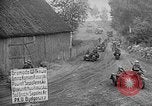
German troops advance on tanks and motorbikes to attack a polish town in Poland during World War II.
A film shows the Invasion of Poland in 1939 by German Army during World War II. The German troops on motorbikes and tanks as they leave for their next destination. The troops on tanks roll down a dirt road. The troops on tanks and motorbikes advance. The Machine gunners advance on motorbikes for opening the attack. They get down from their bikes. The gunners advance on a grassy area. A soldier fires camouflaged artillery. Smoke rises due to firing. A soldier fires a machine gun. The tanks advance towards the polish town. Troops advance and fire. An explosion occurs in the foreground. Smoke rises in the background due to firing. The town is burnt and occupied. The Nazi soldiers enter the town. They walks past the damaged and burning buildings. A building burns. The bombed buildings. Rubble on the streets. Wrecked vehicles including a German Pz.I tank from 4.Pz.Division. The troops on tanks and motorbikes advance for their next destination. The troops carry guns and advance. The soldiers on bicycles and horse drawn wagon move forward.
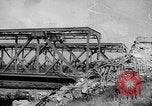
German troops repair a bridge over the Vistula river to continue advance in Poland during World War II.
Invasion of Poland in 1939 by German Army during World War II. A damaged bridge over the Vistula river, blasted by retreating Polish forces. A view of the damaged bridge. The German troops carry railroad ties on their shoulders and make repairs to the bridge. The troops continue to advance over the repaired bridge. The soldiers at work during the construction of the bridge. A jeep drives over a new road. The horse drawn carriages cross the bridge. A Sd.Kfz. 11 (Sonderkraftfahrzeug) 3-ton German halftrack towing an artillery piece moves in water and crosses the river. A smaller car drives in water behind it.
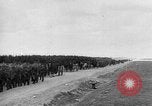
German troops rest in transit and clean weapons during World War 2 invasion of Poland
German Invasion of Poland in 1939 during World War II. The German troops in a squad carry guns on their shoulders and advance, many on foot. The troops on horseback and seated on horse drawn artillery as they advance. They cross a town. They rest in transit. The horses stand in the background. A German soldier cleans weapons. Two soldiers clean barrel of artillery.
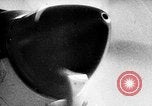
Aerial photographs are taken and German troops study the photographs in Poland during World War II.
German aerial reconnaissance efforts during invasion of Poland in 1939, in World War II. A propeller of a German He 111 aircraft rotates. The aircraft stationary at an airfield. The aircraft taxis. Wheel of the aircraft. The Heinkel He 111 aircraft taxis off. Aerial photographs are taken. Crew seated inside the aircraft during mission. A Dornier Do 217 aircraft shown landing and a signal officer gives a signal. German soldiers remove camera unit from airplane and they are taken to developing unit. The troops use equipment to develop and review the photographic images. German soldier marks important targets on the photographs including an area with Polish military vehicles are grouped together near a crossroads. A hand holds a photograph. The troops and officers seated around a table study the aerial photographs.
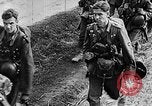
Adolf Hitler and German Generals travel by train in Poland after the German invasion in World War II.
German troops seen casually advancing during their invasion of Poland in World War 2. View inside Hitler's traveling railroad Headquarters, known as the Leader's Special Train (Führersonderzug), where General Franz Halder, Chief of the German General Staff, is seen briefing Hitler over a map. Other senior officers join the planning discussions. Brief view of German soldiers in the communications center of the Sonderzug, preparing orders and sending and receiving messages. Hitler is seen stepping from his Pullman car (Number 10206 in which his personal military assistants and a valet were also quartered). He is followed by military officers. A large cadre of German officers greet him and his entourage at the station. They all walk across several railroad tracks to a parked 1939 Mercedes G4 car, into which Hitler climbs. He renders a half-Nazi salute as they drive away. Glimpse of the vehicle steering wheel. (Note: In 1940, Hitler's train was re-named "Amerika", after a Belgian village, where his regiment found temporary respite on November 1, 1914, following the battle of Geluveld, during World War I. Later, the Sonderzug was finally re-named "Brandenburg.")