


 Francais
 Deutsch
 Italiano
Refine Your Search
+"Poland" +1939 stock footage and images
- Showing 25 to 30 of 129 results more
more Hide
Hide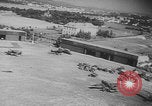
German military use of airport in Bromberg, Poland as a base during World War 2
Long shot aerial view from a low-flying airplane shows airport in Bromberg (Bydgoszcz), Poland. View of many German Air Force planes, as well as various outbuildings. Narrator describes that after the German invasion of Poland during World War II, the Germans took over the airfield to use for their own military aircraft and operations. Bomb craters on ground from German bombing on September 1st, 1939. View from inside a hangar looking outward on destroyed aircraft debris. More shots of debris on the airfield. Several Polish aircraft are shown in various states of ruin. German soldier approaches a Polish biplane with gun damage to the skin of the fuselage.
The German troops shell Danzig post office and spray gasoline on a building in Poland during World War II.
A film shows the Invasion of Poland in 1939 by German Army during World War II. The German armored columns assemble for the assault. The German troops on tanks, jeeps and motorbikes assemble. German troops in tanks and armored vehicles and trucks advance. The armored columns roll down a dirt road. The troops on the tanks advance towards the battle front. A view of a harbor and buildings in Danzig. The German troops fire artillery and shell Danzig post office. Smoke rises due to firing. A German ADGZ armored car rolls past the damaged post office. "Sudetenland" is written on the side of the armored car and it has a Nazi Schutzstaffel SS insignia and skull and crossbones painted on the front. Firing at the post office. The German troops advance. The soldier spray gasoline on a building. The building is set on fire.
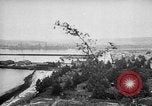
German troops fire artillery at Gdynia harbor and smoke rises due to bombardment in Poland during World War II.
German forces invading Poland in 1939 during World War II. The Polish harbor of Gdynia. The Poles have sunk ships at the edges of the harbor to block the entrance of German warships. The German troops fire artillery across the harbor. Smoke rises at the harbor due to an explosion. German soldier fires a rifle from a bridge overlook. A German warship at the harbor. The German sailors fire guns on deck. Smoke rises due to bombardment. German soldier bracing rifle and firing at Polish forces. Black smoke rising from the Polish garrison at Gdynia.
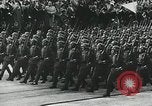
Soviet-German non-aggression pact is signed in Moscow and the Germans and the Red Army invade Poland in the European Theater.
German aggression during World War II. German troops marching in formation. A large crowd on either side of a road watches the troops. German Chancellor Adolf Hitler delivering a speech in Germany. Troops standing in formation listen to Hitler. On August 23, 1939 : People holding banners that read 'Down with War and Racism' and 'Aid the Allies'. New York Times headline reads: 'Reich and Soviet Join for Peace -- or War; No Buffer State; New Pact Warns Allies; Estonia Gives Moscow Sea and Air Bases'. Soviet politician Vyacheslav Molotov, Soviet Union leader Joseph Stalin and German Foreign Minister Friedrich Wilhelm Ribbentrop with other officers during the signing of Soviet German non-aggression pact (also called Molotov–Ribbentrop Pact) in Moscow, Russia in August, 1939. German Stuka dive bombers in action, when Germany invades Poland in a "blitzkrieg.".German Heinkel He-111 bombers in action. Buildings being totally destroyed by bombs. Red Army tanks and troops moving in snow. Victorious German troops marching in occupation. German heavy artillery batteries firing.
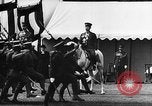
Actions of Axis and Allied powers on brink of World War II in period 1937-1939.
Japanese troops parade for Emperor Hirohito, mounted upon a white horse. Italian troops goosestep and German troops goosestep on parade. View of an Austrian town with snow-covered Alps mountains in background as German troops enter Austria on March 13, 1938 during the Anschluss. Local citizens welcome them, displaying swastika flags and giving Nazi straight arm salutes. Troops, military vehicles, tanks, motorcycles, and horse-drawn artillery comprise the German invading force. Shifts to Spain, where war torn buildings reflect effects of German and Italian intervention during the Spanish Civil War. A donkey standing near field artillery piece. Artillery being fired from an urban park in Spain. Artilleryman using a range finder. German gun crew with heavy artillery piece. Soldiers wearing Adrian steel helmets, firing a two-wheeled water-cooled machine gun. Spanish carrying wounded on stretcher. Spanish civilians inadvertently slain during civil war conflict. Starving dog walking in street. Huge poster of Francisco Franco and view of him on reviewing stand saluting marching Nationalist troops. Repeat of Hirohito reviewing troops and Italian and German troops goosestep. Adolf Hitler and Benito Mussolini stand together in open car heading to Fuhrerbau in Munich, Germany, for signing of Agreement between Germany, Italy, Britain, and France in 1938. Neville Chamberlain, and Edouard Daladier riding in car to Fuhrerbau. Views of the principals signing the accords. First is Adolf Hitler, followed by Prime Minister Neville Chamberlain, Benito Mussolini, and Edouard Daladier. After the signing, the principals, plus Hermann Goering, mingle and converse. Change of scene to nighttime in Rome, Italy, where Benito Mussolini addresses a huge throng gathered near the Victor Emmanuel Memorial to cheer him after his return from Munich. Next, German troops are seen entering Sudetenland (Czechoslovakia) greeted by joyous ethnic German inhabitants. Banners are stretched across a street. One gives thanks to the Fuhrer. Several scenes of cheering population. A woman strews flowers in a roadway. Hitler arrives, standing in an open car, and is met with cheers of adulation. A military brass band plays from the open beds of two moving army trucks. Signpost points to Prag (Prague), Eger (Cheb), Joachimstal (Jáchymov), and Komotau (Chomutov) after German annexation. Scene shifts to Prague, where German troops are seen occupying the city. High ranking German officers in a car are seen coming through the gateway from the Court d´honneur of the Prague Castle into the Hradčany Square. The next sequence shows an Italian Freccia-Class destroyer in the Albanian Port of Durrës. An Italian L3/35 Tankette is driven off a large cargo ship. Italian troops on bicycles ride in a city street. A German 88mm antiaircraft (flak) gun is shown, mounted at a fort overlooking a river and city. Final scene shows Adolf Hitler addressing a meeting of the Bundestag in the Kroll Opera House (alternate meeting place after burning of the Reichstag). He reads, contemptuously from an April 14, 1939 letter sent to him by U.S. President Roosevelt, asking him to give "assurance that your armed forces will not attack or invade the territory or possessions of the following independent nations: Finland, Estonia, Latvia, Lithuania, Sweden, Norway, Denmark, The Netherlands, Belgium, Great Britain and Ireland, France, Portugal, Spain, Switzerland, Liechtenstein, Luxembourg, Poland, Hungary, Rumania, Yugoslavia, Russia, Bulgaria, Greece, Turkey, Iraq, the Arabias, Syria, Palestine, Egypt and Iran." As Hitler reads through the litany of nations, the Bundestag erupts in laughter.
Analysis of the German labor force from 1939 to 1943 (WW2)
Analysis of the Germany's labor force, military strength and effects of World War II on manpower. German soldiers march. Men work in factory on equipment and machinery. Women work in factory. A cemetery of World War 1 soldiers in Germany. Narrator explains how loss of man power from world War 1 deaths, and subsequent lower birth rate leads to war production worker needs being filled by many young German women and even German boys and girls working in industrial factories also. Wounded German soldiers being treated in field during World War 2. A map points Germany, Sudetenland and Austria. Graphs examine labor force by sex, age and military replacement availability; compare the labor force according to sex from 1939-1943; detail the increase of work force through the women part time workers and the veterans. Women weld equipment in a factory. Men do mining work. Narrator speaks of foreign workers (such as from Poland, Netherlands, Czechoslovakia, Yugoslavia), and how some now serve "under economic pressure and compulsion" (as forced labor or slave labor). Views of forced labor crews working digging earthworks. Laborers also work on building or repairing railroad stations and track work. Lines of prisoners of war, also used for labor, walk under German guard as lines of German uniformed troops walk in the opposite direction. Graphs compare the labor force in agriculture, industry, trade services, transport and government.