


 Francais
 Deutsch
 Italiano
Refine Your Search
+"Russia" +1943 stock footage and images
- Showing 13 to 18 of 84 results more
more Hide
Hide
U.S. shuttle-bombing of German positions and military installations under Operation Frantic during World War II.
Film title slate indicates "Operation Titanic" but it, in fact, depicts "Operation Frantic" with U.S. shuttle bombing operations over Germany from bases in Great Britain, Italy and Russia during World War II. United States Army Air Force B-17 Flying Fortresses in flight. Aerial view of bombers in flight with several aircraft flying in formation leaving behind contrails. View inside bomber aircraft with bombardier preparing to drop bombs. View of bomb bay door opening and closeup of hand near bomb drop switch. Bombs awawy view as bombs are dropped from American aircraft. German defenses are bombed along the invasion coast of France (just prior to D-Day) on June 2, 1944. Aerial views of B-24 and B-17 bombers also in flight bombing German military installations in German-occupied northwestern Europe. Aerial view of a target area. Smoke rising up from bombardment. Two different U.S. Army Air Force B-17 Liberator aircraft are seen falling from the sky toward crashes after being hit by German enemy fire. One of them has smoke trailing from it, and the other is in a free fall. Railroad and marshaling yards are also bombed over Debrecen, Hungary on June 2, 1944, with aircraft continuing on (shuttle bombing) rather than returning to base. United States Army Air Forces B-24 Liberator flying in formation on June 21, 1944. Aerial view as they bomb the Focke-Wulf Fw 190 engine aircraft factory near Basdorf, Germany. German factories are bombed. B-17 aircraft on the same date are seeing in formation and bomb railway stations, freight yards, and factory targets, along with the Nazi German Ministry of War, Ministry of Propaganda, and Gestapo headquarters in Berlin, Germany. Heavy flak bursts seen in the air near the aircraft. Dogfight scenes as several German airplanes are shot down. Machine gunners aboard U.S. bomber aircraft firing at German fighter aircraft and shooting down 43 of them, according to narrator. Aerial view of ball turret rotating below bomber and firing guns at German fighter aircraft. The B-17s and B-24s bombing the targets. Synthetic oil plants and refineries are bombed at Ruhland Germany, east of Leipzig. Planning for the operation was done on December 7, 1943. A document about the operation is typed. Animated map shows Nazi positions and method of shuttle-bombing, allowing American aircraft to bomb from Soviet bases, and allies broadly to bomb German targets from bases in the United Kingdom, Italy, and Soviet Ukraine.
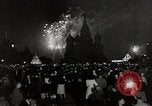
Fireworks in Red Square. Tehran, Iran, conference in 1943. Potsdam conference, 1945.
A crowd enjoys fireworks in Red Square, Moscow, Soviet Union, at night. Past events show Soviet Premier Joseph Stalin, U.S. President Franklin D. Roosevelt and Prime Minister Winston Churchill of the United Kingdom in Tehran, Iran for the Tehran Conference of 1943. U.S. President Harry S. Truman in Germany during the Potsdam Conference of 1945. The Grand Kremlin Palace in Moscow, Soviet Union. Soviet people along a street in Moscow. Foreign Minister of the Soviet Union, Vyacheslav Molotov with others applauding at the Bolshoi theater, in Moscow. Anti-soviet disorders. Street cars being overturned. (Hungary?).
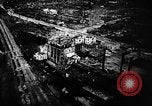
Russian soldiers take Reshitsa and Gomel and help restore a city in Europe.
A Russian film titled Srazhenie Za Gomel about the Battle of Gomel. Russian soldiers take Reshitsa on November 18th and Gomel on November 26th, 1943. Russians help restore town. Buildings in city. Ruins of buildings. Soldiers enter the city. Old women happy to see the soldiers. Empty streets, bomb damaged buildings. Graves in a cemetery. Boards placed on poles and trees. Civilians return to city. Soldiers march into city. Artillery fired. (World War II period).
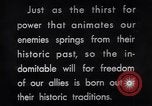
Documentary titled 'Why We Fight, The Battle of Russia' depicts history of battles fought by Russia defeating invading armies.
A documentary titled 'Why We Fight, The Battle of Russia' depicts battles fought by Russians, fighting military raids from other nations. Dramatized scenes of invasion of German knights in 1242. Town Pskov destroyed and civilians roped. In the battle of Novgorad, the Russians under emperor Alexender Nevesky defeat the Germans in a fierce battle. The Swedish attack Russia and get defeated by Russian army in battle of Poltava in 1704. French troops retreat in a frozen desert after getting defeated by Russians in 1812. German Kaiser Wilhelm II inspects World War 1 troops on Eastern front in 1917. Russian army of cavaliers and infantrymen march for battle. Map shows a part of Russia, Ukraine occupied during the battle. (World War II period).
A brief description of Russia (Soviet Union or USSR)
Animated map on globe of world shows extent of the USSR from East to west and North to South (9 million Square miles). Miners extracting her natural resource minerals. 110 million acres of forests and timber being felled. Coal on a conveyer belt. A "forest" of oil derricks in a Soviet field. Oil tank cars moving on a railroad. Iron and steel mills. 370 million acres of farmland. Farms being worked. Tea, tobacco, and cotton crops. Herds of ranch animals. Corn,oats,hops,rye and wheat being harvested by machinery. Huge parades of people parading in Red Square, Moscow, Russia. Dancers on floats in the parade. Cossacks from the Don River Valley demonstrate horsemanship. Map showing Ukraine, Russia,Hungary, Romania,and other adjoining areas. Musicians playing balalaikas accompany dancers. Ukranians,Moldovians and Beserabians in local costume. Map of the Caucasuses between the Caspian and Black Seas. People from that region dancing and playing instruments. Armenians,and people riding on horseback from tribes of the Caucasian mountains. Uzbeks blowing long horns. Turkmen with horses. Mongols playing stringed instruments. Views of people from further East and North approaching Siberia. Some hunting with rifles. Views of Moscow. Moscovites walking on a summer day. Man riding in a horse-drawn carriage. Cars driving on a street. All kinds of vehicular traffic in Moscow city, including trams. Outside views of Soviet factories. Soviet soldiers. Soviet bricklayer, traffic cop, and sailor are shown. A riveter at work. Soviet school children. An old fireman.Nurse in a hospital. Civil engineer with transit. A window washer. A sales girl. Housewives. A Postal clerk. A radio announcer. A stewardess on an airliner. A chemist in a laboratory. A typist at work. A harpist playing and a ballerina dancing as an orchestra plays. Soviet citizens walking across a field. Narrator refers to their love for the soil. Animated map sums up Russia's size and characteristics. (World War II period).
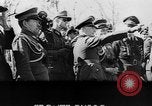
Japanese and Turkish military missions tour Eastern Front at German invitation, in World War II
Opening scene shows German Field Marshal Wilhelm Keitel gesturing as he hosts members of a Japanese military mission and a Turkish military delegation (headed by Colonel General Cemil Cahit Toydemir). At Adolf Hitler's invitation, they are on a tour of the Eastern front and English channel coasts between June 25th and July 7th, 1943, during World War 2. Here, they are seen inspecting German positions and witnessing firepower demonstration on the Russian Front near Kharkov (also Kharkiv) just south of Kursk. They observe a German artillery gun crew as they demonstrate rapid firing of their field piece. Shells explode raising black smoke. Closeup of a senior Japanese military official. Turkish and Japanese delegation visitors board two small open train cars driven by German soldiers on motorcycles adapted for the purpose. Following a pause, the scene shifts to the visiting officers inspecting German armor, including a small armored personnel carrier; a Tiger Tank of Pz.Abt.503; and other armored vehicles. They watch a Tiger tank moving along a muddy berm rotating its turret and 88mm gun as it moves. Another tank races past the camera at high speed, raising clouds of dust. A German gun crew, in a trench, fires an MG 42 heavy machine gun. They look up and camera focuses on formations of German JU 87 Stuka dive bombers flying overhead. Visiting officer peers through a periscopic viewing device, as Large explosion occurs in the field. German, Japanese, and Turkish officers converse as a huge plume of smoke rises in the background, capturing their attention.