


 Francais
 Deutsch
 Italiano
Refine Your Search
+"Russia" +1945 stock footage and images
- Showing 25 to 30 of 71 results more
more Hide
Hide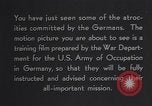
Training film for U.S. troops with the Army of occupation in Germany after world War II
Opens with bell tolling Victory against Germany in World War II. Next, a slate reads: "Victory Leads to Peace," and a farmer is seen with cattle pulling a plow. But narrator says "the problem now is future peace," and a map of Germany is shown overlaid with "Your Job in Germany." A cartoon of a soldier is superimposed on the map, along with one of a World War 1 American soldier and a figure of possible future soldier with similar mission. Camera focuses on parts of German aircraft in a jumbled heap. Closeups of weary defeated German soldiers at end ot World War II. Glimpse of Adolf Hitler speaking and haranguing an audience from a podium in an animated and forceful way. Swastika flags displayed from houses in a quaint German town. Joseph Goebbels, Nazi Reich Minister of Propaganda, at a microphone. Glimpse of a German concentration camp. But as they appear, each of the Nazi elements promptly disappears, showing the scenes without such Nazi symbols and persons. Skeleton remains of bombed buildings. Flower displays. Bucolic German rural countryside and quaint old villages in peaceful settings. Camera focuses on a book titled "German History." Chapter I, titled "Blood and Iron," shows Image of Otto von Bismarck. German troops march in a parade. Narrator states that "under Bismarck, the German empire was built." (He formed the German Empire in 1871, unifying Germany with himself as Imperial Chancellor, while retaining control of Prussia at the same time.) The film shows mounted German lancers as it alludes to Bismarck's campaigns against Denmark in 1867; Austria in 1866; and France, in 1870. Germany's leaders celebrating its status, in 1871, as the mightiest power in Europe. Troops marching and girls dancing nearby. Farmers plowing field with a horse and cow. Classic peaceful rural alpine scenes with local people in agricultural pursuits. A group of local German musicians playing folk music as village people dance outdoors. Back to the book, Kaiser Wilhelm II is shown on Chapter 2, entitled: "Deutschland über Alles." Gathering of German soldiers in Pickelhaube (spiked helmets). A German Big Bertha howitzer firing. German troops marching against Serbia; Russia; and France (with view of war damaged French cathedral). German invasion of Belgium in 1940 (with view of clock tower resting in rubble). German troops seen in Italy, walking past battle-damaged buildings. German Zeppelin dropping bombs on British targets and view of bombed out London neighborhood. Next scene shows a capsized ship with survivors running across its hull. Film slate labels the scene as United States, as if it is a U.S. ship attacked by Germany. (Actually, it is the Austro-Hungarian Battleship, SMS Szent Istvan, torpedoed, by Italian torpedo boats, during World War I.) Next, American soldiers in trench are seen going "over the top" and into "no man's land" on the western front of World War 1. Glimpse through a window of Kaiser Wilhelm II, after defeat of Germany, in 1918. View of Germans in a Beer Garden. Picturesque view of German town. A German orchestra performing. American soldiers marching out of Germany, with flags waving. Back to the history book,as chapter III is revealed, entitled "Today Germany, tomorrow, the world," and featuring Adolf Hitler. German troops invading Austria (where a civilian lies dead on the ground). German troops entering Czechoslovakia (where local people in tears render the Nazi salute). They march into Poland (where a girl weeps over someone, not seen, on the ground). They march into France (where a wounded, bandaged child cries in a bed). Next, is a scene from England, where a British child victim of bombing lies dead in the remains of a shelter. German troops invading Norway, Holland, Denmark, Belgium, Luxembourg and Russia (where a woman tries to rouse a dead woman). They invade Yugoslavia (where women sit near coffins of children) and Greece (where a woman rescues a naked child). A U.S. merchant ship explodes after being torpedoed by a German submarine (unseen). Scenes of destruction with people plucking dead victims from rubble of buildings. American troops invading Normandy, France on D-day, June 6, 1944. Several American soldiers fall to German gunfire on the beach. Wounded American soldiers being transported in jeeps on the battlefield and being placed on landing craft for evacuation. Americans walking past huge piles of destroyed aircraft parts. A landing craft filled with wounded American soldiers. American wounded and dead on a battlefield. Sailors abandoning a burning American ship by jumping into the sea. A sailor picked up in a life boat. A wounded American soldier being dragged from the beachhead at Normandy. Various wounds being treated by U.S. Medical Corps personnel. More scenes of American wounded being moved on stretchers. Scene shifts abruptly to German people folk dancing. Film concludes with question marks about the future.
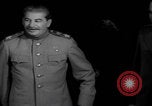
Leaders of the United States, United Kingdom, and Soviet Union commence meeting during the Potsdam Conference (WW2)
The Potsdam Conference at the Cecilienhof (Im Neuen Garten, 14469 Potsdam, Germany), Potsdam, Germany during World War 2. Russian Premier Joseph Stalin greets outgoing United Kingdom Prime Minister Winston Churchill and Minister of War Anthony Eden inside the conference room. Delegates crowd to greet each other before the conference. United States Army General Dwight D. Eisenhower speaking with other delegates. Churchill shakes hands with Molotov. Incoming Prime Minister Clement R. Attlee of the United Kingdom and Anthony Eden greeting representatives of the United States, Russia and their staff members. Stalin smoking a cigarette beside United States President Harry S. Truman. The leaders of United States, United Kingdom and Russia take their places at conference table.
Traces the route of lend lease activities of American goods bound for Russia via Iran and Iraq
Lend lease activities at American outposts in Iran. Traces routes of American shipments from United States to Iran. Cargo unloaded from ships at ports in Basra, Iraq and Khoremshar, Iran. Exterior views of U.S. military base building complex in Iran. Group of local civilians crouched and breaking a pile of rocks into smaller pieces. Aerial view of harbor area. Dock-side view of ships harbor offloading supplies. Boxes including a food box labeled "Pork Luncheon Meat" from the American company Armour and Company, and many others are unloaded and stacked at port by African American personnel. Line of African American soldiers or sailors on dock receiving food in a chow line. Railroad engines and train cars being unloaded at port. A Soviet military officer walks with a checklist and checks the shipments. Massive piles of supplies including food, tires, trucks received from America. Soviet officer reviewing supplies with an American officer.

United States Secretary of States Edward Stettinius Junior, meets ambassadors of Britain, Russia and China in Washington D.C.
San Francisco Security conference of representatives of four powers meets in Washington DC prior to the United Nations San Francisco Parley. United States Secretary of States Edward R. Stettinius Jr. meets British ambassador to U.S. Edward Wood (Lord Halifax), Russian ambassador to U.S. Andrei Gromyko, and Chinese ambassador to U.S., Dr. Wei Tao-ming. Assistant Secretary Archibald MacLeish speaks on a microphone. Chinese ambassador speaks. Assistant Secretary of State, Archibald MacLeish, poses and talks on a microphone.
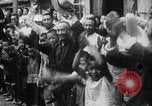
People greet the Soviet Red Army as they move back to Russia after the World War II.
Demobilization of Red Army at the end of World War II. Chinese people gather along road side and cheer the Soviet Red Army troops as they demobilize at the end of World War II. Troops loaded on tanks move past the cheering crowds. A large crowd celebrates as they carry a huge poster of Joseph Stalin.
Officers of Soviet Red Army in Russia after the World War II.
Demobilization of Red Army at the end of World War II. A view of a coast with a hill in the background. Men carry a flag. Red Army officers with medals decorated on their uniforms. Soviet flag waves. A memorial at the coast.