


 Francais
 Deutsch
 Italiano
Refine Your Search
+"Soviet Union" +1941 stock footage and images
- Showing 1 to 6 of 156 results more
more Hide
Hide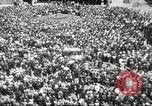
The Soviet Union is placed on a total war footing in June 1941, as the Fascist axis powers invade in Operation Barbarossa.
Soviet Union mobilizes in wake of the Operation Barbarossa, invasion by Germany and its allies in World War 2. At beginning, the film shows a large crowd of Soviet citizens gathered as they learn about the invasion on June 22, 1941, Camera pans over the crowd and shows many closeups of individuals and groups. Brief view of Joseph Stalin broadcasting to the Soviet people on June 22nd, saying, "This war is not an ordinary war. It is a war of the entire Russian people, not only to eliminate the danger hanging over our head, but to aid all people groaning under the yoke of Fascism." High speed printers produce news reports for distribution across the land. Views of men on horseback leaving a rural village to answer the call for recruits to defend the nation. Views of conscripts being marched in formation on a city street, under direction of a Soviet officer. Film emphasizes the roll of women in the war effort, showing women pasting patriotic posters on a wall. A cadre of uniformed women soldiers is seen marching along a city street past spectators. A large group of many kinds of Soviet citizens walking together, including men, women, and youths. A boy works, checking a newly manufactured rifle, in an arms factory. Boys digging with pickaxes alongside older miners in a coal mine. Women in an army unit wearing full uniforms including bed rolls. A Soviet army unit containing both men and women. A woman operating a lathe in a war plant machine shop. An old man seen along with women harvesting grain by hand, on a farm. A steam locomotive moving on a rail road. A woman at the helm of a ship. Women operating farm equipment. Soviet soldiers removing usable metal objects from a dwelling to use in the war effort. Women and children gleaning remains in a farm field. Cattle being driven to prevent their capture by the enemy. An old man with an old fashioned rifle, tanding watch over rural fields, on the lookout for German airplanes.

Soviet Union mobilizes to defend against German invasion in June, 1941, World War II
A film titled ' Our Russian front. It shows Soviet Russia's state of preparedness and national mobilization at the time of the German invasion (Operation Barbarossa) in 1941, during World War 2. Soviet troops on parade in Red Square, Moscow, carrying Tokarev SVT-40 semi-automatic assault rifles, with curved magazines and fixed bayonets. Glimpse of a Soviet heavy gun (possibly 152mm howitzer). A Soviet Navy gunboat speeding toward the camera. A formation of Polikarpov I-16 aircraft inflight overhead. Several views of soviet forces, including units composed entirely of women; Closeups of troops, some holding Russian RPD 7.62 cal m44 light machine guns. A Soviet T-26 speeding in Red Square with flag flying, during a parade. View from the rear of a line of Soviet Zvezda BT-7 light tanks being deployed along a dirt road. Russian civilians, most of them women, work digging hillside fortifications. Closeup of woman with small boy in her arms. Views of destroyed buildings and dead civilians in a Russian town Aerial view of bombs bursting on Russian city. Smoke rising from resulting fires. Several views of light flashes from artillery firing at night. American envoy, W. Averell Harriman, participant in the U.S.-British military mission to Moscow, broadcasts about Soviet determination to defend against the Nazi invasion, at all costs. He refers to Soviet mechanics assembling American aircraft (Provided under "Lend Lease"). Narrator identifies Harriman as Chairman of the Board of Union Pacific Railroad. View of Russian airplanes in formation, flying high above the State Museum building in Red Square, Moscow. An American Government aircraft (C-47 /DC-3) aircraft lands at Moscow Airport. View of the aircraft parked and surrounded by a large crowd of military and diplomatic attendees. Harriman steps from the plane. Next he is seen with British Lord Beaverbrook and Soviet diplomat, Andrey Yanuaryevich Vyshinsky. Another view of Russian aircraft flying over the State museum in Red Square. U.S. President Franklin D. Roosevelt (unseen) is heard in the background extolling the Russian efforts against the Nazis. Soviet Tupolev SB bombers in formation overhead. Flags waving Aerial view of a formation of Polikarpov I-16 aircraft in flight. A Komintern Artillery Tractor,carrying Soviet soldiers, tows a 152mm field howitzer. A formation of army vehicles carrying Russian troops along paths already formed in the dirt by prior tracked vehicles. Seen are Komintern Artillery Tractors and ordinary army trucks.
German Operation Barbarossa invasion of the Soviet Union is successful at first but then fails to defeat the Soviets
German forces overrunning Soviet cities and towns during Operation Barbarossa of World War II. View of the city, Pskov, on the Veilakaya river. A steel bridge is seen and city across it with smoke rising. German troops marching in loose formation over a bridge in Novogorod. Views of German armor and troops entering Soviet cities of Brest-litovsk, Minsk, Mogilev, and Vitebsk. View of German Panzer III tank heading toward the camera as it enters a narrow street in Smolensk. Animated map shows progress of these German advances and highlights German forces under German Field Marshal Gerd Von Runstedt attacking deep into the Ukraine. Headline on Chicago Daily News reads: "Nazis Claim Knock-out Victory" with subtitle line reading,"Moscow line cracks." Other newspapers reflect conviction that Soviet forces face imminent defeat by Germany. Slate shows communique issued by the German High Command, stating: "The issue in the East has already been settled. Smolensk is the last halt on the road to Moscow." More views of marching German troops. A battery of Soviet artillery firing from a snow-covered field. Animated map shows German forces movement close to Moscow and Foreign diplomatic representatives being moved from Moscow to city of Kuibyshev. Hitler speaking on October 3, 1941, saying "This enemy is broken and will never rise again." Animated map depicts 500 thousand square miles of Soviet territory occupied by December, 1941, and compares it to the entire west central United States encompassing the states of : South Dakota, Iowa, Nebraska, Kansas, Missouri, and Oklahoma. Glimpse of fires raising much smoke in agricultural area of the Soviet Union, destroyed industrial plants, and huge numbers of Soviet citizens under German occupation. Destroyed Soviet armor, aircraft and artillery pieces. With winter coming on, views of German forces in rain gear moving slowly through cold rainy weather. Some walk beside horses and other ride on horse-drawn caissons along with artillery pieces. Segments of film show contrast between the German military strategies. The German forces would plunge deep into enemy territory and create an area of conquest. This is illustrated by a slate bearing Adolf Hitler's statement that, "A single blow must destroy the enemy, without regard for losses, a gigantic destroying blow." An animated map reminds the viewer of the success of this approach by the Germans in Poland, France, and the Balkans. German Generals seen planning the same "Blitz" approach against the Soviets. Film shifts to the Soviet strategy, showing their military planners idea of defense in depth, with multiple lines of successively stronger defense, taking advantage of the great size of their territory. Views of Soviet troops on the move. View of Shells knocking out a German tanks. Panzer III tanks advancing. Panzer VI tanks completely covered by German troops catching rides. Soviet field artillery and machine guns firing in cities, forcing German soldiers to leave their vehicles and seek them out. Soviet cities bombed out and burning, limiting the ability of armor to navigate in them. Montage of battle scenes cities of Rostov, Kharkov, Kiev, Kursk, Smolensk, standing in the way of the Nazi blitz into the Soviet Union. Battles being waged in cities. (World War II; WW II; World War 2; World War Two)
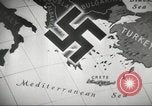
Germany launches Operation Barbarossa against the Soviet Union, which has been mobilizing for war, during World War II
Film begins with animated map depicting conquest of the Balkans by the German-Italian Axis powers. With Southern flank now protected, Germany begins Operation Barbarossa, the invasion of the Soviet Union on June 22, 1941, View of German troops goosestepping on parade in large formation. German troops being transported on parade in formation of wheeled open personnel carriers. Glimpse of upper part of Spasskaya Tower and clock overlooking Red Square in Moscow, Soviet Union. View of Soviet heavy industry complex with many smoke stacks. New farm tractors being moved on a railroad train. Scene segues into train carrying Soviet tanks, and then continues with scenes in a steel mill, a machine shop, a tank factory, and an artillery plant. Soviet troops parade bearing left shouldered rifles and singing as they march. Soviet civilian men are seen reporting for duty in the military and then training in hills overlooking a war plant complex. New Soviet recruits training with calisthenics and with small arms. A Soviet soldier speeds past the camera on a motorcycle and segues into a soldier on a horse jumping over a barrier, and then into several Soviet soldiers in uniforms, with rifles, diving into a swimming pool and swimming across it. Film ends showing Soviet troops in formation bringing their rifles from present arms position to pointing forward, as they march.

Soviet Union reacts to German attack as Stalin calls for national effort to defend against Nazi aggression in World War II.
Film begins with picture of famous Soviet statue of Worker and Kolkhoz Woman holding hammer and sickle, respectively, over their heads. The title,"View of the World Soviet," is superimposed. A slate gives a title in English: "Stalin Says the Word." Soviet civilians are seen lined up buying newspapers containing Stalin's call for all-out war following the German attack against the Soviet Union in Operation Barbarossa on June 22, 1941, in World War 2. They read newspapers in the streets. Picture of Joseph Stalin can be seen in newspaper held by one man as others look on with him. People reading copies of the newspaper posted at an outdoor display with Pravda (Russian: “Truth”) written above it. Civilians reading outdoors in various places. A slate appears reading: "Wrath of the People." Camera pans across a mass of workers gathered at the Stalingrad Tractor plant. Local leaders address the crowd passionately about the need for a national defense against German aggression.
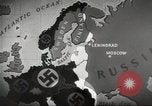
German forces invade the Soviet Union in Operation Barbarossa during World War II
Animated map shows German potential thrusts into the Soviet Union (Operation Barbarossa) coming from six different directions an targeting key cities like Leningrad and Moscow. June 22, 1941 is highlighted on the map. Large formation of German twin engine bombers with extended landing gears is seen in flight. Formation of German Panzer III tanks moving across a field. Formation of German Kfz.70 Personnel Carriers filled with troops. Formation of German soldiers on motorcycles (some with side cars) moving across a field. German troops leaving their transports and running into woods, as they encounter shelling. Animated map reiterates German emphasis on Leningrad, Moscow and Kiev (in Ukraine). It shows German forces converging on Leningrad, and then towards Smolensk. (World War II; WW II; World War 2; World War Two)