


 Francais
 Deutsch
 Italiano

Refine Your Search
+"Soviet Union" +1941 stock footage and images
- Showing 61 to 66 of 157 results more
 Hide

Soviet Union builds railroads and mines natural resources for war effort west of Urals in World War II
Views of Moscow, and the Kremlin, in the Soviet Union, during World War 2. View of snow covered mountains in the Urals. Map of Russia and environs focusing on areas east of the Ural mountains including Siberia. A pointer highlights areas where raw materials such as coal, bauxite copper, oil, and nickel are found. View from above of numerous Soviet workers in the Steppes, where blasting occurs during road building. Giant trees are seen being felled to clear the way for roads. Young Russian men and teenage boys are seen at a camp, marching with shovels and other tools over their shoulders. Next some are seen driving spikes as others in teams swing iron rails into place for a railroad. A group of boys are seen shoveling sand into the road bed as a steam locomotive passes pulling a train of box cars on an adjacent completed track. Siberian engineers, examine a construction site and converse. Workers digging a deep ditch for a pipe line to cross the plains. A field of oil derricks and oil drilling operations are seen, with Soviet roughnecks tending the drills and pipes of the oil wells. A pump operating and crude oil flowing. A camel is seen behind a roughneck tending an oil drill.

Civilian volunteers donate blood at a clinic in the Soviet Union, during World War II
Waiting room in a clinic in the Soviet Union, during World War 2. it is filled with women and a few men waiting to donate blood. A nurse in white, calls one of the women, who follows her out of the room. One woman, seated at a table in the waiting room, writes a letter that will be sent with her blood donation. Closeup of her writing. A laboratory technician speaks to her. Closeup of her letter. She gives it to the technician and then leaves the room. Next, she is seen being helped to don a white gown. Then, also wearing a surgical mask, she goes to a bed where she lies down and is covered with a blanket by a woman nurse or technician. Closeup of her smiling. View of her blood entering a collection flask. A technician is then seen wrapping vials of blood and placing them in an insulated container for shipment to the battle front.

Harry Hopkins, President Roosevelt's personal representative, departs Moscow after negotiating American Lend Lease assistance to the Soviet Union in World War II
Slate reads (in Russian) "Departure from Moscow by Mr. Harry Hopkins." Harry Hopkins, President Franklin Roosevelt's personal envoy, steps from a car and receives farewell expressions from a British Admiral and army officer, as he prepares to board an airplane departing Moscow, after negotiating American Lend Lease assistance to the Soviet Union, during World War 2. Soviet Chairman Mikhail Kalinin, arrives in a car and walks to the group saying goodby to Hopkins. Two Soviet officers and two men in civilian clothes stand on the airport ramp. American Ambassador, Lawrence Steinhardt and British Ambassador, Sir Stafford Cripps chat with an American Army Air Forces pilot. Group of diplomats and military officers gather wishing Hopkins well. Hopkins conversing with Chairman Kalinin. Hopkins making the rounds shaking hands with diplomats and a final vigorous one with Kalinin. He climbs aboard the waiting C-47 transport plane. It taxis out and is next seen flying overhead as those on the ground wave goodby.

German troops cross a river and besiege outskirts of Leningrad in the Soviet Union during World War II.
German invasion of the Soviet Union (Operation Barbarossa) during World War II. German Pz.35t tanks and troops advance towards Leningrad. Explosions occur. Night time advancement of German armor and tanks, setting fires and burning areas as they advance. German artillery being fired at night as flashes occur in the dark. Artillery being fired across a river. German assault troops load into boats to cross the river. Aerial side view of German Luftwaffe bombers and pursuit aircraft in flight, including close-up views with pilots visible in cockpit. Infantry shock troops on bicycles wait to cross the river (Neva ?) in a captured river steamer. German troops advance through outskirts of the city on horseback and with loading equipment trailers. A wrecked through arch bridge being repaired by German engineers. Other damaged bridges in Leningrad. Smoke rises as German Pz.II and Pz.IV tanks roll past.
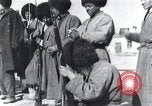
Soviet Tartar soldiers clean and adjust their rifles in Soviet Union.
Contingent of Soviet Tartar soldiers cleaning and adjusting their rifles. Most wear large black hats. although several wear smaller pointed style. (World War II period).
Soviet Union Commanders in Chief at the front with Russian troops during World War II.
Film begins with picture of famous Soviet statue of Worker and Kolkhoz Woman holding hammer and sickle, respectively, over their heads. The title,"View of the World Soviet," is superimposed. A slate gives a title in English: "The Commanders in Chief." Commander in Chief of North-West Forces, Marshal Kliment Voroshilov is seen meeting and exchanging handshakes and salutes with several Soviet soldiers in a wide open field during World War 2. Russian tanks drive past, raising lots of dust. and Commander in Chief of Western Front, Semyon Timoshenko at the front with troops. Commander in Chief of South-West Forces, Marshal Semyon Mikhaylovich Budenny, watches with several officers and soldiers, from behind a Soviet armored vehicle, as a BT-7 tank passes them. Next, Chief of Western Front, Marshal Semyon Timoshenko, visits troops at the front. Accompanied by officers of his staff, he bends down to observe something with soldiers at the front. Closeup of two Soviet troops in a defensive position. Timoshenko next to a soldier in a trench, pulls some foliage in front of himself, as camouflage. Marshal Budenny is seen again, this time, consulting with officers at the front. They converse and point at something of interest in the distance. Soviet infantry are seen advancing across a wide area in the distance.