


 Francais
 Deutsch
 Italiano

Refine Your Search
+"Soviet Union" +1941 stock footage and images
- Showing 115 to 120 of 157 results more
 Hide

Soviet Navy warships defend allied convoy against German air and submarine attack during World War II
Elements of the Soviet Navy Nothern Fleet escorting a supply convoy in the Barents Sea during World War 2. Soviet destroyers in camouflage are seen moving amongst the transport ships of the convoy. Soviet officers conferring in pilot house of a ship. Scene of some heavy seas. A Soviet Leningrad class destroyer moving rapidly astern the photo ship. Cargo ships steaming in background. Soviet antiaircraft gunners near their weapons, search skies with binoculars. Three German airplanes are sighted overhead and an alarm is sounded. Soviet sailors run to their battle stations. One gun crew is seen uncovering their weapon and beginning to fire at the German aircraft. A German three-engine Ju-52 flies low over the ship and drops a bomb that explodes in the water. Soviet gunners continue their barrage. Black flak begins to appear in the sky. A German Ju-78, Stuka dive bomber heads toward a ship. Two Soviet officers, on deck in heavy clothing, looking through binoculars. sailors load shells. Sequence shifts to a fast moving Soviet MO-4 small guard ship. View from aboard the MO-4 as it speeds through the water. Officers seen on the open foredeck. A crew member signals and the ship launches a depth charge to defend the convoy against German submarines. She continues to lay a cordon of depth charges. Final scene shows convoy transport ships continuing safely.

Crude oil being extracted from a Soviet oil field for the war effort during World War II
Opening slate in Russian refers to "Oil for the front" (in World War 2). First scene shows an oil field with drilling derricks in place and trucks passing over a bridge. Scene switches to oil worker high in a drilling rig, making an adjustment to a moving oil drilling arm. Closeup from even with the moving arm shows drill suspended from it. On the ground below, two supervisors look at a drilling site. Roughnecks attach a block and cable to a hook suspended from drilling derrick. A closeup of crude oil flowing into a compartment hatch on an oil tank rail car. View of train with oil tank cars being filled from pipes. A locomotive engine begins the train of filled oil cars.
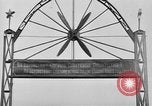
German Operation Barbarossa on the Eastern Front in World War II
Opening scene shows a Russian steel gateway topped by a propeller and two stars. Camera pans down to show that this is the entrance to a Soviet airfield containing a damaged hangar and Soviet military aircraft scattered about. Closeup of a destroyed Soviet airplane. A damaged Soviet Tupolev Tu-2 bomber. Numerous damaged Soviet Polikarpov I-15 bi--wing fighter aircraft. Caissons and Soviet artillery sitting at a railroad siding. Closeup of a damaged artillery piece. Numerous pieces of abandoned soviet artillery, sitting next to heavy guns mounted on rail cars. Soviet tanks missing their turrets. A German soldier examines what looks like a damaged British Mark V tank of World War I vintage. Camera pans over a number of undamaged Soviet tanks parked in a field. Thousands of captured Soviet prisoners of war are seen on a hillside, and then marching under guard. Closeup of one with a large star on his uniform hat. Soviet prisoners being marched about ten-abreast along a road. (Note: about 20 thousand Soviet troops were captured by the Germans in Operation Barbarossa.)
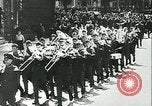
Legion Unit of France soldiers (LVF) march through streets of Versailles and board train bound for eastern front in World War II.
View of collaborationist French soldiers from the Legion of French Volunteers Against Bolshevism (Légion des volontaires français contre le bolchévisme, or, Légion des volontaires français, or LVF.) The LVF soldiers, made of of right-wing French and French prisoners, are marching through the streets of Versailles, in Vichy France, toward the Versailles Chantiers train station, to begin their trip to the Soviet Union where they will fight together with Germany against Soviet forces in World War 2. To the Germans they were known as Infantry Regiment, or Infanterieregiment 638. Led by a Band, the soldiers march through streets of Versailles and uphill toward the main arched entrance of the Versailles Chantiers station. Civilians line streets to bid farewell, and some women kiss soldiers goodbye. View of black locomotive leading the train. LVF board a train car with chalk inscription on the side "Paris - Moscow, LVF".
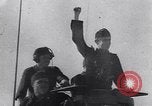
German tanks advance and attack Soviet forces on the eastern front during World War 2
German panzer tanks move forward to attack Soviet Union in European Theater during World War II. Nazi tanks move against Russian troops. Fire and scenes of destruction from battle.

German units advance under cover aerial bombardment in European theater during World War 2
German motorized and horse drawn equipment advance further in Soviet Union under cover of aerial bombardment. German bombers drop bombs over Soviet targets.