


 Francais
 Deutsch
 Italiano
Refine Your Search
+"Soviet Union" +1958 stock footage and images
- Showing 1 to 6 of 22 results more
more Hide
Hide
New York Times headlines about the military posture of the U.S. in relation to the Soviet Union.
The New York Times dated February 1, 1958. The headline reads ' Military Power: How U.S. Stands'. The article is about the military posture of the U.S. in relation to the Soviet Union.
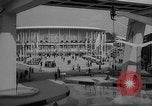
Montage of news items about international tensions in 1958
Opens showing views of the U.S. Pavilion at the Expo 58 in Brussels, Belgium. An array of international flags and artistic fountains grace the Pavilion. Glimpse of the Exhibition Hall of the Soviet Union with hammer and sickle symbol on front. Egyptian President Gamal Abdel Nasser shakes hand with Nikita Khrushchev, 1st Secretary of the Central Committee of the Communist Party of the Soviet Union. Nasser speaking to the 600-member assembly of the new United Arab Republic (encompassing Egypt and Syria). Arabs marching with banners. King Faisal II of Iraq and his uncle, Abdul Ilah, step to a podium. Faisal II riding in a horse-drawn carriage. View of seaport in Lebanon. A U.S. Naval task force is visible, arriving in response to a request for aid from Lebanon. U.S. marines in an amphibious landing near Beirut. They establish a beachhead as local Lebanese watch and applaud. The marines load artillery and ammunition on the beach. The scene changes to the island of Quemoy in the Taiwan Strait, where entrenched KMT Nationalist Chinese troops of Chiang Kai-Shek, are seen scrambling as they undergo constant shelling from Mainland China. The American Destroyer, USS Ammen (DD-527) is seen underway on patrol in the Taiwan Strait. U.S. Navy vessels provide relief supplies to the bombarded Islands in the Taiwan Strait. Landing craft are loaded with essential supplies for delivery. Sailors are seen throwing sacks of food over their ship railing into a landing craft below. A line of laden landing craft follows in the wake of a Navy ship. High rise apartments in West Berlin, Germany. West Berlin citizens are seen going about their daily activities. A large sign in German warns “Achtung! Sie verlassen jetzt West-Berlin” (“Warning! You are leaving West-Berlin”). Views of damaged buildings left untouched in East Berlin. Militia in black uniforms perform close order drills in East Berlin. Street sign identifies Unter Den Linden. The formerly elegant avenue is seen virtually deserted. A horse-drawn carriage moves along, and men push a cart full of supplies. Bicyclists ride along the side of the street. Headquarters of the 4-powers administration building is seen without a Soviet flag. French, American, and British soldiers stand guard. (Soviets are absent.)
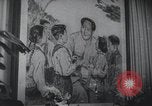
Implementation of the Mao Zedong led economic and social plan titled the 'Great Leap Forward' in Red China.
Postwar living conditions in the People’s Republic of China under the Communist regime of Mao Zedong (Mao Tse-Tung) photographed by Indians visiting the country. The film highlights China's problems of industry, agriculture, and excess population. Advertisements and posters for the Mao Zedong led economic and social plan titled the 'Great Leap Forward' in 1958. Objectives of the plan. Agriculture, industry, and education in China, including brief shot of men, women, and children in classroom, possibly for re-education. Men and women work in factories and plants. A Russian sign reads 'Made in the Soviet Union'. Workers inside a huge automatic automotive plant set up and supplies by the Soviet Union (SU). A steel and iron company rebuilt and enlarged with the aid of Soviet Union. A seamless steel tube mill supplied and erected by the SU. A plant designed, equipped, and built by SU technicians. A bridge over a river. Women work in a high voltage testing laboratory equipped by the East German government. A fully automatic petroleum refinery built by the Japanese. A heavy gilding machine plant started by the Japanese in 1937. Various factories, plants, and industries in China. Rural farmland and irrigation. People work in backyard furnaces, factories, presses, rolling mills and automotive factories. Deserted city streets with few cars. Workers inside an automotive plant. Communist Party of China Chairman Mao Zedong signs a pact with the Premier of the Soviet Union Nikita Khrushchev. Newspaper headlines regarding the disagreements leading to rifts in the China-Soviet relations in 1960. The Soviet Union withdraws technicians and support from China resulting in closure of industries. Statistics highlight China's dropping industrial production in steel, coal, electricity, and petroleum compared to that of USA, Soviet Union, and United Kingdom.

People gather to watch the parade at the 41st Anniversary of the Soviet Union in Moscow, Soviet Union.
Celebrations on the 41st Anniversary of the Soviet Union (following 1917 revolution) in Moscow, Soviet Union. Soldiers parade on a street. Officers and dignitaries including First Secretary Nikita Khrushchev review the parade. A large crowd gathers on the street. Armored vehicles and weapons in the parade. Large balloons shaped like rockets herald the Soviet's Sputnik space program.
Communist demonstrations in Budapest and Russian invade Hungary at time of Hungarian Revolution.
In 1956, crowds of Hungarians walk peaceably in their Capital, Budapest, calling for establishment of their own style of communist rule. A woman waves a Hungarian flag from a window. A communist star is pulled down from atop a building. On October 24, 1956 Hungarian authorities crack down, with police supported by Russian troops from local garrison. Russian soldiers in T-34 tanks seen on city street. View of Russian soldiers leaving the area aboard a T-34 tank. Hungarians battling their police. View of Prime Minister,Imry Nagy, ascending steps of a government building. Narrator states that Nagy declares Hungary neutral in conflict between Soviet Union and the West. Soviet books and documents being burned. The next sequence shows Soviet T-34 tanks entering Hungary in force, on November 4, 1956. One is seen firing from a city street. Picture of Imre Nagy shown as Narrator says his execution was announced on June 17, 1958.
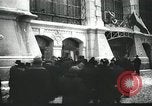
Czechoslovak coup with Communists coming to power; anti-Communist demonstrations in various European nations over 10 years
U.S. propaganda piece about threats by communists against various European countries. The Czechoslovak coup and demonstrations. Czech citizens moving on a street in Czechoslovakia during a strike forcing conservative elements to resign from the cabinet. Scenes of police brutality and beatings against strikers. Communists take over the police. Czech President Edvard Benes with conservative politicians in a government building. Huge crowd on a street. Police clashing with crowd. Czech Prime Minister Klement Gottwald with officials. President Edvard Benes, facing possible civil war or invasion by the Soviet Union, accepts a Communist cabinet. He is seen signing documents to that effect on February 25, 1948. Other officials beside President Benes during the signing. View of the first President of Czechoslovakia Tomas Masaryk's son, Jan Masaryk, who remained the Foreign Minister, and did not agree to the new government. Two days later Jan Masaryk is discovered dead. The body of Jan Masaryk in a coffin. Edvard Benes, who resigned in June 1948 after refusing to sign the communist constitution, is seen walking slowly outside the Parliament using a cane. A guard saluting Benes. View of the body of Edvard Benes, who died in September 1948, laying in a coffin. Mourning citizens offering flowers and cry. Officials bearing the coffin. Shift several years later to street strikes in East Germany in 1953. People during a strike and riot in Poland in 1956. Russian tanks moving on a street and Soviet soldiers are seen. Elevated view of panic and Polish citizens fleeing soldiers. October 1956: Student demonstrators on street in Budapest Hungary during the Hungarian Uprising of 1956. Soviet Russian red star is toppled by crowds from a building roof in a sign of defiance. Russian troops respond with tanks on the streets in Hungary. Crowd fights back. Russians retreat. Crowd overwhelms local police. Imre Nagy, Prime Minister of Hungary, ascends steps. Hungarian crowd on streets burn communist books and papers. Russian tanks invade Hungary to crush revolt. Tanks fire guns on Hungarian street. Imre Nagy's execution announced June 17, 1958.