


 Francais
 Deutsch
 Italiano
Refine Your Search
+"United Kingdom" +1917 stock footage and images
- Showing 7 to 12 of 26 results more
more Hide
Hide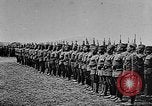
Russian infantry drill on a rough field during World I. A formation of British Royal Guards in full dress uniforms with fur hats, slow marches on parade.
Russian infantry are assembled in an open field, during World War 1. They maneuver their rifles from sling arms to parade rest and then to weapons at the ready position, in response to commands from officers (unseen). Next, they march in loose formation over rough ground, with their field gear and rifles. Russian General Grand Duke Nicholas and Emperor of Russia Nicholas II are seen conversing on a parade field. Russian cavalry unit cross a bridge, on horseback. At this point, the scene changes completely to the United Kingdom, showing a formation of British Royal Guards in formal dress uniform, including fur hats. They carry their rifles, with fixed bayonets, at left shoulder arms, and "slow march" across the parade grounds.
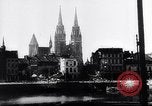
Britain attempts to recover its defensive capabilities following equipment losses in the evacuation at Dunkirk, France, in World War II
Opening scene shows a cathedral and houses near the English Channel coast in World War 2. German troops, part of a force of 100 Divisions, are seen advancing through French towns toward the coast. A German army band leads some. Others march through the countryside. Close-up of some ot the marchers, along with a Sd.Kfz.9 Half-Track pulling an artillery field piece. A column of German army trucks raising dust on a French country road and many waiting in line to cross a canal. A covered German halftrack pulling a covered trailer across a partially collapsed bridge. View from a moving railroad train with German troops and one manning an MG-08 machine gun on an open flat car. German soldiers in a "bucket brigade" passing cargo, including jerry cans, being off-loaded from a German Junkers Ju-52 transport plane at a grass airfield in France. A German Krupp K5 railway gun being run up an elevated rail. Imaginative animated map showing Nazi-dominated Europe in contrast to the British Isles. British troops marching. Change of scene to the beachhead at Dunkirk, France, during the mass evacuation of British forces ahead of approaching German armies. View from a British Destroyer of troops wading out through the water towards it. Close-up of two British soldiers being pulled from the water onto a boat, by two men in fowl weather gear. In skies above, British and German aircraft are engaged in aerial dogfights. A British Destroyer filled with soldiers evacuated from Dunkirk. Vickers/Maxim Octuple QF 2-pounder Mark VIII guns being fired by a British warship. British soldiers, some covered with oil, on the deck of a destroyer. Scene shifts to armor and weapons abandoned by the retreating British forces, including trucks, tanks, anti-aircraft guns and armored cars. Scene shifts to England where rescued soldiers begin ascending a gangway from the crowded deck of a warship to a pier above. Smiling British soldiers relaxing as they arrive on a pier. Many rescued soldiers getting organized on land. Narrator mentions that the losses of war materiel leave Britain short of its needs. Soldiers standing around a British Infantry Tank Mk.III Valentine. Soldiers manning a coastal defense machine gun position. Views of the British English Channel coastline. A British battleship (or Battle Cruiser) showing two forward triple gun turrets, is seen underway, ahead of an aircraft carrier. Silhouetted distance views of several British destroyers, and closer view on one escorting a supply shiip. (Narrator notes the British navy was absorbed in protecting supply lines all over the globe.) Animated map illustrates the overwhelming superiority of German Air Forces directed against Britain. view of British airfield displaying flag with Union Jack and RAF roundel. Several RAF personnel stand around an Avro Anson twin engine airplane, parked on the ramp. Several Supermarine Spitfire aircraft are seen parked on an airfield. Close-up of two flying in formation. View of St. Paul's Cathedral in the heart of London, England. British people are seen in a city and at home engaged in ordinary activities, scrubbing floors, chatting over drinks at a Pub, and waiting on a customer in a lady's shop. A farmer tends sheep in a field next to a church, where he converses with the Vicar. A baby crawls across pavement to his mother who reaches out from a doorway. New recruits in uniform mingle with people on a sidewalk. Mature women in uniform walk along with British Army officers in uniform. British sailor and an officer walk past the camera. A boy and older men at work in a field. Four businessmen dressed in civilian clothes are next seen in military uniforms, shouldering rifles. Home Guard civilians carrying rifles are trained in close order drills on a lawn. A home guard man points to a drawing of a tank as he asks a question during an outdoor training session. Recruits watch demonstrations with Browning M1917 water-cooled machine gun, and hand grenade launcher on Enfield rifle. A recruit takes his turn firing a single round (to save ammunition) from a Thompson M1921 submachine gun. He hands the weapon back to the instructor and returns to his place.
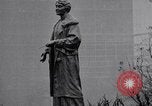
Brief montage of moving images from early 20th Century Women's suffrage and equal rights movement in Great Britain.
Scene opens showing the statue of British Women's suffrage movement leader, Emmeline Pankhurst, located in Victoria Tower Gardens next to the Houses of Parliament, Westminster. (This was erected in her memory, in 1930, two years after her death.) A World War 1 parade of women in clothing of religious orders; nurses; some military; and academics. One group carries a banner reading "Demonstrate-Trained Nurses." It also depicts What appears to be an Angel of Mercy and an appeal to buy war bonds. They are followed by women carrying a large British Union Jack, and by others, in academic garb, carrying banners of academic institutions. (This march was probably organized by the "Women's Party," the 1917 group founded by the Panghursts' to replace their "Women's Social and Political Union." The new party emphasized support for the British war effort.) Scene shifts to suffragist Emmeline Pankhurst (sometimes called a suffragette) viewed from camera behind her right shoulder as she addresses a large crowd. She is standing on a roofed platform in a park-like setting. The audience is mostly civilian, but a soldier is seen here or there. Several London Bobbies are in the audience, close to the speaker's stand. The next scene shows pedestrians gathered near Buckingham Palace, in London. A number of Bobbies (London policemen) are present, some on foot and some on horseback. The Queen Victoria monument is visible in the background. A horse-drawn carriage passes in front of the camera. Next, a woman is seen being arrested by two Bobbies, as passersby watch. An automobile passes and then the woman and police are seen approaching the camera as more officers become involved, keeping spectators away. In the final scene, in the 1920s, a man standing in front of a large group of women, congratulates one (probably Christabel Pankhurst). Closeup shows, from left to right, the man; a somewhat tired-looking Emmeline Pankhurst; and her daughter, Christabel.
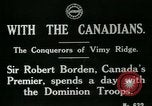
Canadian soldiers with Sir Robert Borden on a field in England during World War I.
Sir Robert Borden, Prime Minister of Canada, spends a day with the Dominion troops of Canada, famous for their conquering of Vimy Ridge during World War 1. Scene of the field (likely near Shorncliffe). Soldiers train and drill, advancing on a battlefield, running and lying down prone to ready rifles and bayonets. Near barracks, they gather and listen to an address from Sir Robert Borden. Canadian Army soldiers raise hats and cheer.
King George V visits American officers club in England during World War I.
During World War 1, King George V and Queen Mary visit American officers club and are received by Mr Walter Hines Page, United States ambassador, and Vice Admiral William S Sims in England. Officials stand at the stairs. Car arrives at a building. Guard salutes. Flags at the balcony. King enters a door with the officials. Crowd gathers and a dignitary addresses them. King and the ambassador stand and pose.
Wounded Anzac soldiers pose on their way back to New Zealand during World War I.
Wounded soldiers of the Australian and New Zealand Army Corps (ANZAC) during World War 1 pose dockside before boarding a ship returning to to New Zealand. Soldiers stand beside the ship. They wave. Two New Zealand soldiers wear gas masks and pose. A wounded soldier with a cane stands and shows a German Iron Cross medal he is wearing around his neck (captured from a German soldier).