


 Francais
 Deutsch
 Italiano
Refine Your Search
+"United Kingdom" +1918 stock footage and images
- Showing 13 to 18 of 49 results more
more Hide
Hide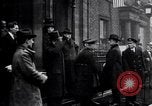
U.S. President and Mrs. Woodrow Wilson visiting various places during their State visit to England in 1918.
President Woodrow Wilson leaves No.10 Downing Street, in London. He enters an automobile. Among others present are: Lloyd George, Arthur Balfour, and Arthur Henderson. Mrs. Wilson is escorted, by The Duke of Connaught, carrying an umbrella, to a different automobile. The Wilsons and several other cars proceed through a light rain past Windsor Castle. Spectators line the sidewalks, many holding umbrellas. Spectators with umbrellas gather around the Crown and Mitre Hotel in Carlisle, England, where a reception was being held for President and Mrs. Wilson. (President Wilson's mother was born in Carlisle, England, and he wanted to visit there, accordingly.) (World War i; World War 1; WWI; WW1)
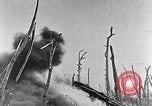
Extract from film "The Somme" depicts German troops in trench warfare against South African Brigade in Battle of the Somme, World War I.
Scenes from British feature film "The Somme" made in 1927, about the Battle of the Somme in World War 1. Part of it depicts events involving the South African Brigade in the battle. The extract opens with shells bursting all along No Man's Land among fragments of trees. Explosions and smoke everywhere. On July 18, 1916, Nine German Battalions deploy to drive the South African Brigade from the Delville Wood. Several soldiers of the Brigade seen entrenched in a sand-bagged position as a German shell explodes only yards from them. German soldiers advance through the broken trees and brush, while under fire by British gunners using Vickers machine guns. Some German soldiers falling and others seeking cover in abandoned trench. A line of South African troops firing their rifles from a trench, as several German soldiers reach them and are shot dead just feet away. A British soldier is shot while climbing out of a trench containing several fallen comrades. Other British (or South African) troops scrambling to find a safer place. One crawling across the ground. A British gunner firing a Lewis gun. German troops starting to go over-the-top, from their trench. British soldiers advancing. German gunner firing Maxim gun from fortified position, as shells burst in the distant background. A horizontal line of British troops advancing toward the German position. Some are cut down by the machine gun fire. German gunner firing a captured British Vickers machine gun. British soldiers hunkered down in a deep shell hole behind a ridge. They use their trenching tools to dig in deeper. Several German shells burst in the air. Two British soldiers watch as a tank approaches through the smoke. Large numbers of British troops attack downhill through smoke and haze. German soldiers preparing to defend an occupied structure, as more British troops charge forward. Post-battle view of the area, with fallen soldiers marked by rifles stuck in the ground with helmets on them. (Note: The tanks shown in this film are models Mark V which did not enter service until 1918.)
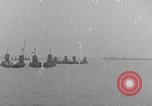
German U-boats obtained by Britain after World War I
German submarines taken as war prizes by Britain after World War I. A British official is taken by boat to inspect the submarines. Accompanied by British Naval offiers, he steps walks along the deck of the German submarine, U-9, pointing to its identifying letters. He poses with the officers. Visible behind them is the British submarine, L-15. (Note: The German U-boat, U-9, was surrendered on November 26, 1918 and broken up at Morecambe, England, in 1919.)
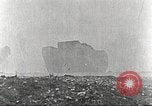
Extract from 1927 British feature film "The Somme," portraying events during the Battle of the Somme, in World War I
Scene from 1927 feature film about World War 1. British tank crosses a battlefield under fire. It is a Mk V tank with dummy guns fitted to simulate a fighting tank. British troops sheltering in a shell-hole recognize it as friendly and follow it towards enemy lines, where it rides over the parapet of a German trench and crushes a machine-gun position. (The tank is an anachronism; the Mark V did not enter service until 1918.)
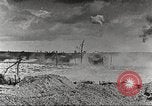
Extract from British feature film "The Somme," made in 1927, depicting warfare on the Western Front during WWI.
Reenactment of scenes from 1916 in World War 1, filmed in 1927 in Southwest England. Two British Mk V Tanks advance through shellfire. One has its gun mountings plated over and has dummy guns; the other has its gun mounts intact, though the guns might be dummies, and carries anti-grenade mesh on its roof. (These are by historical errors by the film makers, since this type of anti-grenade protection was not carried on Mark V [Mark 5] tanks, and the Mark V did not enter service until 1918.) The tank advances towards enemy trenches, followed by British soldiers who pursue German soldiers fleeing along the network of trenches. The tank, filmed from below, in the trench, as it moves over the trench. Note: (The film "The Somme" can be seen in full on the British Film Institute website.)
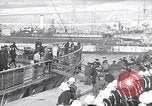
British Field Marshal Douglas Haig reviews Royal Navy guard of honour upon arrival in Dover, late at end of World War I
British Expeditionary Force commander and Field Marshal, Sir Douglas Haig, debarks from a smaller ship onto a dock in Dover in December 1918, soon after the signing of the armistice ending World War 1. White cliffs of Dover seen briefly in background behind a large ship. Victorious Marshal Haig is met by Vice-Admiral Sir Roger Keyes. A man with a royal mace stands behind the officers. British Royal Navy Guard of Honor band in white helmets plays as Commander Haig and Commander Keyes pass by the assembled forces. Civilians are lined up behind the military forces to welcome home Field Marshal Haig.