


 Francais
 Deutsch
 Italiano
Refine Your Search
+"United Kingdom" +1944 stock footage and images
- Showing 55 to 60 of 376 results more
more Hide
Hide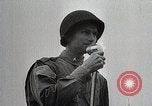
U.S. Paratroopers of 82nd and 101st Airborne divisions preparing to depart England the day before D-day in World War II
Film begins showing Brigadier General James M. Gavin, Commander of the Force A (parachute) contingent of the 82nd Airborne Division, standing on the hood of a jeep, at an airfield, to brief his paratroopers as they prepare for the D-Day invasion, during World War 2. A C-47 transport plane taxis behind the assembled group of troopers. Barbed wire is strung in the foreground. Paratroopers are issued French currency before departure. Some gamble with it using dice. Troops are seen playing volleyball on a field surrounded by trees. On an airfield, one trooper hits ground balls with a soft ball and several others field it. Some other troopers sit in grass next to the ramp, assembling wooden containers for airdrop. Two Army Air Forces mechanics fasten a tow bar on the nose wheel of a British-built Horsa Mk.II glider. They then tow it with a tug. View from above of Horsa gliders and C-47 tow airplanes, all in D-Day paint stripes, lined up on an airfield ramp. Paratrooper tent camp is viewed from above. Then, General Dwight D. Eisenhower and other senior officers are seen visiting paratroopers of the 101st Airborne Division, at the camp, on June 5, 1944, as they prepare to board their aircraft. Famous closeup of General Eisenhower speaking to a tall paratrooper who has his face camouflaged with grease paint.View looking down, as Eisenhower circulates among the troopers. Closeup of him conversing with another one directly.
American troops in England, rehearse for the amphibious invasion of Normandy, France during World War II.
American troops rehearse amphibious landings at Slapton Sands, England in January, 1944, before the invasion of Normandy, France, in World War 2. American soldiers descend from a troop transport ship and board a Landing Craft Tank (LCT 504) that takes them toward the beach. A group of Higgins Boats is seen maneuvering in the water. Their troop transport ship is seen further offshore. Next, a Higgins Boat full of soldiers is silhouetted against the sky and the sun shining on the water. Closeup of Coast Guardsman at the tiller of the boat. Scene changes to a view from the beach as a Higgins Boat, from Transport ship, USS Samuel Chase (APA-26) hits the beach, drops its front door ramp, and soldiers rush ashore. Complete change of scene shows American troops, carrying full battle gear, coming up a gang plank to a large established port terminal, where they go up another gangplank to board a large transport ship.
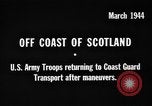
United States soldiers return to their Troop ship after practicing amphibious assaults off Scottish coast during World War II.
Opening scene shows the American transport ship, USS Thomas Jefferson (APA-30) anchored in a bay off Scotland in March, 1944 during World War 2. View from deck of the USS Thomas Jefferson, as some of her Higgins boats return from maneuvers to bring soldiers back on board. The troops climb up landing nets at the side of the ship, with help from U.S. Coastguard crewmen. View from directly overhead shows the landing net clearly. Various views of the Coastguard crewmen helping the soldiers. (World War II; WW II; World War 2; World War Two)
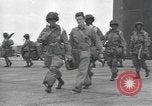
U.S. paratroopers board C-47 airplanes in England for the D Day invasion of Normandy, France in World War 2.
Paratroopers of the U.S. 502nd Parachute Infantry Regiment, 101st Airborne Division, at RAF Station, Greenham Common, proceed, in full battle gear, to board C-47 aircraft for their flight to Normandy, France, on June 5, 1944, during World War 2. Camouflage is seen on their helmets and their faces are blackened. One group is seen boarding C-47, tail number 43-15296. An officer reads briefing notes to them.They don life vests. A Captain and two Sergeants discuss briefing notes.Paratroopers help others who have difficulty climbing aboard the aircraft because of their heavy and ungainly equipment. Ninth Air Force Commander, Lieutenant General Louis H. Brereton speaks to Chaplain, Lieutenant Colonel Louis R. Goodrich, and shakes hands with some of the troopers, wishing them well, as they board C-47 number 42-92847, named, "That's All...Brother."(This was the lead aircraft for the airdrop, just behind the C-47s dropping pathfinders. It was piloted by the commander of the 438th Troop Carrier Group, Colonel John Donalson, and 87th Troop Carrier Squadron Commander, Lieutenant Colonel David Daniel.) The C-47s taxi out for takeoff, as senior officers watch them depart. (Note: There has been confusion about the name of the lead aircraft, C-47, 42-92847, because Colonel Donalson normally flew one named "Belle of Birmingham. " Research, including information from his daughter, indicate that he chose 42-92847, as lead aircraft, because it would have to be cut open to accommodate SCR 717C radar equipment, and he didn't want that done to his favorite airplane.)
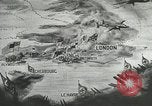
Allied invasion fleet prepares and leaves England for D-Day invasion in World War II
Montage of war scenes related to World War 2 Allied invasion of France. German sentry looking though binoculars. German coastal rail gun. Field Marshal Hermann Goering with Marshal Wilhelm Keitel, Chief of German High Command, inspecting Atlantic Wall coastal defenses on French coast. Allied D-day forces boarding ships in England. Troops loaded and waiting for orders to depart. Barrage balloons aloft. British and American troops, Coast Guard men, and sailors being briefed and studying aerial photographs and maps of the coast of France in the Normandy beach landing region. General James Gavin briefing American Airborne troops. American and British aircrews being briefed for missions. British King George VI visiting Royal Navy sailors aboard British warship. Sailors use light signals; ships weigh anchors,cast lines. Task force convoys underway. General Eisenhower visiting US Army paratroopers of 101st Airborne Division. U.S. paratroopers boarding C-47 airplanes the night of June 5, 1944. A C-47 named: "That's All Brother."C-47s with D-Day paint stripes taking off at nightfall.
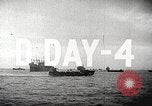
U.S. forces make preparations for the invasion of Normandy in World War II.
D-Day minus 4 (June 2, 1944). A U.S. Transport ship and landing craft at a harbor in the South of England, during World War 2. A jeep, with American soldiers in it, is hoisted aboard a ship. View of men riding a jeep as it is lowered into the hold of the ship. A diesel engine being loaded aboard the ship. A welder making repairs to the ship's superstructure. A cargo net filled with boxes of K-rations being hoisted aboard the ship.