


 Francais
 Deutsch
 Italiano

Refine Your Search
+"United Kingdom" +1944 stock footage and images
- Showing 61 to 66 of 381 results more
 Hide
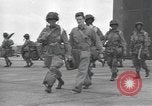
U.S. paratroopers board C-47 airplanes in England for the D Day invasion of Normandy, France in World War 2.
Paratroopers of the U.S. 502nd Parachute Infantry Regiment, 101st Airborne Division, at RAF Station, Greenham Common, proceed, in full battle gear, to board C-47 aircraft for their flight to Normandy, France, on June 5, 1944, during World War 2. Camouflage is seen on their helmets and their faces are blackened. One group is seen boarding C-47, tail number 43-15296. An officer reads briefing notes to them.They don life vests. A Captain and two Sergeants discuss briefing notes.Paratroopers help others who have difficulty climbing aboard the aircraft because of their heavy and ungainly equipment. Ninth Air Force Commander, Lieutenant General Louis H. Brereton speaks to Chaplain, Lieutenant Colonel Louis R. Goodrich, and shakes hands with some of the troopers, wishing them well, as they board C-47 number 42-92847, named, "That's All...Brother."(This was the lead aircraft for the airdrop, just behind the C-47s dropping pathfinders. It was piloted by the commander of the 438th Troop Carrier Group, Colonel John Donalson, and 87th Troop Carrier Squadron Commander, Lieutenant Colonel David Daniel.) The C-47s taxi out for takeoff, as senior officers watch them depart. (Note: There has been confusion about the name of the lead aircraft, C-47, 42-92847, because Colonel Donalson normally flew one named "Belle of Birmingham. " Research, including information from his daughter, indicate that he chose 42-92847, as lead aircraft, because it would have to be cut open to accommodate SCR 717C radar equipment, and he didn't want that done to his favorite airplane.)
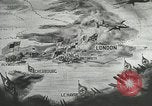
Allied invasion fleet prepares and leaves England for D-Day invasion in World War II
Montage of war scenes related to World War 2 Allied invasion of France. German sentry looking though binoculars. German coastal rail gun. Field Marshal Hermann Goering with Marshal Wilhelm Keitel, Chief of German High Command, inspecting Atlantic Wall coastal defenses on French coast. Allied D-day forces boarding ships in England. Troops loaded and waiting for orders to depart. Barrage balloons aloft. British and American troops, Coast Guard men, and sailors being briefed and studying aerial photographs and maps of the coast of France in the Normandy beach landing region. General James Gavin briefing American Airborne troops. American and British aircrews being briefed for missions. British King George VI visiting Royal Navy sailors aboard British warship. Sailors use light signals; ships weigh anchors,cast lines. Task force convoys underway. General Eisenhower visiting US Army paratroopers of 101st Airborne Division. U.S. paratroopers boarding C-47 airplanes the night of June 5, 1944. A C-47 named: "That's All Brother."C-47s with D-Day paint stripes taking off at nightfall.
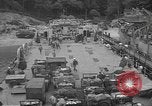
U.S. Military Vehicles loading into positions on upper deck of a Landing Ship Tank, in England, during World War II
Loading of USS Burnett County (LST-512) at Polgwidden (a.k.a. Trebah) beach, Helford River, near Falmouth, England during World War 2. View from top deck of the LST, as vehicles drive up a ramp and into positions on the deck. An M3 half track pulls up a trailer on the ramp of the LST. View from antiaircraft gun emplacement overlooking embarkation point. A sailor aboard the LST signals. Army vehicles are seen moving down a road and assembling at the embarkation wharf. (Note: Although these troops and equipment embarked on June 1, 1944, they remained aboard 5 days as foul weather delayed the actual D-Day landings until June 6, 1944)

Allied forces preparing in England for the Invasion of Normandy.
A dramatized film entitled "Beachhead to Berlin" describes preparations for the Allied invasion of France and the drive toward Berlin. Film combines actors and actual footage. Harbor in Greenway England in July, 1944. U.S. Coast Guard Barracks. Coast Guard men playing cards. One on a bunk contemplating. Chaplain's office: Chaplain typing and smoking a pipe. Audio narration of his letter being read, describing how things transpired at the Normandy beaches during the Invasion of France. Then actual footage of wounded being transported on ships after D-Day Normandy invasion. In England, footage of LCIs, LCVPs, Coast Guard cutters, including the Flying Angel Rescue Cutter. All of these ships participating in "dry run" practices for the actual Normandy landing. Coast Guard crews on decks of ships. Infantry loading landing crafts in England for dry runs. Landing craft arriving on English beaches during dry runs. A jeep drives off a landing craft and gets stuck on metal mesh on the beach. A tank is driven off a landing craft. Men maintaining ships. Scraping rust from the deck, painting identifications on ships, repairing rope ladders, and welding. (World War II period).
Montage of scenes from the day before the invasion of Normandy in World War II
D-day minus 1 (June 5, 1944) during World War 2. U.S. soldiers eat a meal while seated on the deck of a Large Landing Craft Infantry LCI(L) number 88, docked in Weymouth, England. (This ship would be the first LCI(L) to carry troops to the Easy Red landing zone during the second wave of landings at Omaha beach, on D-Day. Among troops landing there would be the 16th Regiment, 1st Infantry Division, with support from 7th Field Artillery Battalion;1st Engineer Combat Battalion; 1st Medical Battalion; 741st Tank Battalion (DD); 62d Armored Field Artillery Battalion; and 20th Engineer Combat Battalion.) A Captain and a field grade officer sit next to each other on the ship's deck. One soldier looks through his binoculars at an English woman standing outside her back door, looking back at him through her binoculars. Wash is drying on her line. The soldier tries to call out to her, but stops, realizing it is futile. Several of his buddies are amused by the whole event. Scene shifts to U.S. Army Air Forces B-26 bombers flying in formation, and then to aerial views from an aircraft, of bombs exploding on the ground in a city below. Next, a formation of B-17 bombers is seen, escorted by P-47 fighters. Scene shifts back to Weymouth harbor again, where American troops attend a Roman Catholic mass on the pier, adminstered by a military chaplain, wearing traditional clerical garb. LCL(L)s number 89 and 93 are seen tied up in the background. Coast Guardsmen gather around one of their ship's officers who briefs them on the operation.
The upper deck of a U.S. LST (Landing Ship, Tank) is loaded with army vehicles at Falmouth, England during World War II.
Loading of a U.S. LST (Landing Ship, Tank) at Polgwidden (A.K.A Trebah) beach , Helford River, near Falmouth, Cornwall, England during World War 2. (From the superstructure visible this is probably LST 532, USS Chase County.) A jeep pulls a trailer aboard the LST. Two jeeps on the elevator of the LST as it rises to upper deck. The upper deck of the LST shows a truck backing up on a ramp. (Note:This footage was taken on June 1, 1944, as the troops and equipment embarked for the D-Day invasion of Normandy. They spent the next 5 days very uncomfortably aboard due to stormy weather that delayed the landings until June 6th.)