


 Francais
 Deutsch
 Italiano
Refine Your Search
+"United Kingdom" +1961 stock footage and images
- Showing 7 to 12 of 17 results more
more Hide
Hide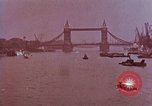
President and Mrs. John F. Kennedy visit London on the way back from Paris and Vienna, in 1961
Views of London Bridge and the Houses of Parliament in London, England. Closeup of Big Ben. Views of St. Paul's Cathedral, Trafalgar Square and Nelson's Column. Scene shifts to Royal Navy band, playing at London Heathrow airport, as the United States President's airplane, Air Force One, arrives. President John F. Kennedy and Mrs. Jacqueline Kennedy step from their aircraft and are greeted by The Lord Chamberlain, Roger Lumley, 11th Earl of Scarbrough, representing Queen Elizabeth II and by Prime Minister Harold Macmillan. The party walks on a red carpet and pauses for a salute from the Navy band. Lady Dorothy Macmillan and Mrs. Jacqueline Kennedy stand together next to the President's airplane, during these ceremonies. View of Admiralty House (temporary residence of the Prime Minister, due to renovation at 10 Downing Street). President Kennedy and Prime Minister Macmillan walk to the President's car following their consultations. President Kennedy and Mrs. Kennedy say their good-byes. Britons cheer as the car drives away. A new sequence shows guards parading during the Changing of the Guard at Buckingham Palace. Police strain to hold back crowds of spectators during arrival of President and Mrs. Kennedy, on June 5, 1961. But some manage to break through and approach closer as their car arrives, bringing the Kennedys for a private dinner with Queen Elizabeth II and Prince Philip, the Duke of Edinburgh. The next scenes show President Kennedy still in formal attire, from the Royal dinner, escorted to his airplane by Prime Minister Macmillan. U.S. Ambassador to the Court of St. James, David Bruce, is the last to shake hands with the President as he ascends the steps to Air Force One, which then taxis out for takeoff, at midnight. Scene shifts to the White House in Washington, DC, and President Kennedy's broadcast report on June 6th to the Nation about his trip.
Implementation of the Mao Zedong led economic and social plan titled the 'Great Leap Forward' in Red China.
Postwar living conditions in the People’s Republic of China under the Communist regime of Mao Zedong (Mao Tse-Tung) photographed by Indians visiting the country. The film highlights China's problems of industry, agriculture, and excess population. Advertisements and posters for the Mao Zedong led economic and social plan titled the 'Great Leap Forward' in 1958. Objectives of the plan. Agriculture, industry, and education in China, including brief shot of men, women, and children in classroom, possibly for re-education. Men and women work in factories and plants. A Russian sign reads 'Made in the Soviet Union'. Workers inside a huge automatic automotive plant set up and supplies by the Soviet Union (SU). A steel and iron company rebuilt and enlarged with the aid of Soviet Union. A seamless steel tube mill supplied and erected by the SU. A plant designed, equipped, and built by SU technicians. A bridge over a river. Women work in a high voltage testing laboratory equipped by the East German government. A fully automatic petroleum refinery built by the Japanese. A heavy gilding machine plant started by the Japanese in 1937. Various factories, plants, and industries in China. Rural farmland and irrigation. People work in backyard furnaces, factories, presses, rolling mills and automotive factories. Deserted city streets with few cars. Workers inside an automotive plant. Communist Party of China Chairman Mao Zedong signs a pact with the Premier of the Soviet Union Nikita Khrushchev. Newspaper headlines regarding the disagreements leading to rifts in the China-Soviet relations in 1960. The Soviet Union withdraws technicians and support from China resulting in closure of industries. Statistics highlight China's dropping industrial production in steel, coal, electricity, and petroleum compared to that of USA, Soviet Union, and United Kingdom.
King George VI ascends the throne abdicated by his elder brother King Edward VIII in 1936.
King Edward VIII walks past guards in formation followed by other British officials outside the palace. Still image of Wallis Simpson who became wife of Edward (Prince Edward, Duke of Windsor). Guards outside main door to 10 Downing Street. Car pulls up on road. King George VI, who ascended the throne after King Edward VIII abdicated, exits the car with his wife, Elizabeth Angela Marguerite Bowes-Lyon, and daughters, Princess Margaret and Princess Elizabeth (later Queen Elizabeth II). The king and his princess daughters shake hands with guards. The king reviews British troops. From a 1961 newsreel recounting events roughly 25 years earlier.

Winston Churchill turns 87. People gather outside his home in Hyde Park Gate to wish him well.
British Prime Minister Winston Churchill celebrates his 87th birthday in England. People lined up outside his Hyde Park Gate home to wish him happy birthday. Churchill comes out of his house and the people cheer. Police and officials stand along with them. Cars parked on the street. Churchill sits in a car and the car leaves the area.

A stalwart truck moves along a lofty area and fords a river in England.
A stalwart truck in England. The truck moves across a lofty area. The truck fords a river. Trees in the background.

Queen Elizabeth II attends the consecration of Guildford Cathedral, signs the Sentence of Consecration as the principal witness
Queen Elizabeth II and the Royal Family attend the consecration of the Guildford Cathedral, the first Anglican Cathedral to be built in 500 years (Stag Hill, Guildford, England GU2 7UP). The procession of Guildford Cathedral clergy to the altar. Queen Elizabeth II, Prince Philip, the Duke of Edinburgh, Princess Margaret and Anthony Armstrong-Jones, the 1st Earl of Snowdon, participate in the procession. The Bishop of Guildford, the Right Reverend George Reindorp, enters the cathedral through the Great West Door. Congregation participants hold prayer books. Queen Elizabeth II and Prince Philip are holding prayer books. Right Reverend George Reindorp signs the Sentence of Consecration. Queen Elizabeth II signs the Sentence of Consecration as the principal witness and as the supreme governor of the Church of England . Trumpeters of the Royal Military School of Music. The Anglican clergy, Queen Elizabeth II and the Royal Family leaving the newly consecrated Cathedral after the service.