


 Francais
 Deutsch
 Italiano
Refine Your Search
+"United States" +1945 stock footage and images
- Showing 1081 to 1086 of 2149 results more
more Hide
Hide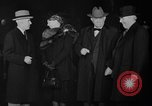
Activities of Eleanor Roosevelt in post-World War II period
December, 1945, former First Lady, Eleanor Roosevelt, now appointed by President Truman, as a delegate to the United Nations, is seen with other members of the U.S. Delegation. She is seen speaking while serving as chairman of the UN Committee Three, dealing with human rights. She recognizes the delegate from the Soviet Union, as the committee addresses issues of refugees. (The USSR insists that displaced persons be returned to their original homelands.) As chairman, Mrs. Roosevelt, rules a USSR proposal out of order, causing the USSR representatives to leave the room. A glimpse of Eleanor Roosevelt at a microphone during debate over the issue with the USSR, before the full General Assembly, where she successfully argues to allow refugees to make their own decisions about repratriation. She is seen sitting next to delegate,Senator Arthur Vandenburg, at the forum. Eleanor Roosevelt being greeted by U.S. Army officers as she steps from an airplane in Europe. She is seen mingling with persons in Europe, displaced by World War II. Back in the UN forum, she extols the International Declaration of Human Rights as an "International Magna Carta of men everywhere," and goes on to compare it with similar charters of history. She is seen at a Pan American World Airways terminal, preparing to board a flying boat (unseen). Several scenes show Eleanor Roosevelt visiting with people in various parts of the world, with particular attention to children. She speaks of her candid nature in a broadcast.
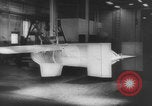
Flying bombs rocket launching with radar system (WW2)
A GB-4 glide bomb in a hanger, suspended from the ceiling. A robot bomb, possibly V-1, launching from a catapult ramp. A United States Air Force bomber drops GB-4 glide bomb during World War II. United States army air men use a television screen with radar system to direct the GB-4 glide bomb to its target. POV view target via GB-4 glide bomb camera. GB-4 glide bomb seen at ground level gliding to target and exploding. United States soldiers preparing a V-2 rocket for launch in the desert in the United States. Men working on radar system. V-2 firing room engineer gives the "go" signal for launch. V-2 rocket lift off in the desert. Scientists in radar control room at Fort Evans. Soldiers at controls of early field radar control system. Large radar console with circular CRT display. A United States soldier repairs radar console. Various types of radar antennas and dishes moving while in operation.
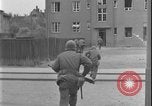
U.S. Army soldiers engage in battle with German forces, Sherman tank and machine gun battle scenes in Halle, Germany in WW2
United States soldiers, including a United States Military Red Cross Medic, advance towards an apartment block in Halle, Germany during World War 2. United States Army officers discuss together as they confer to map, behind them a soldier looking at camera from top of tank. United States soldiers crouch in front of brick wall. Gate with words “Feuerwehr” (“Fire Department” in German). United States soldier sprints across street. United States soldier on lookout on the streets of Halle, Germany. A Sherman tank in front of building. United States soldier sprints across street towards a doorway. Soldiers climb over destroyed walls. Sherman tank fires on the street. White flag drapes from fence in Halle, Germany. Sign says “Halle Saale”. United States soldiers with Sherman tank marches in Halle, Germany. United States soldiers open a wooden door and enter. White flag on tree in a street with German civilians and United States soldiers in Halle, Germany. American Sherman tank drives over rifles confiscated from German soldiers. Soldier fires with machine gun from house window. Soldiers dash across street towards doorway of German house. Soldier sprints towards a doorway of apartment.
Career of U.S. Air Force General Henry, "Hap", Arnold. The final years.
U.S. Air Force General Hap Arnold meeting with other allied military chiefs at the Potsdam conference, following the end of World War II, in Europe. General Arnold gives a speech during the 38th Anniversary of air power in the United States. Military band plays during the ceremony. General Henry steps from airplane and shakes hands with some of his Air Force Commanders in the Pacific theater. B-29 Super fortresses bombing Japan.Bombardier seen inside B-29 Super fortress. View of General of the Army, Henry (Hap) Arnold. Aircraft of the Air Force demonstration team, The Thunderbirds, in flight. September 18, 1947, formation of the United States Air Force as a separate service. January, 1950, the funeral of General Arnold at Arlington Cemetery, Virginia. Arnold Engineering Development Center building in Tullahoma, Tennessee. President Harry Truman dedicates the Center. B-47 and B-52 bombers taking off. Various Air Force aircraft seen taking off. Views of the United States Air Force Academy, Colorado Springs, Colorado.
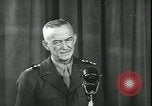
General Courtney H. Hodges informs about the new assignment of the 1st Army in the south Pacific during World War II.
United States General Courtney Hughes speaks during a radio talk in United States. General Courtney H. Hodges speaks into a microphone as he talks to radio audiences soon after the end of World War II in Europe. He says that he is happy to be home and will soon visit his home town in Georgia. He says that after that he will visit Washington and then leave for the South Pacific where the United States 1st Army has been ordered to go. He poses with other officers.
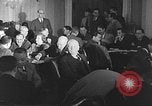
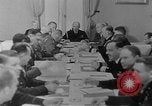
U.S. Secretary of War at the meeting of a committee for discussion about the U.S. policy towards China (WW2)
Meeting of a Committee in United States during World War II. Officials gather inside a building. The officials discuss amongst themselves. United States Secretary of War Patrick J. Hurley address the officials and talk about the policy of the United States in China.