


 Francais
 Deutsch
 Italiano
Refine Your Search
+"United States" +1945 stock footage and images
- Showing 1 to 6 of 2149 results more
more Hide
Hide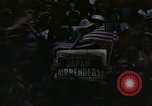
French General Charles de Gaulle is feted in Chicago during his visit to the United States in 1945
Film opens showing people in an American city (possibly Chicago) celebrating the Allied victory over Japan on VJ Day, August 15th, 1945. Scene shifts abruptly to Chicago, Illinois, where French General Charles de Gaulle is seen saluting in a reviewing stand at Victory Plaza near Lasalle Street entrance to City Hall. (On August 24th, he had accepted an invitation from Mayor Edward Kelly to stop in Chicago on August 27-28, 1945, during his visit to the U.S. and Canada.) Next, general de Gaulle and Mayor Kelly are seen in an open car in a motorcade amidst crowds of well-wishers. Enthusiastic spectators run along side their car. Glimpse of a dense crowd of people, including a contingent of sailors in dress whites. Final scene shows General de Gaulle speaking with reporters and photographers near a sign reading "W-G-N." (A Chicago radio station). (World War II period).
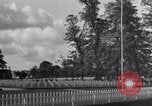
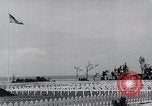
United States soldiers and officers at a military cemetery in France for Memorial Day services in 1945.
American soldiers and officers at a military cemetery in Ste Mere Eglise, France. Flags on grave markers. Soldiers stand with flags in hand. Officers stand. They pay respect to the graves of the American soldiers killed in World War 2 in the invasion of France. They place wreath on a grave. Children watch the officers paying respect to the graves. Soldiers stand with flags. Soldiers band. They fire in the air. They march with the band.
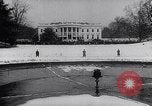
Harry Truman sworn in after death of Roosevelt and surrender of Germany to Allied Nations in World War II during 1945.
A review of significant events that occurred in the year 1945. Scenes from fourth inauguration of Franklin D. Roosevelt as President. Wide view of snow covered lawn of the White House, and guards positioned on the south White House lawn. View of President Roosevelt as he is sworn in as President of the United States, on the south portico of the White House due to wartime austerity measures, on January 20, 1945. Roosevelt, Winston Churchill and Joseph Stalin pose at the Yalta Conference. Death of Roosevelt in April 1945. Burial procession and funeral ceremony of Franklin Roosevelt. Men and women weeping. An African American woman waves her handkerchief as she mourns. Wreath on grave of President Roosevelt. Harry S. Truman sworn in as U.S. President on April 12, 1945. Surrender of the Germans signed by General Jodl and General W.B. Smith in Reims, France. Representatives of Russia, Britain, France and United States at the surrender. General Dwight Eisenhower smiles.
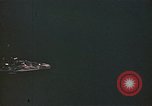
Warships of the U.S. Navy fleet in the Hudson River on Navy Day in 1945
View of the Hudson River from an aircraft flying North, over the New Jersey shoreline. United States Navy warships are seen in the Hudson River, on the occasion of President Truman's first official visit to New York City, on Navy Day, October 27, 1945. Approximately 50 ships were anchored in the Hudson. The first clearly identified is the Battleship, USS Missouri(BB-63) with the Destroyer USS Renshaw (DD-499) tied alongside (bringing President Truman aboard during his review of the fleet). Others seen include the USS Midway (CVB-41); the USS Enterprise (CV-6); The USS Augusta (CA-31); and the USS Boise (CL-47). Several more surface ships are seen followed by six submarines on the surface, as the aircraft approaches the George Washington Bridge. More warships seen North of the bridge. Scene shifts to the USS Missouri and USS Renshaw, again. Next, the aircraft flies past a Navy blimp hovering below, over the river. The Aircraft Carriers, Enterprise and Midway are seen again. Glimpses of the New York City shore and buildings are seen at times in the film, as well as the palisades on the New Jersey shore, near the George Washington Bridge.
U.S. Army aircraft bombing raids on Japanese cities in 1945, and atomic bomb explosion in World War 2.
Air raids and battle in Japan in the Pacific Theater near the end of World War II. A cemetery of United States military soldiers in the Japanese island of Okinawa. Memorial at the tombstone of Ernie Pyle built by the 77th Infantry Division of the U.S. Army. General Doolittle, General Henry Arnold, General George Kenney, General Ennis Whitehead and other officers during a discussion standing before planes at the 48th Air Force base. B-29 aircraft advances towards Tokyo. Bomber aircraft dropping of a number of guided bombs towards their targets. Targets include Japanese airplane factories, shipping industry, military supply chains in the cities of Tokyo, Nagasaki, Nagoya, Okinawa and Yokohama of Japan. Explosion and smoke arises from bombed targets on ground. Aerial wide and close up views of a B-29 aircraft in flight. Narrator notes that on 05 August 1945, Enola Gay, a B-29, carries the atomic bomb and flies towards Hiroshima. Atomic explosion seen signifying the one in Hiroshima on August 6, 1945, but narrator indicates the image seen is that of the first atomic explosion (the Trinity test) during on July 16, 1945 in New Mexico. Immense cloud of smoke and light. This atomic explosion, the first of two, was pivotal in compelling Japan to surrender unconditionally. Film ending includes public service announcement image "Buy Bonds. Hold Them. Victory Loan."

Allied aircraft bomb the City of Dresden in Germany on February 13, 1945 (British) and again on February 15 (American)
Aerial views of British Royal Air Force Lancaster bomber aircraft heading toward Dresden. View of the Lancaster bombers as they drop bombs over German targets in Dresden during night of February 13-14, 1945, during World War 2. Bombs impact and view of explosions and smoke. Two views of German scarecrow bombs exploding, designed to look like the explosion of an Allied bomber aircraft in order to intimidate the enemy. Next scene is two days later, with aerial views of United States Army Air Force B-17 bombers in flight toward Dresden. They attack the city again on February 15-16, 1945, focusing on railroad marshaling yards. Narrator notes that the population of Dresden before the war was 625,000 people, and that the combined bombing by the American and British forces is estimated to have destroyed virtually the entire city.