


 Francais
 Deutsch
 Italiano

Refine Your Search
+"United States" +1945 stock footage and images
- Showing 127 to 132 of 4253 results more
 Hide
African American units U.S. 769th Field Artillery, 761st Tank Battalions, and other units in action in European Theater during World War II
U.S. 769th Field Artillery and the 761st Tank Battalions, as well as other African American units battling enemy together with other Army units in the European Theater during World War 2. Tanks advance along a rough terrain. Soldiers run across a field. Column of African American soldiers of 370th Infantry march along a road toward an attack in the Po Valley, supported by the 695th Field Artillery, who are seen loading and firing an artillery piece. African American soldiers of 761st Tank Battalion running interference for the 409th Infantry as it is seen crossing the dragon's teeth of the Siegfried Line in March of 1945. U.S. Army tanks fire at enemy targets on a field. Soldiers advance. African American soldiers of 761st Tank Battalion loading shells into a tank near battlefield and then participating in battle, firing from tanks during battle. Close view of African American soldiers with their tanks, and firing rifles.
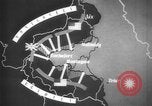
U.S. C-47s drop supplies to troops at Bastogne. General Taylor congratulates General McAuliffe for his defense of Bastogne
Map shows Allied army drives toward Germany in World War 2, and Battle of the bulge counter attack by Germans. Smoke rising from ruins. An American Army engineer douses a fire. In the ruins of Malmedy, Belgium, a sign reads: "Tower Room Malamedy, Protestant Church." Map shows Bastogne. Some of 400 C-47 transport aircraft resupply flights are seen in the air after weather clears. They airdrop food and ammunition to U.S Army troops who had been holding their position and preventing Germans from overtaking in the snow at Bastogne. U.S. gliders, that brought medical assistance, are seen on the snow-covered ground. Aerial view snow covered town. View of food bundles and supplies. Elements of General Patton's 3rd Army arriving to break through German lines and reach the embattled 101st Airborne at Bastogne. Dead and captured German soldier prisoners of war (POW). Destroyed tanks and equipment. Later (January, 1945) Commander of the 101st Airborne Division, Major General Maxwell Davenport Taylor congratulates Brigadier General Anthony McAuliffe for his defense of Bastogne. American troops in Bastogne find time to rest up and smile for the camera after enduring difficult battle.
Allied 9th Army units advance into heart of Germany during World War II
Allied 9th Army advancing beyond Munich, Germany, during World War II. U.S. soldiers firing mortars from a street and a cemetery. Allied troops crossing a pontoon bridge across a river. U.S.soldier, from 102nd Infantry Division, leads line of German civilians to safety, as troops and vehicles enter the town of Erkelenz. U.S. troops fill the streets and sidewalks of the town as they pass through. Prisoners of war and forced laborers are freed by advancing Allied forces. Group is seen wearing berets. One wears a fez. Boxes of Red Cross foods intended for American prisoners are found opened and used by Germans in Eppendorf, Germany. On February 28th, 1945, soldiers of the 2nd Battalion, 413th Regiment, 104th Infantry Division,find the boxes in German military billets and throughout the town. Views of boxes with "American Red Cross Prisoner of War Food Package," written on them. Units of the 1st Allied Army are seen driving directly toward Cologne, Germany. A Sherman tank is seen completely covered by U.S. infantrymen, riding on top. U.S. infantrymen cross stream on makeshift steel bridge. Infantrymen take cover in railroad culvert as tanks of U.S. 3rd Armored Division move forward to deal with intense German resistance. Incoming artillery shell squeals overhead and explodes nearby out of camera view. U.S. troops take shelter behind brick wall. U.S. troops occupy abandoned German trenches. A commanding defensive view from one of the trenches. On March 2, 1945, troops of the 83rd Infantry Division, advancing toward Cologne, pass through town of Neusse. Sign on wall reads: "Mit Hitler zum Sieg." Another reads: "Wir kapitulieren nie!" U.S. troops reach the Rhein River. Telephoto lense view shows city of Dusseldorf and its bridges, spanning the Rhein (Rhine) River.
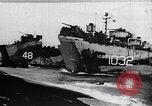
U.S. Coast Guard combat cameramen capture CG and Navy Landing Craft at the Iwo Jima beachhead.
1945: United States Coast Guard and Navy Landing Ships at the Iwo Jima beachhead. Soldiers on the beach. Military vehicles and tanks unloaded from the crafts. Coast Guard and Navy Landing Craft smashed by the hidden guns of Mount Suribachi. Waves lash against the shattered boats. Soldiers salvage parts. Soldiers and military vehicles on the beach. Half-tracks and tanks. Soldiers carry supplies. Landing Craft off shore. (World War II period).
U.S. Army orientation film "Here is Germany" showing the contrast in life in Germany pre-war and during World War 2
U.S. Army training film titled 'Here is Germany'. Circa 1930 - 1938 views of pre-war German countryside, and German cities including Berlin and others before destruction in World War 2. Shots include famous German landmarks and buildings in major cities including Brandenburg Gate and Victory Column sculpture close-ups and other monuments all before bombing of World War II. Lifestyle of German people with families and children in their routine lives in the decade of 1930 before the war. Farmers working fields, mined coal transported by rail, potatoes poured from a full sack, a boy shepherd with geese; a farmer counting pigs descending a ramp at a farm. City port or harbor scene with ships and a modern looking railroad train arriving at a station, sign on side reads Deutsche Reichsbahn (German Reich Railway). High speed highway roads like the Autobahn. German cruise ship at sea. Aerial view of airport with "Berlin" sign on ground. German schools, offices, factories and markets. German woman braiding a girl's hair. German woman taking in washed clothing from a clothesline. German men, women, and children cleaning and polishing work areas and possessions. A German library with people studying and others at book shelves. German classroom with a teacher instructing children and writing on a blackboard. Scenes of German musicians and symphony orchestra and musical instruments, artisans, masons, cooks. Busy roads with cars. Narrator then presents a darker other side, showing an arms factory during rearmament of Germany, German soldiers escorting away a religious priest. German military officials. Scenes circa 1945 of victims of German armies and of the concentration camps. Lumps of dead bodies from massive public shootings, a man being tortured, burning chambers, prisoners of war, concentration camps, human ovens, gas chambers. Survivors of the German custody in relief camps of Red Cross. Evidence of atrocities committed by Nazi Germany. Articles made of human skin and bones. Daily utility items like toys and brushes made from human body parts. Scenes of survivors of concentration camps. Polish people dead from Nazi atrocities at Lublin Castle. Italians and Belgians murdered by Germans, American POWs murdered by Germans. Scenes return again to 1930s views of peaceful German citizens and German lifestyle juxtaposed with views of German soldiers and military actions in World War 2. Some famous Americans of German roots: Wendell Willkie, Admiral Chester Nimitz, Henry J. Kaiser. Narrator talking about American customs and values. View of two teenage American boy students viewing a housing area and taking notes. One of the teenage boys is African American. Some men gathered at a bar in an American town. A man holding a long fly fishing pole preparing to depart on a fishing trip. Woman neighbors in discussion. Young American women walking down a sidewalk in an American town as a group of American boys watch and admire them.
Officer paints nose art on B-29 bomber Deaner Boy of U.S. Army Air Force at their base on Tinian, Mariana Islands during World War II
United States Army Air Force crew at their base in the Tinian, Mariana Islands during World War II. A Army Air Force officer stands on a hoist near the cockpit of a B-29 bomber paints a picture on it. Picture of a baby wearing boxing gloves. Officer paints the baby's diaper with white paint. Soldier looks at nose art painting on the B-29 nose with written wording "Deaner Boy" on it. Another soldier walks up and looks at the nose art painting. (Note: Painter might be Lieutenant Dean C. Forburger, based on examination of image reflected back from aircraft body. Forburger was a B-29 pilot stationed at Tinian at the time, and images exist of him standing beneath this nose art. Forburger was not a member of the crew on Deaner Boy when it perished in a mid-air collision accident in February 1945. The Deaner Boy nose art was painted at least twice on this aircraft, as there are also other images of it in existence with a side-facing baby and cursive lettering for "Deaner Boy").