


 Francais
 Deutsch
 Italiano

Refine Your Search
+"United States" +1945 stock footage and images
- Showing 145 to 150 of 4253 results more
 Hide
Color Sound
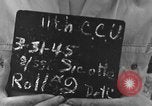
Remains of a United States Army Air Forces B-29 Super fortress that crashed on Tinian in the Northern Mariana Islands., during World War II
Remains of USAAF B-29 number 42-65283 from the 9th Bomb Group, 99th Bomb Squadron, that crashed, 30 March 1945, in World War 2, on Tinian, Northern Mariana Islands. All crew members were immediately killed in the crash, except tail gunner, Sgt. Joseph C. Trullo, Jr., who initially survived but died of his injuries, five days later, and the sole survivor, Radio Operator, Sgt. James Langraf who was injured but eventually recovered. Air Force personnel inspect debris that is scattered across the crash site in sand dunes close to the ocean in the background.
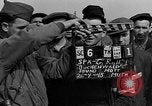
Long term captive of Buchenwald concentration camp, Otto Feuer, is interviewed after U.S. forces liberate camp.
Internees at a concentration camp in Buchenwald, Germany. Otto Feuer, a Jewish internee from Hamburg states how he has been in concentration camps for past so many years. He thanks the American Army for liberating them from the concentration camp in Buchenwald, Germany on April 11, 1945. Other internees in the background.
U.S. 8th Regiment Combat troops during invasion of Aguni, Shimajiri District, Okinawa, Japan during World War II.
Invasion of Aguni, a village in Okinawa, Japan during World War II. Battleships at sea during invasion of Aguni in Ryukyu Islands in Japan on 9th June 1945. Artillery fired from the ships. Landing crafts carrying 8th Regiment Combat troops approach the island. The troops holding guns, advance on the island. The soldiers fire guns. The soldiers move under cover. The Japanese civilians come out of their hiding in underground shelters. A civilian and few others come out of their hiding place. The Japanese civilians being held. Women and children standing on the road. The native women prostrate before a soldier. The soldier offers them cigarettes to calm their fear. Soldiers with the women and children.
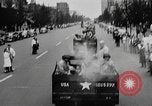
A motorcade of U.S. Generals in Philadelphia, Pennsylvania during World War 2
Returning Heroes Parade on June 4, 1945, in Philadelphia, Pennsylvania. Generals Carl Spaatz and Omar Bradley sit on either side of Pennsylvania Governor Edward Martin, in an open jeep. Spectators stand at road sides. Large number of school children waving American flags. A policeman on a motorbike with the American flag escorts the motorcade. . Spaatz and Bradley pose with Governor Martin and Philadelphia Mayor, Bernard Samuels, for photographs. The Generals and the officials march on a street. The Generals stand, with Governor Martin, in an open jeep. People standing on railroad platform.
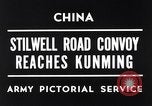
First Allied convoy reaches Kunming, China, over the Ledo Road, during World War II
U.S. military trucks, part of a convoy of 113 vehicles, led by Brigadier General Lewis Andrew Pick, are seen traversing the Ledo Road (aka the Stilwell Road) approaching their final destination of Kunming, China, on February 4, 1945, during World War 2. (They departed Ledo, India, on January 12, 1945, traveling a distance of 1,079 miles.) (Narrator gives distance as 1,044 miles.) View from an overflying airplane shows the long column of trucks on the road below. View from the ground, of the convoy reaching the city gates, where it halts as General Pick and his staff proceed through the gates to a speaker's platform set up in a covered pavilion displaying American and Chinese flags, and pictures of U.S. President Franklin D. Roosevelt and Chinese Generalissimo Chiang Kai-shek. General Pick and staff are introduced by Chinese General J.L. Wong who, speaking in English, celebrates this first convoy over the Ledo Road, and points to a banner containing four Chinese characters that spell out "The Road to Victory." General Pick takes the podium, shakes hands with General Wong, and accepts the banner from him. Camera shows the area completely filled with Chinese troops, witnessing the ceremony, including many sitting atop a nearby roof. General Pick speaks briefly, accepting the banner on behalf of the convoy members. He then leaves accompanied by the Governor of Yunnan Province, China. Officers cut a ceremonial ribbon across the road at the West Gate of the city, and the convoy is led into the city by two Chinese soldiers on motorcycles. Chinese spectators line the way and celebrate with firecrackers and cheers, as General Pick passes, standing in a jeep, displaying the Amercan flag and with the Chinese "Road to Victory" banner in its back seat. views of the convoy trucks proceeding through the city. Closeup of one, with a painting of the road, and snow capped mountains, and "First Convoy over the Ledo Road" and "Pick's Pike Life Line from India to China" painted on its canvas cover. A sign over one of the shops along the road reads in Chinese and English, "Welcome First Stilwell Highway Convoy." Views of troops waving from the trucks and Chinese citizen spectators crowding the sides of the road to watch.
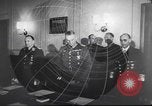
German surrender, UN founding, and Chiefs of Counsel meet before conducting Nuremberg and other trials after World War 2.
A film on preparations that are made for prosecution of axis war criminals following World War 2. Ratification of the surrender documents (from surrender two days earlier at Reims) held at Soviet headquarters in Karlshorst, Berlin, on May 9, 1945. German officers Colonel-General Hans-Jürgen Stumpff as the representative of the Luftwaffe, Field Marshal Wilhelm Keitel as Chief of Staff of OKW, and Admiral Hans-Georg von Friedeburg as Commander-in-Chief of the Kriegsmarine enter room and are seated. View of Keitel signing the surrender document. Scene change to Hall of the United Nations Conference, held in San Francisco from April 25 to June 26, 1945, with delegates from 50 Allied nations creating the United Nations. This was officially the United Nations Conference on International Organization (UNCIO). Leaders of various United Nations countries address delegates present in the War Memorial Opera House of San Francisco, including Edward Stettinius Jr of the United States. Next: A meeting of the military tribunal Chiefs of Counsel of many nations, including France, Russia, Great Britain and the United States, held in London, England, United Kingdom. They sign the International Military Tribunal Charter governing how the major war criminals from World War 2 would be tried.
CRITICALPAST.COM: About Us | Contact Us | FAQs - How to Order | License Agreement | My Account | My Lightboxes | Shopping Cart | Advanced Search | Featured Collections | Website Terms & Conditions | Privacy Policy ©2026 CriticalPast LLC.
License Agreement |
Terms & Conditions |
Privacy Policy
©2026 CriticalPast LLC.