


 Francais
 Deutsch
 Italiano
Refine Your Search
+"United States" +1945 stock footage and images
- Showing 1609 to 1614 of 2149 results more
more Hide
Hide
Civilians gather to look at U.S. troops as they move past them after the Germans surrender in Milan, Italy during World War II.
Crowd cheers at the center of Milan, Italy during World War II. Many people gathered at a square in Milan as they celebrate after the Germans surrender. United States Army tanks and trucks move past a large crowd along a street. The Milan Cathedral (Duomo di Milano, P.za del Duomo, 20122 Milano MI, Italy) is seen in the background. A large billboard for Chlorodont, a German toothpaste, is seen in the Milan Cathedral piazza. Location is incorrectly slated by camera man.
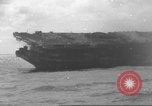
Severely damaged U.S. aircraft carrier USS Franklin after Japanese attack on it in the Pacific Ocean during World War II.
Aftermath of Japanese attack on United States Navy aircraft carrier USS Franklin (CV-13) underway in the Pacific Ocean during World War II. USS Franklin listing heavily smoking after the Japanese attack. Extensively damaged flight deck of the ship. USS Franklin listing heavily to starboard side.
Men wounded during the Japanese attack on the USS Franklin in the Pacific Ocean during World War II.
Aftermath of Japanese attack on United States battleship Franklin (CV-13) underway in the Pacific Ocean during World War II. USS Franklin listing heavily to starboard after the Japanese attack. Sailors on the deck of a ship as they look at the USS Franklin. A sailor with a bandage on his hands due to the Japanese attack. A man with a burned face aboard the ship.
An American prisoner talks about the harsh treatment at a Japanese prison camp in Honshu, Japan during World War II.
American prisoners of war being interviewed at a Japanese prison camp in Honshu, Japan after World War II. A U.S. officer interviews a prisoner who has been liberated from a Japanese prison camp. The prisoner says that his name is James Robertson. He says that he is from St. Louis and was born in Chicago, United States. He speaks that he came to fight against the Japanese on April 22, 1941. He states that he was captured by the Japanese on May 6, 1942 in Corregidor, Philippines. He narrates an incident to prove that they were tortured at the prison camps. He also states how hot tea was poured on the legs of a prisoner.
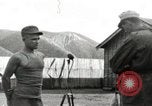
A freed American prisoner talks about the experiences at a Japanese prison camp in Honshu, Japan during World War II.
American prisoners of war being interviewed at Japanese prison camp number 3, in Honshu, Japan after World War II. A U.S. officer interviews a prisoner who has been liberated from a Japanese prison camp. The prisoner says that his name is Benini. He says that he is from Pennsylvania, United States. The officer asks him whether he was in the Philippines and when was he captured. He states he was captured before the Bataan Death March. He narrates his experiences of his prison camp, noting that a building in the prison camp was called the white house because it was large and painted white.
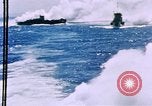
Marines land on the coast of the Philippines and move up a beach during World War II.
United States Marines in the Philippines during World War II. LCIs ( Landing Crafts Infantry) lay a smoke screen around the coast of the Philippines. A Coast Guard photographer clicks pictures. Explosions occur on the beach. A Landing Craft Tank beaches and troops run off onto the beach. Marines advance up the shell torn beach. Shells explode on the edge of water. Three marines on the side of a hill. A combat photographer shoots with speed graphic.