


 Francais
 Deutsch
 Italiano

Refine Your Search
+"United States" +1945 stock footage and images
- Showing 163 to 168 of 4253 results more
 Hide
Liuchow recaptured from the Japanese forces, and Chinese 169th Division troops in flag raising ceremony in Liuchow, China.
Chinese troops recapturing Liuchow, China. Liuchow, the former U.S. 14th Air Force Base and largest communication center in South Central China, in ruins after the withdrawal of Japanese forces. The burnt buildings on the streets in Liuchow. The ruins of buildings along the sides of the road. Chinese troops walk along the road. The Chinese troops recapture Liuchow on 13th June 1945. The civilians in China cheering and welcoming the soldiers to the town. The Liuchow Air Base, which was not usable since the Japanese forces had dug holes in places. The entire stretch of the airstrip being blocked with gas drums. The center stretch of the airstrip being damaged. An Air Force engineer examines the heavily mined air strip. Men of Chinese 169th Division assemble for the flag raising ceremony on 2nd July 1945. The troops are welcomed by a citizens' committee. The Chinese 169th Division Major General addresses the men. The Chinese flag hoisted. The troops salute the flag. (World War II period).
Two soldiers arrest suspected Nazis and a woman takes firewood out of debris in Germany during World War II.
Activities of civilians in Germany during World War II. Two U.S. Army soldiers arrest two suspected Nazis. They stand and interact at the entrance gate of a building that is under guard by American forces. Scene changes to a bomb damaged Atlas relief carving on a destroyed building. Next scene is a wide view of a totally destroyed area from bombing, with the same portion of broken wall with the Atlas carving seen at center. A German woman walks through rubble and debris from bombing, carrying two stacks of broken wooden timber pieces for firewood. (Location is possibly Nuremberg. Despite film slate stating 2-24-1945, these shots appear to be more likely April or May 1945.)
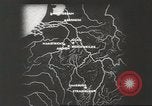
German Army Group Oberrhein undertakes Operation Nordwind, in Alsace, during World War II
German troops are seen in white winter uniforms, during World War 2, with some holding panzerfaust. Narrator mentions combat against Anglo-Canadian forces, and then speaks of preparation for the New Year's offensive. Heinrich Himmler, as commander of Army Group "Oberrhein" had ordered the launch of Operation Nordwind to recapture Strasbourg. Accordingly, On New Year's Eve, 1945,The Germans launch an offensive (Nordwind) into Alsace, attacking the Allied 6th Army Group at multiple points. On January 5, 1945, Army Group Oberrhein begins a support attack by General Otto von dem Bach's XIV SS Corps, the 553d Volksgrenadier Division, reinforced with armor and commando units. They are seen crossing the Rhine river in small boats at Gambsheim, just ten miles north of Strasbourg. Allied aircraft bomb German positions on the West bank of the Rhein (Rhine) River. The German troopers seize high ground West of the Rhein. German troops are seen firing recoilless anti-tank weapons in a field, Views of knocked out British and American tanks. Abandoned German Jagdpanzer IV faces a U.S. Tank Destroyer. German troops are seen advancing into town North of Strasbourg (Herrlisheim, Drusenheim, Offendorf ?). Scenes of destruction in town. Words: "Haus Bewohnt Civil" scrawled on homes to identify them as civilian occupied.
Franklin Delano Roosevelt retrospective - FDR with Winston Churchill, Chiang Kai-shek and Joseph Stalin at different events in different continents.
Life of the President of the United States Franklin Delano Roosevelt in the United States. U.S. President Franklin D Roosevelt is greeted by British Prime Minister Winston Churchill aboard HMS Prince of Wales during the Atlantic Conference for signing of the Atlantic Charter off Newfoundland in 1941. The ship approaches the harbor. Soldiers present arms aboard a ship. Prime Minister Churchill and President Franklin D Roosevelt talk. President Franklin Roosevelt addresses U.S. Congress with declaration of war after the Pearl Harbor attack by Japan in World War 2. The President signs a document. President Roosevelt reviews troops in Casablanca. The troops march. Franklin Roosevelt salutes troops. Vehicles driven in the foreground. Cairo: Franklin D Roosevelt and Winston Churchill with the Chairman of the Nationalist Government of China Chiang Kai-shek. Tehran : Franklin D Roosevelt, Winston Churchill and General Secretary of the Communist Party of the Soviet Union Joseph Stalin pose. United States: The exteriors of the White House. People enter White House. President Franklin Roosevelt with Vice President Harry S. Truman at the 1945 inaugural ceremony. Yalta : President Franklin D Roosevelt, Winston Churchill and Joseph Stalin pose. Franklin D Roosevelt addresses a conference. (World War II period).
Brutalities against prisoners, officials gathered in 1949 in Palace of Nations for Third Geneva Convention; discussion of Geneva Conventions.
Film from 1965 shows scenes that span from early 1940s through mid 1960s. Film opens showing armed conflict in Laos and South America. Soldiers firing rifles in jungle areas. Armed men running across a field and in a town in Cyprus. Heavy armor engaged in conflict and buildings burning in undisclosed location. Riots in Congo with a crowd of men beating another man. Armed Republic of South Vietnam soldiers (ARVN) moving through jungle in Vietnam War. A Viet Cong fighter shot as ARVN troops attack a hut. People fleeing in streets of Cuba as government soldiers engage armed revolutionaries under Castro. A civilian woman suffering a seizure as Red Cross workers attempt to carry her. Burned body of dead tank crew soldier atop a tank. Medical corps persons moving wounded on a stretcher. Various views of ARVN with captured Viet Cong in Vietnam. Narrator discussion about Geneva Conventions and Counterinsurgency. View of the Palace of Nations building in Geneva Switzerland. Scene shifts to inside, in 1949, where delegates of 59 nations are gathered to develop new rules expanding the original 1929 Geneva Conventions, in order to better protect prisoners of war, wounded prisoners, noncombatants and others caught up such internal conflicts. View from ground of German paratroopers during World War 2, jumping from Junkers Ju-52 trimotor transport planes. Closeup of German soldiers leaping from a plane and descending in parachutes. Japanese soldiers surrendering to Americans on a Pacific Island in World War 2. Several scenes of massacre victims lying on the ground, victims of Nazi German brutality in Europe during World War II. Survivors of a Nazi concentration camp near the time of its liberation in 1945. A U.S. Army medical corpsmen help one to a stretcher. Executed prisoners of war. Courtroom of the Nuremberg trials. Seen in the front row of Nazi leaders are: Hermann Göring, Rudolf Hess, Joachim von Ribbentrop, Wilhelm Keitel, Ernst Kaltenbrunner, Alfred Rosenberg, Hans Frank, Wilhelm Frick, and Julius Streicher. Seated behind them are: Karl Dönitz, Erich Raeder, Baldur von Schirach, Fritz Sauckel, Alfred Jodl, Franz von Papen, Arthur Seyss-Inquart, Albert Speer, and Konstantin von Neurath. Scene shifts to the postwar trial of Japanese Lieutenant General Masaharu Homma, in the Philippines. Prisoners with hands bound, in an unidentified Asian conflict, being herded into an open truck. Views of the document constituting the 3rd Geneva Convention of 1949, addressing treatment of prisoners and of parts directed to "conflicts not of an international character." Views of a traumatized civilian driver wounded and a female passenger killed in in his car (appears to be in Cuba or Latin America). Armed gunmen have the man leave the car. A man lays the body of the woman beside the car. Scene shifts to a group of surrendered Vietcong fighters with their weapons stacked. Wounded combatants being carried on stretchers. American survivors of a Japanese prison camp receiving a good meal after being rescued - this is possibly in the Philippines in 1945. Many of the American prisoners are gaunt and emaciated and malnourished. Narrator recites list of activities prohibited by Geneva conventions, as images show these activities: A ditch filled with victims of massacre. Hostages being taken in an internal conflict in an African country. Prisoners being beaten by non-uniformed civilians in and humiliated in public. A recently liberated prison with a former prisoner in striped uniform beating a man as a group is marched away (likely a World War 2 concentration camp with a liberated prisoner beating a former Nazi guard). Death sentences being rendered without due process. A court in Cuba. A boy pointing at a lineup of prisoners. A prisoner shot.
Japanese 1931 aggression in Manchuria condemned by the League of Nations. Continued Japanese aggression in the Pacific, through World War II
Japanese international activities during 1931-1945. Opening scene shows Japanese troops embarking on ships bound for an invasion of Manchuria, in 1931. Officers walking on the dock, amongst the departing troops. Scenes of explosions and destruction. Views of Shanghai during Japanese attacks in 1937. Destroyed buildings. Civilian dead lying in the streets. Japanese soldiers racing along a street in a three wheeled motorcycle vehicle. Change of scene shows Japanese diplomat Yosuke Matsuoka addressing a League of Nations meeting in 1933, after that body adopted a report blaming Japan for events in Manchuria. He objects to that action and then leads his delegation in walking out of the meeting. View of Japanese delegates in top hats and bowler hats exiting the building. Scene shifts to Japanese forces firing artillery and machine guns in Manchuria.They wave large Japanese flag victoriously after a battle. The next scene shows Italian forces occupying Ethiopia and raising the flag of the Kingdom of Italy, as Italian troops salute, presenting arms of rifles with fixed bayonets. Axis leaders celebrate the 1940 Tripartite Pact between German, Italy and Japan. The festivities take place in a hall displaying the three nation's flags on the walls. A large number of persons attend including Japan's Prime Minister, General Hideki Tojo, seen with two celebrants. Scene reverts to China with Chinese civilian people trying to escape from invading Japanese forces. The refugees carry their belongings as they flee. Occasional shell burst is seen among advancing Japanese troops as Chinese soldiers put up resistance. Chinese soldiers firing artillery. In the U.S., Japanese envoys Kichisaburō Nomura and Saburō Kurusu are seen walking together into a building and entering a room inside. Next, are views of the Japanese attack on Pearl Harbor, with huge plumes of smoke obscuring the bombed U.S. battleships in the harbor. U.S. battleships in line formation in the Pacific during World War 2. Aerial view of U.S. warships moving in parallel. British ships augmenting the U.S. warships. Naval guns firing. U.S. amphibious assaults on Japanese held islands in the Pacific. Prisoners of the Japanese who suffered in the Philippines. General Douglas MacArthur mingling with former prisoners and internees upon his return to Manila in 1944. Aerial views of Iwo Jima. Naval bombardment and amphibious assault of Iwo Jima. Numerous fallen Japanese soldiers. The iconic American flag raising by U.S. Marines on Iwo Jima. View of Lieutenant General Simon Bolivar Buckner Jr. during the campaign on Okinawa, where he was killed in action. A Soldier being carried on a stretcher. Another throwing a hand grenade. U.S. soldier firing at a Japanese defender who falls out of his bunker. Large numbers of Japanese prisoners of war assembled in a field. Japanese Kamikaze attacking U.S. warships off Okinawa. The sky filled with antiaircraft flak clouds. View of 40mm Bofors antiaircraft cannon firing and a Japanese plane falling and exploding on impact in the ocean.