


 Francais
 Deutsch
 Italiano
Refine Your Search
+"United States" +1945 stock footage and images
- Showing 2083 to 2088 of 2149 results more
more Hide
Hide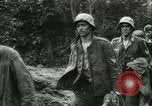
Dead bodies of German soldiers who lost their lives during World War II.
A film dramatizes the life of civilians under German Chancellor Adolf Hitler's totalitarian government. Dead bodies of German civilians who joined the army during World War II. Graves of German soldiers. Two men seated on a bench talk. One of them says to the other that they do have freedom no matter even if they are a minority group. He talks about dignity of the individual.

Montage of scenes showing American civilian mobilization on the home front, life in the Navy, war scenes and demobilization after war.
View of a U.S. battleship heading toward the camera at high speed. Images of hip's wake becoming gradually more turbulent as camera focuses closer upon it in successive views. U.S. sailors in uniform. The first wears a the Silver Star medal. The next wears a Navy Cross medal. The third sailor wears a Cross medal with red and gold ribbon. A petty officer and two sailors posing together, each one displaying Cross and star medals, respectively. The scene fades to this last three, wearing civilian clothes in a flashback to the beginning of World War 2. The three watch as a draftsman lays out a Roll of Honor for a place called Middletown. Townspeople cheering at an outdoor sporting event. Next they sit and watch a tennis match. Next, many are seen as sailors scrubbing the deck of a battleship. Scene shifts to a Navy Wave guiding a C-45 aircraft into parking position. Another one is parked behind her. Next a "white shirt" on deck of an aircraft carrier is seen directing an aircraft with signals. A Douglas Dauntless aircraft is parked on the deck behind him. Abrupt change of scene shows a wounded sailor being attended by a physician. Members of a Navy ship's crew enjoying a swim, hanging out on a boom extended from their ship, and using rubber rafts and a dinghy as they enjoy recreational time allowed by the Captain. A sailor in a dining hall relishing a large piece of chicken. In contrast, a sailor at an antiaircraft station eats hastily. Twin guns are silhouetted behind him. Sailors getting dressed to go on shore leave. Photos of pinup girls displayed on locker behind them. They leave, but one sailor remains behind, on some kind of restrictions. Sailors on deck in formation as they are inspected by officers. One asks a sailor to adjust his hat and also examines his tie. A sailor sitting alone by a lake in Central Park, New York City. A sailor standing watch in setting sun. A chief Petty officer instructing a sailor on wearing his hat. Successive closeups of the imposing face of the Chief. that transitions into the face of a Lieutenant Junior Grade who is yelling at a sailor. Scene shifts to actual World War 2 battle footage scenes as Navy crew battles fire in an aircraft carrier's Island during naval combat in the Pacific. Hose lines are stretched across the flight deck and smoke envelopes the ship. Injured are carried to place of safety. Another scene aboard a U.S. Navy ship in World War 2, shows a Navy Chaplain praying over sailor who was killed, followed by a ceremonial burial at sea for the dead. U.S. Marines fire rifle salutes as coffins slide out from under American flags to carry the fallen sailor into the sea. As the nation demobilizes after the war, various "rabble-rousers" begin to cause trouble. One is seen speaking before a group of women, who seem influenced by his remarks. Scene shifts to aerial views from a low-flying airplane revealing the total destruction and rubble over miles of a German city, probably Berlin, from Allied bombing and shelling during World War 2. Views of suffering survivors of World War II (especially children) in various parts of the world. Emaciated and starving children in a war-torn area.
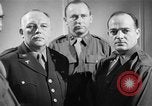
World War 2 Combat Exhaustion patients undergo personality tests, receive sleep therapy and various treatment in the U.S.
Treatment for combat exhaustion cases among U.S. soldiers following combat in World War II. U.S. officers talk about operation plan of a hospital and speak about three sections including admission, treatment and rehabilitation. A patient undergoes a physical examination. A dental survey and necessary laboratory studies. Doctors seated at table to perform an intelligence tests and mental examination. Psychiatric and other personality tests and intelligence test are administered including Rorschach test and Kohs block design test. The doctors check the psychiatric and physical report of the patient by looking at an X-ray. Patients receive sleep therapy: A nurse and an army doctor give narcosis therapy (continuous sleep treatment), by administering barbituates that keep a patient asleep for 18-20 hours per day for several days. Insulin is used on "loss of weight" cases: Combat exhausted soldiers lying on beds and receiving insulin before breakfast by nurses to stimulate their appetite. A nurse checks the weight of a patient during treatment. A nurse checks the diet which will be given to the patients in a kitchen. A patient receives an electric shock therapy treatment. A doctor injects a medicine into a patient. The patients go through physical exercises to maintain physical fitness. The patients are reeducated to know the causes of diseases. (Note: Clips deals with treatment for Combat Exhaustion, also later termed Post-traumatic Stress Disorder or PTSD.)
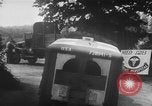
U.S. Army medic staff screen incoming patients before treatment, separating physical injury cases from combat exhaustion cases
Reenactment of treatment for combat exhaustion cases among World War 2 U.S. soldiers. A vehicle of a medical unit arrives at a field hospital carrying a combat exahusted soldier at an aid station. Medical personnel soldiers carry the agitated, traumatized soldier from the vehicle to the tent of the aid station while he yells. Soldiers lay the traumatized soldier on a stretcher. They give medicine to him. They carry his stretcher away. They give soup to another soldier. An exhausted soldier comes into the tent for treatment. He takes off his bag. A medic asks the soldier his problem. He suggests that he take rest and eat food. The medic gives him medicine. The soldier picks his bags and move out with the medics who are holding a blanket and soup for the soldier. Another exhausted soldier arrives for treatment. A Red Cross soldier examines his hand. The injured soldier goes to sleep. (Note: Clips deals with treatment for Combat Exahaustion, also later termed Post-traumatic Stress Disorder or PTSD)
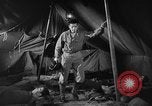
U.S. Army soldiers suffering Combat Exhaustion are asked about their health after treatment at a field hospital
Reenactment of combat exhaustion treatment for World War II U.S. Army soldier. A patient is asked about his health after treatment. The patient and a Red Cross soldier move out of a tent and talk. A Red Cross soldier and patients stand near a truck. The Red Cross soldier goes towards a patient whom he has treated. He asks him about his health. He tells about the problem in his hand and a medic discusses the impact of fear and exhaustion in the soldier's condition. Soldiers talk about exhaustion cases. (Note: Clips deals with treatment for Combat Exahaustion, also later termed Post-traumatic Stress Disorder or PTSD)
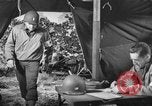
A U.S. Army psychiatric officer tries to detect signs of combat exhaustion and advises ways to prevent them
Reenactment of handling and treatment for U.S. Army World War 2 soldiers suffering combat exhaustion. A soldier gives answers to a psychiatric officer. The psychiatric officer tries to detect signs of combat exhaustion (modern equivalent Post Traumatic Stress Disorder or PTSD) like lack of physical coordination, slowing mental processes, excessive reaction off noise and inability to rest. Soldiers adjust position of artillery. The soldiers are directed to take proper meals and get sound sleep to prevent combat exhaustion and fight stress.