


 Francais
 Deutsch
 Italiano
Refine Your Search
+"United States" +1945 stock footage and images
- Showing 2107 to 2112 of 2149 results more
more Hide
Hide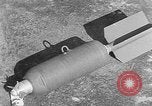
Optimum mix of fragmentation and incendiary bombs is determined during tests at Eglin Field, Florida, during World War II
Conclusions of tests conducted by U.S. Army Air Forces, at Eglin Field, Florida, seeking best way to attack Japanese homeland during World War 2. Actor Lee J. Cobb, portraying an Air Force Captain, smoking a pipe in his "office." Views of M-41 fragmentation bomb and a bundle of M-69 incendiary bombs. The Captain holds a model of a B-17 bomber and uses it to discuss bombing techniques. B-17 in flight. Views of effects of fragmentation bomb, showing numerous small holes produced by it. Aerial view of the test area houses. Mixture of M-69 incendiary bombs and M-41 frag bombs being dropped by the plane on the test area. Various views of resulting damage and effects. Test report is shown, concluding that demolition bombs are not effective against congested wooden structures; that M-41 frag bombs deter early firefighting efforts; and that a mix of 80 percent M-69 incendiaries and 20 percent M-41 frag bombs is optimum. Views of Japanese cities burning, from such bombing, during the war.
View of many city skylines, town centers, and war industries in Texas during World War 2
Cowboys approaching ride horses into a stable. Cattle graze. Oil wells and military airfield from overhead. Distant view of Dallas Texas city skyline. Night view of streets and signs in Amarillo Texas. Daytime view of a tall skyscraper building and wide street in Houston Texas with cars and traffic View of the Hotel Nimitz in Fredericksburg Texas. Downtown Fort Worth Texas city street with shops, offices, and cars. Downtown area in Pampa Texas. Street corner view in Kerrville Texas. Two different views of The Alamo and surroundings in San Antonio, Texas. A water tower and oil rigs in Kilgore Texas. Downtown area of El Paso, Texas from elevated view. Street view in downtown Beaumont, Texas. Downtown view in Wichita Falls, Texas. Downtown San Angelo Texas views. Distant view of the city of Austin Texas from an elevated position, and then in downtown Austin featuring the State House Capitol building. Cattle, sheep, and sorghum farming views. Rice fields and Turkey ranches. Many oil rigs and oil wells. A busy shipyard in Texas making ships for World War II war effort. A sprawling aircraft factory. Oil rigs pumping oil. Farmer on tractor plows wheat field. View of rice harvesting (Massey Harris Self Propelled Harvest Brigade). Men stack magnesium bars. Magnesium factory next to ocean in Texas. Hand cotton picking and view of a mechanical cotton picker. Tractor pulling sorghum harvester. Sulfur mining and Helium plant in Amarillo. Black clouds in sky from burning natural gas in making synthetic rubber for war effort. Cliff of sulfur dynamited and loaded by railroad train crane. Cowboys herd cattle and view of Fort Worth Stockyards and Exchange. Angora goat farm and turkey farming. War time production workers busy in various manufacturing and industrial jobs, showing both men and women workers contributing to the effort. View of sign pointing to the Alabama and Coushatta Native American Indian reservation. Flag with many service stars for men in the war from the reservation, on display at the Indian Agency Office. Native American Indian children with an elder and workers busy at an Indian logging camp. Close-up views of faces of some Native American Indian boys as they listen to the man speak. Campus of University of Texas, with mostly female students walking on the campus. View of State Capitol building in Austin. Well dressed women exit Dallas department store. Narrator points out an attractive woman waiting for someone. View of a large church building with people departing after the end of the church service.
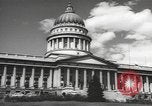
World War II veterans adjusting to civilian life after discharge after WW2
First scene shows the State Capitol building (350 State St, Salt Lake City, UT 84103) in Salt Lake City, Utah. Next a sign identifies a military separation center in Fort Douglas during post-war demobilization. Soldiers in uniform are being processed for separation from the U.S. Army. A sergeant salutes an officer and receives his discharge papers. Narrator identifies Corporal Kirk being processed by a sergeant. He later salutes and receives his discharge papers. Corporal Kirk steps down the stairs from a house, arm and arm with his girlfriend. They are seen enjoying a soda together. Next, they shop together for a civilian hat for him. Then they share shopping for a complete civilian wardrobe. They share time skiing together. Glimpse of some national parks in Utah and of the great Salt Lake. View of people floating easily in the dense waters of the salt lake. Views of the Mormon Salt Lake Tabernacle (50 N W Temple St, Salt Lake City, UT 84150). The couple stroll streets of Salt Lake City. They visit the Veterans' Information Service. He sits with an advisor. View of Provo, Utah and the Geneva Steel Company there. Exterior views of the industrial steel plant. Hot coke being discharged into special rail cars. Steel plant operations with fiery molten steel being poured from Ladles. Billets of steel being formed. Open rail cars full of ore at the Columbia Iron Mine, Cedar City, Utah. A steam shovel loading ore into a truck. Coal mined and moving on conveyers. Miners leaving a mine in open box cars. Miners in rail cars entering a mine. A sign reading: "Welcome, Binghan Canyon, Home of the World's largest Open Cut Copper Mine, Drive Carefully!" Views of the open mine with numerous terraces cut into the walls. A steam shovel digging and loading copper ore into rail cars that carry it away across rail bridges. A sign for the Eitel-McCullough, Company, Inc. where radar tubes are currently being made. Several women employees in the plant.
A project to review methods of attack against Japanese-type fortifications at Dugway Proving Ground, Utah.
Coverage of project to determine the most effective means for destroying Japanese-type cave positions at Dugway Proving Ground, Utah. Paper with typewritten introduction. U.S. Air Force P-38 Lightning fighter aircraft in a napalm incendiary bomb attack. U.S. B-25H Mitchell bomber fires 75mm cannon and U.S. Army Air Force P-47N Thunderbolt fighter aircraft fires 11.75 inch Tiny Tim rocket at targets on hillside. Mountainous terrain and caves similar to Japanese positions on island. Tall Boy (12,000 pound HE bomb) being hoisted from a trailer. U.S. P-38 parked with napalm bombs under wing. P-47N with 11.75 inch Tiny Tim rocket on launcher rail. U.S. Army Air Forces A-26 Invader bomber plane in flight and fires Tiny Tim rocket. Ordnance men load 75mm rounds into B-25H equipped with APG-13B radar ranging device. Gun crew fires 105mm howitzer at hillside. (World War II period).
U.S. P-38 fighter makes napalm attack on hillside to review methods of attack against fortifications of Japan.
Coverage of a project to determine the most effective means for destroying Japanese-type fortifications at Dugway Proving Ground, Utah. U.S. Army Air Force P-38 Lightning fighter aircraft drops napalm incendiary bombs on hillside. Explosion throws billows of smoke in air. (World War II period).
The U.S. Army Ninth Armored Division arrives in Camp Patrick Henry, Virginia, to be deactivated following World War II
Troops coming home to America at the end of World War 2. An Army Sergeant just returned from Europe, at the end of World War 2, stands on a pier, beside the troop ship USS General J. C. Breckinridge (AP-176). With him is a woman who wearing a jacket emblazoned with many emblems of U.S. military units. The sergeant places the insignia of the 10th Armored Division on her back. They hug and laugh. Scene shifts completely to 9th Armored Division soldiers at Camp Patrick Henry, Newport News, Virginia, holding the large sign originally placed on the Ludendorff bridge in Germany, by C Company of the 9th Armored Engineer Battalion during the war. It reads:"Cross the Rhine with dry feet, courtesy of 9th Arm'd Div." The soldiers carry the sign past a wooden building at the camp. Change of scene shows Ninth Armored Division troops arriving by train at Camp Patrick Henry. They march in loose order on train platform, with troop transport railroad train pulled into station. The happy soldiers march through a Victory Arch bearing words, "Welcome Home" at an entrance to the camp. More views of the troops marching into Camp Patrick Henry, where the 9th Division is to be deactivated. In the camp grounds, Sergeant reaches into his dufflebag and takes out a small puppy. ( Note: Vehicles: seen in this clip include: MB GPW, and CCKW)