


 Francais
 Deutsch
 Italiano
Refine Your Search
+"United States" +1945 stock footage and images
- Showing 325 to 330 of 2149 results more
more Hide
Hide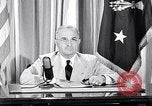
President Harry Truman of the United States speaks about dropping atom bomb on Hiroshima, hours before attack on Nagasaki.
President Harry S. Truman of United States addresses the United States following his return from the Potsdam Conference in Germany, during World War II. President sitting at a desk at the White House explains the choice of Hiroshima as a target for the atomic bomb due to its focus as an industrial rather than a residential center. (This speech is made on the same day as the dropping of the atomic bomb on Nagasaki, but either before the Nagasaki bombing occurred, or before it was confirmed and announced publicly). President Truman warns of additional atomic bomb attacks on more industries in Japan and says the Japanese can foresee what will happen in a future atomic bomb attack, based on what happened at Hiroshima. Truman reminds about the number of warnings issued to the Japanese by the US, Chinese and British governments and how the Japanese rejected them. In a foreshadowing of the attack on Nagasaki, Truman says "I urge Japanese civilians to leave industrial cities immediately, and save themselves from destruction."
United States ambassador to France, Jefferson Caffery arrives in Augsburg Germany, received by Lieutenant General Patch (WW2)
United States Ambassador to France Jefferson Caffery arrives in Augsburg, Germany during World War II. A C-47 plane of the United States Army Air Force lands on a runway strip. Jefferson Caffery descends from the plane. He is greeted by Lieutenant General Alexander M. Patch at the airfield. They sit in their cars.

United states Army Lieutenant General Courtney H. Hodges meets Russian Generals in Torgau, Germany
Lieutenant General Courtney H. Hodges meets American soldiers at United States Army camp in Torgau,Germany. Lieutenant General Hodges meets Russian General Jardov and speaks to him through an interpreter, United States Army Captain Nicholas D. Ruoziak. Lieutenant General Hodges arrives in a military jeep at a river bank where he meets General Jardov and General Bakanov and speaks to them through an interpreter. Lieutenant General Hodges greets General Bakanov and crosses a Russian built bridge over river Elbe. (World War II period).
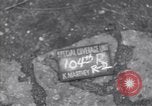
Russian General Suhonov being welcomed by United States Army Major General Terry Allen in Delitzsch,Germany
United states Army Major General Terry Allen greets Russian General Suhonov as he arrives in an American military jeep in Delitzsch,Germany. The two Generals salute as United States Army band plays from a Soviet music sheet. Photographers take pictures of the two officers. General Terry Allen puts Timber wolf patch on sleeve of Russian General Suhonov,Commander of 118th Ukraine Division.
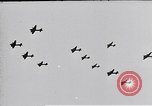
United States mechanics repair damaged Boeing B-17 Flying Fortress bombers in England during WWII
Mechanics repair damaged Boeing B-17 Flying Fortress bombers during World War II. United States Air Force bombers flying in formation. Closer view of a Boeing B-17 Flying Fortress bomber with its damaged engine, wing and nose. A mobile workshop trailer truck carrying United States air corps mechanics arrives beside a damaged B-17 aircraft at an airfield in England. A cartoon with words “Which way’d he go Sheriff?” and “Air Corps- U.S.” designed on mobile workshop trailer truck. Mechanics lift the plane by inflating balloon jacks and work on the damaged aircraft. Groups of mechanics repair engines of damaged bombers. Another B-17 Flying Fortress makes a belly landing without landing gear and skids to a stop. Pilot and co-pilot crawl out of the plane.
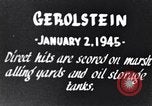
United States 8th Air Force attacks marshaling yards and oil storage centers in Gerolstein, Germany during World War 2
United States B-17 aircraft fly across to attack marshaling yards and oil storage centers of Gerolstein. B-17 emitting vapor trails. United States 8th Air Force Division drops bombs over the targets in Gerolstein, Germany during Second World War. Bombs impact targets causing smoke.