


 Francais
 Deutsch
 Italiano

Refine Your Search
+"United States" +1945 stock footage and images
- Showing 4141 to 4146 of 4253 results more
 Hide
Color Sound
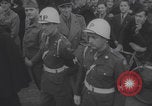
General Charles de Gaulle presents flags to soldiers during an Easter parade ceremony celebrating the liberation in Paris, France (WW2)
General Charles de Gaulle presents regimental colors and standards to soldiers as a symbolic reconstruction of the French Army during liberation ceremony in Paris (World War II). Two stern United States military police stand in the crowd. French troops attend the ceremony in Place de la Concorde (Place de la Concorde 75008 Paris, France). General Charles de Gaulle presents flags with regimental colors that had been hidden from Germans during the war to French soldiers at the Place de la Concorde. Soldiers go down the stage after receiving their standards. Close up of an elderly soldier. Soldiers salute to General de Gaulle after going on stage. Soldiers receive their standards from General de Gaulle. Words seen on flags include "Honneur et Patrie (Honour and Fatherland) and "Republique Francaise" (French Republic.)
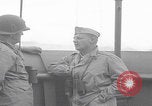
General Andrew D. Bruce and Admiral Ingolf Kiland inspect the Kerama Retto islands (WW2)
U.S. Admiral Ingolf Norman Kiland (Commander of amphibious operations) and Major General Andrew D. Bruce on a ship off the Kerama Retto (near Okinawa Island) in Japan during World War 2. Admiral Kiland and General Bruce talking to each other. General Bruce and Admiral Kiland use binoculars to inspect the Kerama Islands. Closer view of Admiral Kiland. An officer speaks to General Bruce and Admiral Kiland.
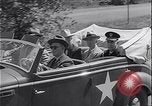
President Harry S. Truman and officials inspect damage in Berlin before the Potsdam Conference (WW2)
United States President Harry S. Truman visits Berlin for the Potsdam Conference at the end of World War 2 in Europe. President Truman, Admiral William D. Leahy, Secretary of State James F. Byrnes, sit in open car to view Berlin in ruins. Berlin buildings and façade are destroyed from heavy bombing. Ruins of the Reich Chancellery (Wilhelmstraße 77 10117 Berlin Germany) is seen. President Truman’s car passes by the Berlin Victory Column or Siegessäule (Großer Stern, 10557 Berlin, Germany). Closer view of the Berlin Victory Column, featuring the Victoria statue on top. Large portraits of President Truman, Russian Premier Joseph Stalin and Prime Minister Winston Churchill on a Russian reviewing stand on Berlin’s Unter den Linden Avenue. President Truman’s convoy approaches the Brandenburg Gate (Brandenburger Tor Pariser Platz, 10117 Berlin, Germany), damaged by heavy bombing. Cars driving on the Unter den Linden Avenue. The Berliner Schloss (Schloßpl. 1, 10178 Berlin, Germany) with significant damage. The Secret Service stand on running boards of President Truman's car. President Truman greets a man from his car. President Truman, Admiral Leahy and Secretary of State Byrnes talking. A huge pile of rubble stands in front of a damaged building. Crowds of men and soldiers surround President Truman and his car. Soldiers with cameras take photographs. Secret Service men running alongside President Truman’s car. President Truman’s car passes by a Nazi-style building, driving into the Autobahn. A Military Police vehicle, which acts as guard, follows behind President Truman's car heading to Potsdam.

President Truman boards aircraft at Frankfurt; USS Augusta arrives in Brussels (WW2)
President Harry S. Truman in Germany for the Potsdam Conference during World War 2. President Truman, Admiral William D. Leahy and Secretary of State James F. Byrnes in official car in Berlin. The Secret Service stand on running boards of President Truman's car. A man takes photographs of President Truman. President Truman’s car drives past the camera. In next scene, the USS Augusta, a Northampton class cruiser, arrives at Port of Brussels (Place des Armateurs 6, 1000 Bruxelles, Belgium) in Belgium. The USS Augusta is being towed by two tugboats. Belgian crowds waving at the ship. Sailors on the deck of the USS Augusta. President Truman and General Dwight D. Eisenhower review the Honor Guards in Frankfurt-am-Main, Germany. President Truman and Eisenhower talking. President Truman and Admiral Leahy boards Douglas VC-54C (2107451) also called "Sacred Cow," the first U.S. Presidential aircraft (later termed Air Force One), at Frankfurt airport. Airplane taxiing on the runway.

Medics rescue a soldier from a tank, in ruined Wingene, Belgium (WW2)
Medics rescue a soldier from a tank in Wingene, Belgium during World War II. The injured soldier is placed on a stretcher. A burning house in Wingene, in the Belgian province of West Flanders. Flames erupt from windows of the house. Bodies of two dead United States soldiers lying on a snow-covered street.

150th Signal Corps, 10th Armored Division paint half-track and truck with white paint in Metz, France (WW2)
United States 150th Signal Corps, 10th Armored Division whitewash an M3 half-track and 2-1/2 ton truck in Metz, France during World War II. This is done for winter camouflage. Soldiers dip brushes on buckets with white paint or whitewash. Soldiers paint vehicles with white paint. A wheel is covered with white paint. Soldiers painting a truck in white on the side of a street. A soldier paints the truck’s wheels. Man uses a long brush to paint the upper part of the truck.
CRITICALPAST.COM: About Us | Contact Us | FAQs - How to Order | License Agreement | My Account | My Lightboxes | Shopping Cart | Advanced Search | Featured Collections | Website Terms & Conditions | Privacy Policy ©2026 CriticalPast LLC.
License Agreement |
Terms & Conditions |
Privacy Policy
©2026 CriticalPast LLC.