


 Francais
 Deutsch
 Italiano

Refine Your Search
+"United States" +1945 stock footage and images
- Showing 559 to 564 of 4253 results more
 Hide
United States troops landing and fighting with Japanese troops in Leyte, Philippines (WW2)
U.S. Third Fleet underway at sea, heads for Leyte in October 1944 during World War II. Warships fire heavy guns at Leyte. Ships advance under naval bombardment. Explosions on ship. U.S. troops aboard landing crafts. Japanese troops and defense during the barrage. They take positions and begin to attack. U.S. landing crafts attacked. Dramatic close up views of faces and expressions of many U.S. soldiers as they prepare for the invasion. U.S. troops leave landing craft and wade through water on to beaches. Japanese troops firing at incoming American forces with rifles and machine gun fire. American soldier raises American flag on island. Artillery fired and U.S. Army tanks advance. Wounded U.S. soldiers carried on litters. U.S. Army soldiers staying low and crawling on beach to avoid enemy fire. U.S. Army soldiers advancing, using rifle fire, hand grenades, and flamethrowers to attack entrenched Japanese enemy positions. Dead Japanese soldiers. Smoke arising from explosions in jungle.
U.S. soldiers of the 69th Infantry Division patrol Leipzig, Germany and fire at remaining Germans offering resistance, near end of World War II in Europe.
As film starts, German civilians are seen running along a street in Leipzig, Germany near the end of World War 2 in Europe. There is no sign of any war damage in this particular area. Next, a young man with an injured arm is helped up from the pavement by German civilians and U.S. Army soldier of the occupying 69th Infantry Division. One of the civilians helps the young man bandage his arm. A group of U.S. Army troops gather around two medics tending to a person lying on the pavement. Scene shifts back again to the young man with the injured arm who seems unable to stand up. A U.S. Army soldier re-bandages his arm. View from a vehicle driving along a street, passing American infantry walking along a sidewalk, past others sitting against buildings. Several U.S. Sherman tanks are gathered along with American infantrymen, in a square in the city. The tank crews fire machine guns and their tank guns as the infantrymen fire their rifles at remaining German resisters and snipers (As film starts, German civilians are seen running along a street in Leipzig, Germany near the end of World War II in Europe. There is no sign of any war damage. Next, a young man with an injured arm is helped up from the pavement by German civilians and U.S. Army soldier. One of the civilians helps him bandage his arm. A group of U.S. Army troops gather around two medics tending to a person lying on the pavement. Scene shifts back again to the Young man with the injured arm who seems unable to stand up. A U.S. Army soldier re-bandages his arm. View from a vehicle driving along a street, passing American infantry walking along a sidewalk, past others sitting against buildings. Several U.S. Sherman tanks are gathered along with American infantrymen, in a square in the city. The tank crews fire machine guns and their tank guns as the infantrymen fire their rifles at German resisters and snipers (unseen). View from moving vehicle of civilians standing on sidewalk and street with some rubble on it. They wave white cloths and some smile. More views of American infantry patrolling a sidewalk and street with a Sherman tank in the background. A man waving a white cloth crosses a square toward the camera. A pair of Sherman tanks move on a street toward the camera. More brief views of infantry patrolling and civilians with anything white they can wave. A pair of Sherman tanks move slowly on a street toward the camera, past more German civilians waving makeshift white flags. View from moving vehicle of civilians standing on sidewalk and street with some rubble on it. They wave white cloths and some smile. More views of American infantry patrolling a sidewalk and street with a Sherman tank in the background. A man waving a white cloth crosses a square toward the camera. A pair of Sherman tanks move on a street toward the camera. More brief views of infantry patrolling and civilians with anything white they can wave. A pair of Sherman tanks move slowly on a street toward the camera, past more German civilians waving makeshift white flags.

Bombing and shelling by U.S. forces during the battle of Iwo Jima, Japan.
Animated map of Tokyo, Iwo Jima, and Saipen. Arrows show attack on Iwo Jima. Aerial view of the island. Ships of United States Navy 5th fleet seen in the region. Numerous views of U.S. Navy ships shelling Japanese targets on Iwo Jima Island, with naval guns and rocket barrage. Smoke and explosions seen. View on a U.S. Navy landing craft after it is hit by a Japanese shell. Dead U.S. sailor on the deck of the ship. View of Aircraft Carrier in region. A U.S. fighter aircraft crash lands on the deck of the carrier. A U.S. plane crashes in ocean right beside a U.S. ship and sinks, but the pilot is thrown clear and is seen swimming. Crewmen on a nearby U.S. Navy destroyer ship throw a rescue ring buoy to the pilot of a fighter aircraft that crashed in the ocean. The pilot is returned from the rescue ship to his aircraft carrier via breeches buoy line between the ships.

U.S. soldiers guard the 102nd Work Hungarian Regiment soldiers near Cham, Germany after their surrender during World War II.
102nd Work Hungarian Regiment officers after their surrender and United States troops in Cham, Germany towards the end of World War II. Hungarian and U.S. officers converse. Several U.S. soldiers who were held prisoners by the Germans for five months, are met on a road by U.S. soldiers guarding the Hungarian Regiment. One of the U.S. soldiers on the road, covered by a blanket. The U.S. soldier abandoned by the Germans is suffering from shock and malnutrition. One of the U.S. soldiers embraces a U.S. medic and begins to cry.
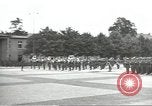
Soviet Union officially transfers control of the American sector of Berlin, to the United States, in a ceremony after end of World War II in Europe
Ceremony in Berlin, Germany, marking official transfer of American Sector of Berlin to U.S. Authorities, following end of World War 2, in Europe. Troops of the U.S. 41st Infantry Regiment, 2nd Armored Division, stand in formation as a U.S Army band plays the American National Anthem (Star Spangled Banner) on the esplanade of the Adolf Hitler Barracks, in Berlin. This is followed by a 48-gun salute fired by "RC" battery of the U.S. 78th Field Artillery Battalion, as all troops assembled render hand salute. Scene shifts to U.S. General Omar Bradley, Commanding General, Twelfth United States Army Group, standing at a microphone. He states that "this ceremony marks the meeting of the United Nations, here, in Berlin and a complete defeat of Germany." He continues with other remarks. Among allied senior officers seen with him are: U.S. Major General Floyd Parks, Commander of the U.S. Sector in Berlin; French Major General Duschesne, Commanding General of French troops in Berlin; and Soviet Major General Nicholei Nicholeiovitch Barinov, Deputy Commander of the Soviet troops in Berlin. Following Bradley's remarks, he, Parks, Duschesne, and Barinov, walk side-by-side across the esplanade, followed by the other military leaders as the Army band plays. Scene shifts to a formation of soldiers from the Soviet 5th Army. Following commands heard, The formation executes a right face,left shoulder arms, and marches off as the band plays.s.
U.S. military takes control of Japanese Military bases after the surrender of Japan to the Allied Forces in World War II.
The surrender of Japan to the Allied Forces after the World War II. The United States Marines landing at Japanese Military base in Yokosuka. The United States National Flag hoisted and marines take the control of the base. USS San Diego at the Yokosuka port. Japanese commanders surrender to the U.S. Army officials. U.S. Army Air Force planes land at Hazuki field near Tokyo and troops deplane. Plane with "Bataan" painted on nose. From a plane descends General Douglas MacArthur, the Commnader of the Allied Forces. He is greeted and welcomed by other U.S. Military officials including General Eichelberger. Field filled with Japanese trucks. U.S. troops board the trucks. American prisoners of war released and greeting the incoming U.S. troops. MacArthur inspects the Hazuki air base.