


 Francais
 Deutsch
 Italiano
Refine Your Search
+"United States USA" +1909 stock footage and images
- Showing 13 to 18 of 25 results more
more Hide
Hide
Animated diagrams show how energy is stored and discharged in Edison storage batteries
How Edison batteries function. The are also known as nickel-iron battery or NiFe batteries. An animated diagram shows how nickel iron alkaline storage batteries such as Edison batteries store and generate energy. The diagram shows the battery, generator, switch, motor, and a light bulb. An early nickel-iron Edison battery in wooden box. A later version of the nickel-iron battery invented by Thomas A. Edison in 1909. Pie chart showing the market share of Edison batteries over other portable batteries in 1926. Photograph of German-born American mathematician and electrical engineer Dr. Charles Proteus Steinmetz, "The Wizard of Schenectady". Slate bearing a commentary on from Dr. Steinmetz claiming "complete reversibility" of the Edison battery reaction. Diagram shows the reversible cycle of a portable battery. Animation in the diagram shows how energy is stored in the battery- the oxygen contained in the negative plate is forced to the positive plate by the charging current. The animation demonstrates the discharge of the battery. Plates from used Edison batteries show little decay after years of use.

Montage of Wright brothers and their airplanes in France and at Ft. Myer, Arlington, Virginia.
As a contrast to the early pioneering airplanes, passengers are seen seated inside cabin of a "modern" airplane (Douglas DC-4E). View of the DC-4E in flight. A view of Orville Wright. Wilbur Wright gesturing as he talks with officials in France about an aerial course to be flown. Wilbur Wright placing wheels under a Wright Flyer before it is moved across a muddy field in France. A team of men pull a rope raising a catapult weight in a tower. The weight falls, catapulting the Wright Flyer airplane into the air. Soldiers remove a Wright Flyer airplane from a storage building onto the parade grounds at Ft. Myer, Virginia. The airplane is seen in flight with Orville Wright alone, at the controls, On July 30, 1909, soldiers are seen moving a Wright Flyer from its shed for its final acceptance test. President William Howard Taft, U.S. Army Major George Owen Squier, U.S. Army Major Charles E. Saltzman and Wilbur Wright are among those standing with the President, as the Wright Flyer is moved toward the parade ground. Views of the monorail and weight and catapult used for launching an airplane. Men turn the two propellers on a Wright Flyer, as Wilbur Wright stands at the rear of the aircraft engine and makes an adjustment. . On September 9, 1908. U.S. Army Lt. Frank P. Lanham, seen in uniform, seated on a Wright Flyer, is joined by Orville Wright. Wilbur. They take off and set a new airborne endurance record, and Lt. Lanham becomes the first Military officer to fly in an airplane. On July 30th, as part of the final acceptance test, Orville Wright takes Army Lt. Benjamin D. Foulois on a cross country flight to Alexandria, Virginia, and back again. They are seen aboard the Wright Flyer, and then high in the air on their way to Alexandria.
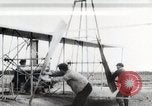
First joint flight by Wright Brothers in 1910 near Dayton Ohio. Also scenes from other "firsts" in early aviation history up until 1919.
Wright brothers' first aircraft flight together near Dayton Ohio in 1910. Wilbur Wright is in the pilot's seat with Orville Wright as passenger to his right. (Until this flight, the Wrights had never flown together so that if one of them was killed, the other could continue their work.) Next, a view of Alberto Santos-Dumont, and the first European flight made by him on 13 September 1909. Following segment shows crowds gathered at Washington DC Polo field as truck arrives carrying mail to be loaded on the first U.S. Air mail flight, May 15, 1918. Army pilot, Lieutenant Webb, in his JN-4H airplane, on Southbound flight from New York, takes off from Philadelphia, where he stopped to pick up more mail. He flies over the Washington Polo Field upon arrival. We see his airplane being unloaded as he jumps down from cockpit and crowds watch. Views of first transatlantic flight begins with takeoff of three out of four existing United States Navy Curtiss flying boat aircraft from Newfoundland, on May 16, 1919. Curtiss flying boats NC-1, NC-3, NC-4 are seen at takeoff from Newfoundland on first leg of the transatlantic journey. Flying Boat NC-4 is also seen at one of its foreign ports, though which is unclear (Azores, Lisbon, or England).
Scenes of American cities and workers in early 1900s and early motion picture film stars in America in the early 20th century
50th Anniversary of cinema, in 1944, recalls historic footage and movies from the early 1900s. Thomas Edison with Henry Ford together using a motion picture movie camera to create a movie. Mrs Edison displays Kinetoscope. Close-up view of Kinetoscope machine operating. View of vintage film images of lower Broadway in New York City in 1896 with busy traffic on streets of pedestrians, horses, and horse-drawn streetcar. Next scene shows Theodore Roosevelt and the "Rough Riders" (1st United States Volunteer Cavalry) in parade in New York City on return from Cuba after the Spanish-American War in 1898. Next is seen the inauguration parade for President Theodore Roosevelt on Pennsylvania Avenue in Washington DC in 1905. Next series of scenes shows American women in the early 20th century. Women workers punching time clock at an industrial factory in the 1910s or 1920s. Women in dresses emerging from a building perhaps after a work shift circa early 1900s. An early beauty pageant circa 1910 with participants in swim suits. Famous star actress and singer Lillian Russell in a movie scene. Film actor William S Hart appearing in an early movie. Two well dressed women sitting in an early automobile as a man starts it up and drives away. Busy scenes of car and pedestrian traffic, and horse-drawn streetcars on Market street in San Francisco, California circa 1910. Silent movie stars Clara Kimball Young and Sidney Drew together in a movie scene. Famous movie star actress Pearl White in a daring stunt scene, and Ruth Roland performing a stunt leaping from a moving railroad train onto a rope ladder suspended from an airplane, and then riding on a railroad car careening out of control down a mountain side in an early Hollywood movie.
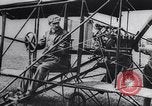
Historic, early aviation pioneers: Glenn Hammond Curtiss, Louis Bleriot, and Lincoln Beachey with their airplanes
American aviation pioneer Glenn Hammond Curtiss sits at the controls of his first aircraft. Two mechanics assist in starting the engines. The first Curtiss aircraft takes off. Louis Bleriot, who was the first to fly across the English Channel, sits at the control of his aircraft in France. Lincoln Beachey, the first man to perform aerobatics in an airplane, dives his first aircraft which is a Curtiss model. Spectators are lined at a fence and watch him flying.
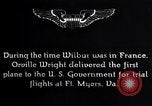
Orville Wright and Army personnel fly in Wright plane, Virginia United States.
Development of airplane by Wright brothers. Orville Wright in a plane presented to U.S. Government by him at Fort Myers, Virginia. Plane takes off catapulted in a field near a building. Spectators on ground observe the plane. Army personnel remove doors of hanger. Wright aircraft take out of the hanger. Army personnel stand near the plane. Lieutenant Lahm and Orville Wright sit in plane and take off for a flight. Lieutenant Foulois and Orville make preparations and sit in plane for a cross country flight.