


 Francais
 Deutsch
 Italiano
Refine Your Search
+"United States USA" +1916 stock footage and images
- Showing 13 to 18 of 108 results more
more Hide
Hide
President Woodrow Wilson nominated for second term
Large crowd gathers at Coliseum in St. Louis for Democratic National Convention in 1916 in the United States. Al Smith of New York poses for picture. President and Mrs. Wilson in an open car. President Wilson accepts nomination for a second term. Crowd cheers and wave their hats. William Jennings Bryan poses for closeup picture and is then seen with other dignitaries on the back of a railroad train from which he shakes hands and waves to the crowd.
President and Mrs. Woodrow Wilson and their party preparing to leave a city by railroad train
United States President Woodrow Wilson standing on a city street corner with a group of men, in January, 1916. They are all dressed for the cold. The President wears a fur collar coat and woolen gloves. Next, a large group of people is seen assembled around a building. Change of scene shows President Wilson and First lady Edith Wilson standing on the back of a railroad train. She is bundled up in a fur coat. Wilson is holding his hat. Mrs. Wilson leaves the platform and goes back into the rail car. The President says a few words from the platform. At about this time, Attorney General,Thomas Watt Gregory is seen far to the President's left (at right of picture). While the President and his party stand on the train platform, one member of the group checks his watch frequently, as if concerned about keeping their schedule.
National Guard is mobilized for U.S. Punitive Expedition to Mexico
A spectator sits on a lamp post to watch soldiers of New York's 6th National Guard Division parade on a street in Manhattan, New York City, following their mobilization for the U.S.Punitive Expedition in 1916. Locomobile Armored cars of the 1st Armored Motor Battery, of the New York National Guard move along a roadway, followed by trucks carrying soldiers and automobiles and motorcycles. Spectators, including girls with flowers, watch from the roadsides. Scene shifts to open platform train station, where National Guard troops, with shouldered rifles, march onto the platform, next to a parked empty passenger train The platform is crowded with spectators and well wishers. Another scene shows a train filled with National Guard soldiers leaning out its windows, waving at friends and loved ones. Closeup of soldiers leaning out the windows of a Pennsylvania Railroad passenger car. Two of them lean out to hold babies and kiss them goodbye. Scene shifts to dusty outdoor rail yard, where army horses are being readied to board boxcars. Closeup of fenced corral in which horses are guided for loading. Huge numbers of horses are herded by cowboys into corrals. A group of National guard soldiers stand on a rail bed and wave and smile for the camera. Army wagons are loaded on flat cars in a train parked behind them. Next, a large contingent of National Guard troops is seen marching onto an Army base.
Republican Presidential Candidate Charles Evans Hughes, posing for pictures and listening to wireless radio
Former United States Supreme Court Justice, Charles Evans Hughes, who resigned to become Republican Presidential candidate, in the 1916 elections in the United States. Charles Evans Hughes Posing for photographs and listening to a wireless radio, with headphones, while seated at a table writing a note.
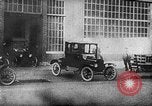
Scenes related to the Ford Motor company and the Ford Model T automobile in the United States.
Ford Model T cars being driven out the exit door of the Highland Park factory, Michigan,circa 1916. Numerous Model T cars driving on both sides of a divided highway. The Ford Highland Park Plant, circa 1920. Panoramic exterior views of the Ford River Rouge plant and factory buildings, circa 1930. A Ford Freighter ship, docked at the River Rouge plant. A view of the home of Henry and Clara Ford, at 66 Edison Road (now 140) Dearborn, Michigan, in 1914. Sketch of children coming home from school, singing song from McGuffey reader school book. View of schoolroom with McGuffey readers on desk. Narrator relates story of Henry Ford trying to buy a McGuffey reader and being unable to obtain one. Narrator states that Ford realizes from this incident "the changes that are reordering his culture. The modes of life which Henry so loved are passing, disappearing into history." Street scene outside Ford Plant, during shift change, and street filled with workers. A car driving on empty road in Sudbury, Massachusetts. The historic Wayside Inn (immortalized in Henry Wadsworth Longfellow's "Tales of the Wayside Inn") which Henry Ford purchased in 1923, to preserve for posterity. View of the original Pennsylvania Railroad Station in New York City, circa 1912. View of crowded sidewalks and street on 5th Avenue, and other street scenes in New York City, circa 1920. Model T Ford cars driving in U.S. National Parks. A visitor feeding a bear from his Ford car, as a U.S. National Park Ranger stands nearby. People in Ford Model T, stopped by side of road to pick wild flowers. Two men remove a seat back from their Model T car to make a camper. Both men lying down in the car. Man carrying picnic basket from Ford Model T, parked beside a beach, where he joins the rest of his party on the sand. Children run along the beach, and stop to play with seaweed.
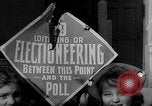
The 1944 U.S. Presidential election in World War II
On Election Day, November 7, 1944, in World War 2, Americans are seen waiting patiently to vote. They stand in a long line extending down a city sidewalk next to brick and stone buildings. Views of several persons in the line. Scene shifts in flashback to the election of Woodrow Wilson, in 1912. Four men on horseback arrive at a polling place. Another travels to vote, in his 1910 Ford Model T truck. Change of time and place shows farmer arriving by horse-drawn wagon and walking to polling place past 1930s car and truck. A fully laden truck stops at a rural gasoline station, temporarily serving as polling place. American town residential street scene in the 1930s. Citizens gathering to vote at a polling place set up at a laundry shop, in the Bronx Borough of New York City. Views of various places in the United States, serving as polling places. Americans seen waiting to vote at various places, in the 1944 national election. Among the sites shown is Bridgeport Central High School, built in 1916, (which later became Bridgeport City Hall), at 45 Lyon Terrace in Bridgeport, Connecticut. Persons in various places, registering to vote, including actor Lewis Stone, actress Esther Williams, and USO entertainer, Bob Hope. Voter closing curtain behind him as he votes in a voting booth. Views of voters' feet, below curtains, as they vote. Various types of boxes. Newspaper headline speaks of the large voter turnout in millions during the 1944 election. Shipyard workers at end of their shift, are seen heading to the polls to vote.