


 Francais
 Deutsch
 Italiano
Refine Your Search
+"United States USA" +1917 stock footage and images
- Showing 55 to 60 of 236 results more
more Hide
Hide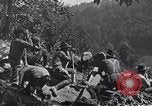
Battle of Blair Mountain, in Logan County, West Virginia,1921
Scenes from the labor dispute and uprising known as the Battle of Blair Mountain. Opening scene shows Sheriff's Deputies firing down upon miners from a hillside in Logan County, West Virginia. One of them is armed with a Model 1917 Browning machine gun. Scene shifts to group of Union miners, cleaning and adjusting their rifles and shotguns. One wears a metal Army helmet. Several more pose for the camera, holding their guns. One of them also wears an Army steel helmet. They check the actions of their weapons. Closeup of one in a steel helmet. Next scene shows miner families leaving the area in horse-drawn wagons. Change of scene shows a group of men boarding a railroad train car. An armed U.S. Army soldier in uniform stands nearby. The final scene shows Sheriff Don Chafin of Logan County, posing with U.S. Army Brigadier General Henry H. Bandholtz.
Newly recruited American soldiers arriving in U.S. Army training camps; Dutch steamer Amsterdam seized in New York Harbor
World War I Draft and mobilization activities in 1917-1918. American WWI military recruits get down from a railroad train to get to the training camp. U.S. Military officials board the seized Dutch steamer ship in New York Harbor (seized as a neutral vessel during timeframe that Dutch ships under the modus vivendi agreement with the allies were threatened by German U-boats). The ship appears to be the Nieuw Amsterdam. (Lettering behind officials as they board is clearly "Amsterdam" but there is an obstructed word before that may be "Nieuw". Several Dutch ships were seized by U.S. military officials during this same month, including the Nieuw Amsterdam). Crew on the deck of the steamer ship Amsterdam. Dutch flag flying on the ship.
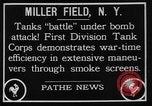
American First Division Tank Corps demonstrate war time efficiency in maneuvers though smoke screen.
Mark I Mod 1917 tanks of the U.S. First Division Tank Corps advance through smoke screens at Miller field in New York, USA during a demonstration.
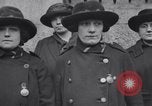
Women join ranks of police reserves in New York City, during World War I.
Closeup of women in the New York City Police reserve, during World War 1. They stand outside the 23rd Police Precinct ("Tenderloin") Station House on West 30th Street, Manhattan, New York City. Their uniforms include round-brimmed hats and overcoats, and they have round badges topped with eagles, pinned to their coats. Next, about 15 are seen, walking two abreast. All wear white gloves and badges, but otherwise, their uniforms are not identical. One supervisor woman walks beside the group, wearing a slightly different badge. Walking casually, a short distance behind the group is a woman (probably Mary Noonan) in the uniform of a captain (with "railroad tracks" insignia on her collar). Scene shifts to a street filled with a traffic mix of horse-drawn and motor vehicles, all staying fairly clear of trolley tracks visible in the center of the road. A police reserve woman stands in the center of the street, directing traffic. Next, a large group of school children is seen standing on a street corner, accompanied by a woman police officer. They begin to cross the street under the watchful eye of another woman reserve police officer, directing traffic in the street. Some adults cross behind the children. (Note: On May 9, 1918, the New York City Police Department announced formation of a new Police Reserve, that would include a women's contingent. This was the idea of Special Deputy Commissioner Rodman Wanamaker, who reasoned, since New York women had received the vote, on November 6th 1917, they should have a role in enforcing the laws. Over 3,000 women were recruited. Their Captain was Mary Noonan. Their duties did not involve direct dealings with criminals. According to the New York Times of May 10, 1918, "If need arose for use of the nightstick or other instrument for curbing crime,the work would be referred to the men members of the force.")
An early model of a tractor on a dusty country lane in United States.
A man drives an early model of a tractor on a dusty country lane in United States. Dust rises as the tractor passes. Close view of tractor on display. A man drives a car on country road.
Mr. Henry Ford takes a ride on a cultivator and drives an early model of a tractor in a field.
Mr Henry Ford drives an early model of a tractor in a field. A man drives a cultivator in a field. Mr Henry Ford stands behind the driver. Mr Ford drives an early model of a tractor. He stands near a fallen frame building. Mr Ford walks out of the gate of the building with a man and watches as men try to get the tractor out of mud. He talks to the men.