


 Francais
 Deutsch
 Italiano
Refine Your Search
+"United States USA" +1917 stock footage and images
- Showing 49 to 54 of 236 results more
more Hide
Hide
Pastor of African American church congregation speaks about defending America during World War II
Opening scene shows a battlefield wooden cross marking the grave of Private Robert. Woods. His photograph is shown.The narrator is an American Pastor of a predominantly African American congregation speaking from the pulpit about men who served America during World War 2. He cites U.S. Army bomber pilot, Colin Kelly, whose photograph is also seen. The pastor also mentions Meyer Levine, Kelly's bombardier (unseen) and an African American sailor, named Dory Miller, who shot down Japanese aircraft while defending the battleship West Virginia during the Japanese attack on Pearl Harbor. Miller is seen shaking hands with officers on the deck of a Navy ship. Camera focuses on a banner in the church displaying stars for the members of the congregation in the Armed Forces. He leads in a prayer of thanks for "this land which our fathers have helped to build." Camera pans over the congregation. The choir and congregation join in singing "Onward Christian Soldiers." Next, a large formation of African American soldiers marches in a parade. They wear uniforms including M1917 steel helmets, and carry rifles and field packs. Scene updates to African American soldiers marching wearing World War 2 M1 steel helmets. Scene shifts to African American Army Colonel and another officer reviewing marching troops on a snowy field. Next, African American women in the WAC (Women's Army Corps) are seen marching. African American troops are seen, again, parading in World War 1 steel helmets, and then others are seen parading in garrison caps. More views of these various groups parading with a glimpse of mounted cavalry inserted, as well. As the film ends, the background music is the singing of "Joshua Fit the Battle of Jericho." (World War II; WW II; World War 2; World War Two)
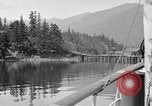
Men and women aboard the trim steamer ship SS Potlatch in Hood Canal region near Puget Sound of Washington state, United States
Various landmarks in Hood Canal region in Washington, United States. Women on deck of the trim steamer ship S.S. Potlatch (active 1912-1917; scrapped 1937). View from ship of wooded shoreline areas in Hood Canal. Men and women aboard the ferry ship. Homes, dock areas are seen. Wooded shoreline in the background. Snow covered mountains of the Olympic Peninsula in the background, including Mount Olympus. A row boat approaches the ship. Views from ship as it heads northward through the Puget Sound to the San Juan Islands. Close views of the San Juan Islands shorelines seen from the moving S.S. Potlatch.
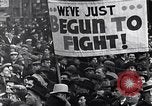
Auto workers union sit-down strike at the General Motors Fisher Body plant in Flint, Michigan, 1937
Union workers gathered in Flint Michigan, 1937, with a sign reading: "We've just begun to fight!" View of an Army truck, with a uniformed National Guardsman atop, manning a Browning M1917 machine gun mounted on a tripod. It drives past the Fisher Body factory, where striking workers, who have occupied the plant are seen looking out the windows. View from factory of National Guardsmen setting up machine guns outside. View from behind two Guardsmen, in battle gear, directing a machine gun from a high point along the factory roadway. Closeup of a machine gun crew setting up. Camera view looking directly into muzzle of the machine gun. Women and children watching the troops. Crowd of supporters waving at the strikers. Several women pass a basket of food to the strikers through a window. Strikers receiving cigarettes and one talking with his wife through a window. A striker lowers his child back down to his wife, after a visit with Daddy. Union workers marching along street, carry a banner of the new local 236 of the UAW (CIO) established on March 3, 1937, for workers at the L. A. Young Spring and Wire Corporation. Former sit-in strikers at the Fisher Body plant are seen outside,with family and friends, celebrating a contract after the 44-day ordeal. A crowd with banner reading: "GM Today, Ford Tomorrow." Several views of union workers from different industries, marching. In one, workers carry a coffin labeled "The Open Shop." Workers walking and waving in front of Chrysler's Desoto plant on Jefferson Avenue in Detroit, Michigan. More views of C.I.O. union workers in gatherings.
Major General Frank P. Lahm's Retirement ceremony at Randolph Field.
Retirement ceremonies for Major General Frank P. Lahm, first military Pilot at Randolph Field, Texas. Frank P. Lahm with other officers and soldiers marching at the ceremony. American planes can be seen overhead. Frank P. Lahm was taught to fly by the Wright Brothers, organized the U.S. Army Air Corps in 1917 and was the first balloon pilot. (World War II period).
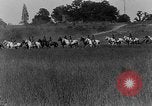
U.S. Army artillery fire power demonstration at Camp Meade, Maryland.
Groups of mounted artillerymen pulling horse-drawn field pieces, enter a training field at Camp Meade, Maryland. Scene shifts to shallow hillside where artillery unit guidons are set into the ground and artillerymen are seated on the grass. Gunners fire pedestal-mounted antiaircraft machine guns. M1917 tanks sitting in a field.
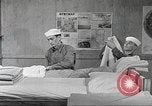
Glimpses of activities in the lives of new recruits during training at the U.S. Great Lakes Navy training center during World War II.
Opening scene shows new recruit sailors making up their bunks, at the U.S. Great Lakes Navy training center during World War 2. A broom being used by a sailor. Six recruits using their feet to clean a floor with scouring pads. Recruits sitting out of windows as they clean them in their barracks. Others with pails and cleaning materials on the barracks porch and cleaning the barracks latrine. The barracks members are seen lined up for inspection, which is announced by a bugler. A Lieutenant, Junior Grade, is escorted through the barracks and salutes the barracks chief as he leaves. Next, an honor guard of recruits, in whites, and shouldered arms, raise a rooster flag, outside their barracks, indicating a successful inspection. Recruits are seen engaged in their turn at cleaning shared entities, such as the mess and cooking facilities and staffing them during so-called Service Week. A recruit standing watch outside a building presents arms in salute, as an officer passes to enter. He tries to be observant, taking notice as a truck passes, and of a work party nearby. Scene shifts to sailors on watch aboard a ship. A sailor aboard ship, speaking into an intercom system. Bow view of a U.S. Navy Cruiser, showing heavy guns in her triple turrets. The sentry continuing to walk his post in a military manner. A petty officer demonstrating the venerable art of knot tying to a class of recruits, who then practice tying them, themselves. more views of recruits performing chores. Scene shifts to recruits being trained to operate 40mm Bofors antiaircraft guns. One is seen at controls of a pedestal-mounted M-1917 water-cooled 30 caliber machine gun. The anti aircraft batteries commence firing at a drone biplane seen flying overhead. A flood of tracers is seen directed toward the target drone.